
Psalm 34:18 — God Is Close to the Brokenhearted
Letting God Near When Your Heart Is Shattered
"The Lord is close to the brokenhearted and saves those who are crushed in spirit."
— Psalm 34:18
Reflection
Grief can make closeness feel threatening. You may want comfort and resist it at the same time. You may long for God to come near, yet pull inward when He does. A shattered heart does not always open easily. Sometimes it protects itself by going quiet, going numb, staying angry, or refusing to hope.
That is a strong picture of spiritual resistance in grief. Not open rebellion. Not loud rejection. Something quieter and more painful: standing alone in the field of your sorrow while God’s promise says He is close, and your wounded heart does not know how to receive Him.
Start with the free sample
No email. No signup.
Psalm 34:18 does not say the Lord is impressed by the brokenhearted from a distance. It says He is close. The verse does not say He draws near only after you have processed everything properly, prayed beautifully, stopped crying, forgiven everyone, or made peace with what happened. It says He is close to the brokenhearted and saves those who are crushed in spirit.
But closeness can be difficult when pain has taught you to brace. You may push God away by refusing to speak honestly, by hiding the bitter parts of grief, by assuming He must be disappointed in your weakness, or by treating silence as safer than prayer. The verse does not shame that wounded reflex. It calls you to notice it.
A broken heart can resist the very nearness it needs.
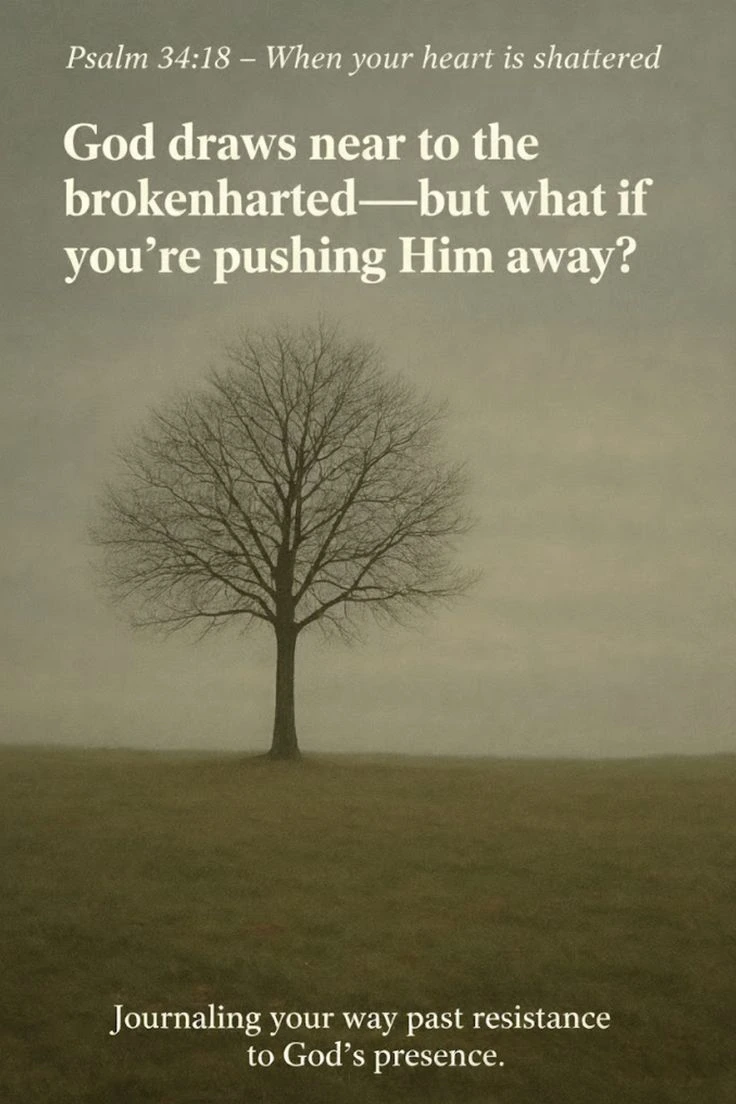
The bare tree stands alone, stripped of leaves, visible against a cold sky. It does not look fruitful, strong, or sheltered. Yet the words over it insist on the nearness of God to the brokenhearted. That tension matters. The field feels empty, but the promise says the emptiness is not the whole truth. For the grieving Christian, the tree becomes a mirror: stripped, still standing, and invited to stop mistaking desolation for abandonment.
Biblical Insight
Psalm 34 is connected to David’s escape from danger, and it is filled with testimony, instruction, fear of the Lord, deliverance, and refuge. David calls God’s people to taste and see that the Lord is good. He speaks as someone who has known fear, danger, and the need for rescue. Psalm 34:18 sits inside that larger witness: the Lord is not far from those who are crushed.
The word “brokenhearted” is not decorative. It speaks of inner fracture. The verse recognises people whose hearts have been broken by loss, fear, betrayal, failure, pressure, or sorrow. “Crushed in spirit” goes even further. It names the person whose inner strength has been pressed down, whose courage has thinned, whose soul feels unable to rise on command.
The promise is personal: “The Lord is close.” That nearness is not vague religious atmosphere. It is the covenant Lord drawing near to the wounded. Scripture does not present God as embarrassed by grief or repelled by weakness. He comes close to the brokenhearted because they are brokenhearted, not because they have already recovered.
The second half of the verse says He “saves those who are crushed in spirit.” This does not mean every painful circumstance changes immediately. It does not mean the bereaved person stops aching at once. It does not mean every question is answered, every relationship repaired, or every wound made painless in this life. Psalm 34 itself recognises affliction. It does not pretend righteous people avoid trouble.
What the verse does promise is that crushed people are not beyond God’s saving care. The Lord sees the inward collapse. He knows the difference between ordinary sadness and a spirit pressed down under sorrow. His rescue may include comfort, endurance, repentance, protection from despair, renewed prayer, help through others, or strength to remain before Him when you cannot feel much at all.
For a grieving Christian, this matters because grief often distorts the meaning of God’s nearness. You may think closeness should feel warm, immediate, and obvious. But sometimes God draws near while the field still looks grey. Sometimes His nearness begins with the small courage to say, “I am resisting You because I am hurt.” Sometimes it begins with admitting that prayer feels dangerous because you fear another silence.
The verse also helps separate brokenness from rejection. Being brokenhearted does not mean God has moved away. Being crushed in spirit does not mean you are spiritually useless. Scripture places the Lord beside the wounded, not only beside the strong, composed, and articulate.
If you are pushing God away, the answer is not to pretend you are not. The answer is to bring even that resistance into His presence. Tell Him you are afraid of comfort. Tell Him you are angry. Tell Him you do not know how to trust nearness after loss. The Lord who is close to the brokenhearted is close enough to hear the truth.
In Application
- Name one way you may be resisting God’s nearness: silence, anger, numbness, avoidance, shame, or distrust.
- Do not confuse feeling spiritually exposed with being abandoned by the Lord.
- Pray honestly from the broken place instead of waiting until your words sound calm.
- Let one small act of openness count today: a sentence of prayer, a verse read slowly, or a truthful journal line.
Practical Journaling
Reflect on Psalm 34:18, then write honestly:
- Where does my heart feel most shattered, stripped, or alone right now?
- What makes God’s nearness difficult for me to receive in this grief?
- How might I be pushing Him away while still longing for comfort?
- What would one honest sentence of welcome or resistance sound like if I spoke it directly to the Lord?

Follow on Medium for More Studies
If writing feels too heavy today, pray, “Lord, come close to the broken place I keep protecting.”
The Faith Recovery Journal explores this and many similar topics for Christians facing grief, loss, and recovery.