
John 20:2 — Grief at the Empty Tomb
Confusion Before Resurrection Hope
"So she came running to Simon Peter and the other disciple, the one Jesus loved, and said, 'They have taken the Lord out of the tomb, and we don’t know where they have put him!'"
— John 20:2
Reflection
Grief can make even good news look like another loss at first. You come to the place where you expect sorrow to be, and something has changed. But your heart cannot yet understand it. The change does not feel hopeful. It feels alarming. Something you were trying to honour, hold, visit, or understand has moved beyond your grasp.ce, shock, reverence, and the first terrifying confusion of Easter morning.
Mary Magdalene did not run from the tomb saying, “He is risen.” Not yet. In John 20:2, she says, “They have taken the Lord out of the tomb, and we don’t know where they have put him!” Her first interpretation of the empty tomb was not resurrection hope. It was further loss.
Start with the free sample
No email. No signup.
That matters for grieving Christians because confusion is often part of the first encounter with pain, change, and absence. You may not interpret events rightly at first. You may see only what is missing. You may stand before an open door and still feel that something has been taken from you. Shock does not always recognise mercy when mercy first appears.
John 20:2 gives room for that honest confusion. Mary loved the Lord, came to the tomb, saw the stone removed, and still did not understand. Her grief spoke the only explanation it could reach: He was gone, and she did not know where He had been put.
Confusion at the tomb was not the end of the story.
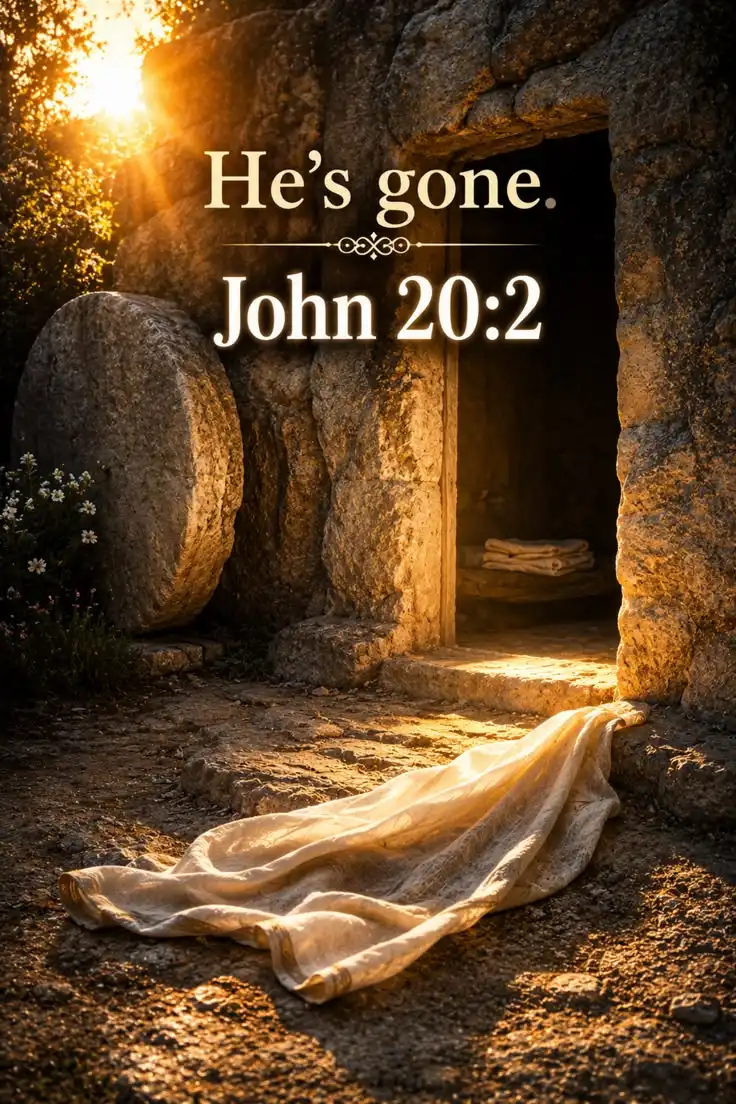
The open tomb, the rolled stone, the abandoned grave cloth, and the hard dawn light hold two truths at once. Something is missing, and something holy has happened. The words “He’s gone” carry Mary’s fear before she understood the resurrection. For the grieving heart, that tension matters. You may stand before absence and feel only panic, loss, or unanswered questions, while God’s greater work remains hidden from your understanding.
Biblical Insight
John 20 opens early on the first day of the week, while it is still dark. Mary Magdalene goes to the tomb and sees that the stone has been removed from the entrance. She runs to Simon Peter and the other disciple and reports what she believes has happened: “They have taken the Lord out of the tomb, and we don’t know where they have put him!”
The verse is important because it shows the emotional honesty of the resurrection account. Mary is not presented as someone who instantly understands everything. She does not stand before the empty tomb with polished theology. She sees absence and interprets it through grief. She assumes removal, not resurrection.
That reaction makes sense. Mary had watched Jesus suffer and die. His body had been placed in the tomb. She returned in love and mourning. Finding the stone removed would not automatically feel like hope. It would feel like violation, confusion, and another wound added to the wound of His death.
John 20:2 does not promise that faithful people will immediately understand what God is doing. It does not shame Mary for fear. It does not rebuke her for running to others with an incomplete conclusion. The verse lets us see the gap between what had actually happened and what Mary could yet perceive.
For a grieving Christian, that gap matters. Grief often narrows interpretation. You may look at a circumstance and draw the darkest conclusion because pain has trained you to expect loss. You may see change and call it threat. You may see silence and call it abandonment. You may see an empty place and believe only that something precious has been taken.
The resurrection does not make Mary’s sorrow imaginary. It does not erase the horror of the cross or the reality of the tomb. Jesus truly died. His followers truly grieved. But the empty tomb shows that their understanding, though sincere, was not complete. What looked like further loss was the first sign that death had been defeated.
This verse must be handled carefully. It does not mean every empty place in your life hides a happy earthly reversal. It does not mean every bereavement will be undone in this present life. It does not tell you that your loss is secretly easy to explain. The Christian hope is not a trick where every pain quickly turns into visible relief.
But John 20:2 does teach that grief does not have the authority to interpret everything finally. Mary’s first reading of the tomb was wrong, though understandable. Her love was real. Her distress was real. Her conclusion was incomplete. The risen Christ would soon speak her name, but in verse 2 she is still running with fear.
That helps the struggling believer. You may be in the verse 2 moment: alarmed, confused, unable to see beyond absence, saying, “I don’t know where He is in this.” Scripture does not despise that moment. It simply refuses to let it be the final word. The tomb is empty before Mary understands why. God’s victory is already true before her heart can grasp it.
In Application
- Allow yourself to name confusion honestly without treating it as final truth.
- Do not assume that your first grief-shaped interpretation is the whole story.
- Bring your “I don’t know where He is” prayer directly to Christ instead of hiding it.
- Let the empty tomb remind you that God’s work may be real before you can recognise it.
Practical Journaling
Reflect on John 20:2, then write honestly:
- Where am I standing before an empty place and interpreting it only as loss?
- What conclusion has grief made me reach too quickly?
- Where do I feel like saying, “I don’t know where the Lord is in this”?
- What would it mean to leave room for Christ’s resurrection truth without pretending my confusion is gone?

Follow on Medium for More Studies
If writing feels too heavy today, pray, “Lord Jesus, meet me where absence has confused my heart.”
The Faith Recovery Journal explores this and many similar topics for Christians facing grief, loss, and recovery.