
Psalm 73:26 — What Holds You Up When Your Strength Is Gone?
When Your Body Is Tired, Your Resolve Is Failing, and You Need More Than Yourself
"My flesh and my heart may fail, but God is the strength of my heart and my portion forever." — Psalm 73:26 (NIV)
Reflection
There are days when you can feel yourself giving way. Your body is tired. Your mind is crowded. Your courage is thinner than you want to admit. Grief can do that. Ongoing pressure can do that. You may still be functioning, still showing up, still speaking normally to other people, but inside you know something is failing.
Psalm 73:26 does not deny that reality. It does not say your flesh will stay strong or that your heart will always hold steady. It says the opposite. My flesh and my heart may fail. Scripture is not embarrassed by human collapse. It does not demand that you pretend to be stronger than you are. It gives you words for the moment when you know you are running out.
That honesty matters. Many grieving Christians feel guilty for not coping better. You may think you should be calmer by now, stronger by now, more spiritually composed by now. But this verse does not shame weakness. It names it plainly. Flesh fails. Heart fails. Bodies wear down. Resolve gives way. Emotions break under strain. Faith can feel thin, not because God has failed, but because you are human.
Start with the free sample
No email. No signup.
Then the verse turns. Not into denial, but into dependence. But God is the strength of my heart and my portion forever. The answer is not that you become enough. The answer is that God remains enough when you are not. If you are looking for proof that you can carry yourself, this verse will disappoint you. If you need to know whether God can hold you when you cannot hold yourself, this verse speaks directly.
That is a different kind of hope. It is not loud. It is not polished. It is not the hope of a person who feels in control. It is the hope of a person who comes empty-handed and stays there. When your own strength is failing, God does not ask you to manufacture more. He asks you to come to Him as the one who is still able, still present, and still yours.
God does not need your strength in order to be your strength.
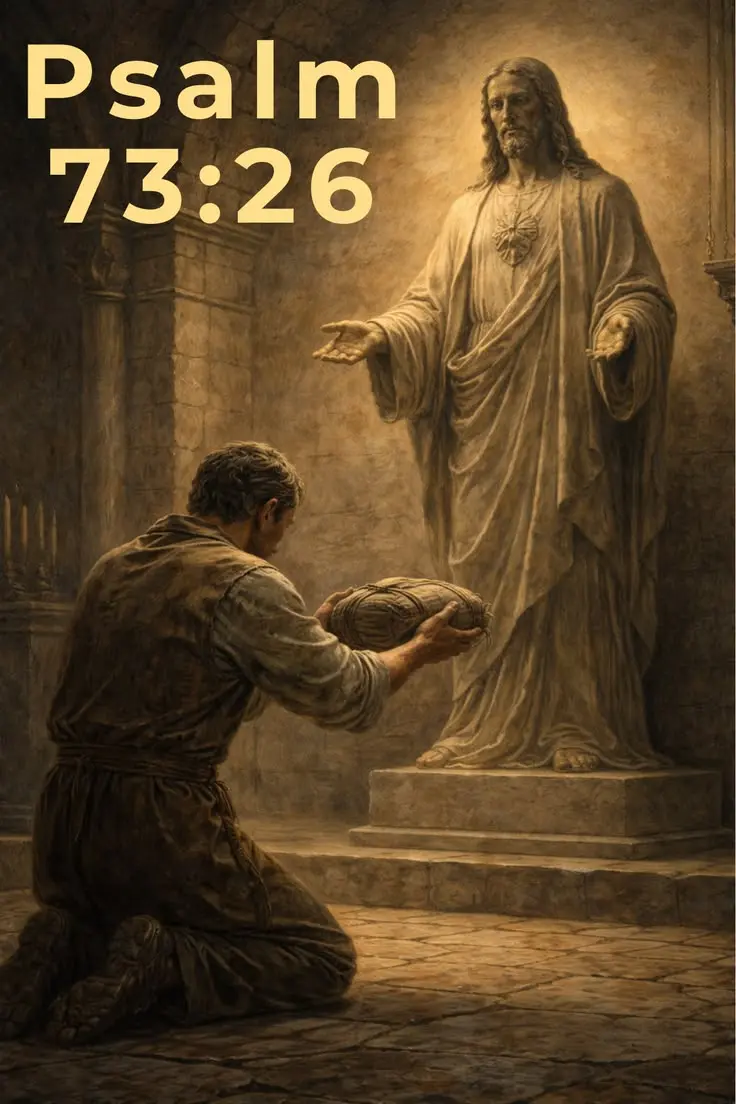
A weary man kneels on the stone floor with both hands extended, offering what looks like a wrapped burden before a towering figure of Christ whose arms are open in welcome. The whole scene is steeped in muted gold and shadow, like a place where surrender has finally become necessary. It fits this verse closely. The kneeling posture shows weakness admitted instead of hidden. The offered bundle suggests the last of what he has left. Christ stands as the one who receives, not the one who recoils. When your flesh and heart are failing, this is the movement Psalm 73:26 points toward: bring what is left and let God be what you are not.
Biblical Insight
Psalm 73 is not written from a place of easy confidence. Asaph begins the psalm wrestling with envy, confusion, and spiritual disorientation. He has looked at the prosperity of the wicked and felt destabilised by it. His footing slips. His thoughts turn bitter. He comes close to collapse inwardly before his perspective changes in the presence of God.
That context matters because Psalm 73:26 is not a decorative line about vague encouragement. It comes after inner conflict, near-failure, and hard reorientation. When Asaph says, My flesh and my heart may fail, he is not speaking theoretically. He knows what it is to be shaken mentally, emotionally, and spiritually.
God is the strength of my heart means God is the sustaining power of the inner life when the inner life is weak. This is not about God helping the already strong become stronger. It is about God becoming the sustaining source when your own resources are not enough. And my portion forever means God Himself is not merely a tool for coping. He is the lasting inheritance, the enduring good, the one possession that does not disappear when other securities collapse.
This verse does not promise that the body will recover quickly, that grief will lift on schedule, or that emotional pain will vanish the moment you pray. It does not say you will always feel strong. What it does say is that your weakness does not cancel God’s sufficiency. A grieving Christian needs that distinction. You may still feel frail. You may still be confused. You may still be grieving hard. But God’s ability to sustain you is not measured by how steady you feel today.
In Application
- Tell the truth about where you are failing. Do not dress it up. Name the exhaustion, fear, numbness, or emotional collapse plainly before God.
- Stop treating self-sufficiency as the goal. Psalm 73:26 does not call you to prove your strength. It calls you to rely on God’s.
- Bring the actual burden you are carrying into prayer. Do not offer polished words only. Offer the real thing: the grief, the tiredness, the dread, the disappointment.
- Return to the truth that God is your portion. When other supports feel unstable, remind yourself that God Himself remains present and does not thin out when your strength does.
Practical Journaling
Reflect on Psalm 73:26, then write honestly:
- Where do I feel my flesh and heart failing right now: physically, emotionally, spiritually, or mentally?
- What burden am I still trying to carry by myself instead of placing before God?
- What does it mean for me, in practical terms, to let God be the strength of my heart today?
- When everything else feels uncertain, what would it look like to treat God as my portion and not merely my emergency help?

Follow on Medium for More Studies
If writing feels too heavy today, pray: “God, my strength is failing, so be the strength of my heart.”
The Faith Recovery Journal explores this and many similar topics for Christians facing grief, loss, and recovery.