
1 Corinthians 6:19 — Your Body is His Temple
When Your Body Feels Broken but You Know it Still Belongs to God
"Do you not know that your bodies are temples of the Holy Spirit, who is in you, whom you have received from God? You are not your own."
— 1 Corinthians 6:19 (NIV)
Reflection
A broken body can make faith feel harder than you expected. Pain reduces your world. Illness changes your routines. Weakness takes away independence. Injury interrupts ordinary dignity. You may still believe God is present, yet struggle with the humiliating fact that your own body has become a place of limitation, treatment, dependence, and fear.
1 Corinthians 6:19 speaks into that pressure with a truth that is easy to repeat and harder to receive: your body is a temple of the Holy Spirit. Not only your strong body. Not only your healthy body. Not only the body that can work, serve, walk, lift, think clearly, sleep soundly, or keep going without help. Your body, as it is now, still matters to God.
The wound here is not only physical. It is spiritual dislocation. You can feel estranged from your own flesh when it no longer does what it once did. You can feel ashamed of needing care. You can feel reduced to symptoms, appointments, results, scans, dressings, medication, and the opinions of professionals. Scripture refuses to let that be the whole truth. The body that feels like a problem is still a place where God has chosen to dwell.
Start with the free sample
No email. No signup.
That does not make suffering romantic. It does not make injury holy because injury hurts. It does not mean every bodily weakness is secretly easy to bear. A temple can be damaged, guarded, repaired, cleaned, honoured, and treated carefully. Calling the body a temple does not deny its fragility. It gives that fragility a different weight.
You are not required to pretend you like what has happened to your body. You are not required to spiritualise pain until it sounds noble. But neither are you permitted to despise the body in which the Holy Spirit dwells. Your body is not worthless because it is wounded. It is not spiritually disposable because it is medically complicated.
A broken temple is still a temple.
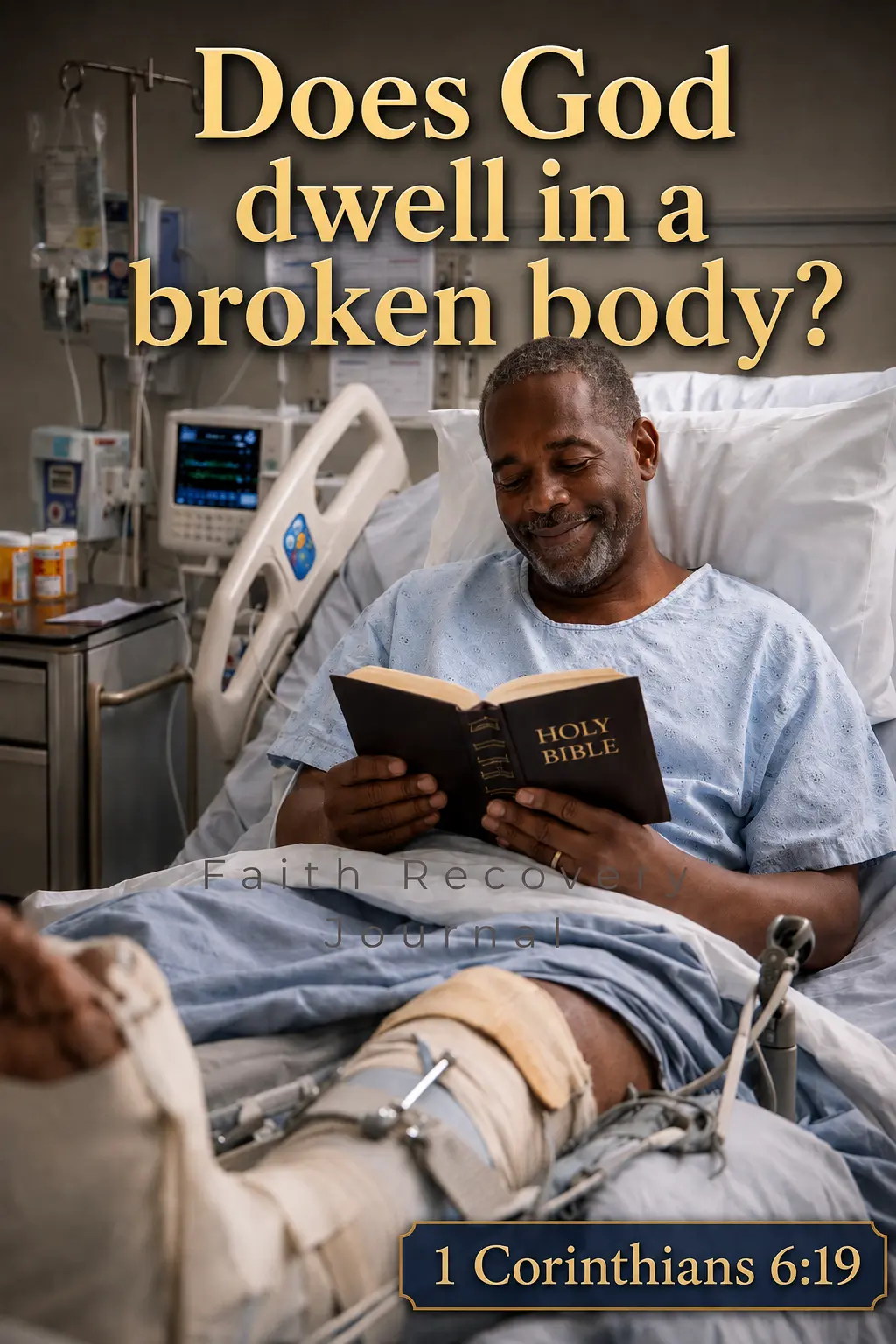
A middle-aged Black man lies in a hospital bed with his injured leg supported by medical equipment, reading a Holy Bible beneath the words Does God dwell in a broken body? The scene reflects how the body under treatment, weakness, and visible damage is not outside God’s concern; 1 Corinthians 6:19 insists that the Holy Spirit’s dwelling place is not cancelled by physical brokenness.
Biblical Insight
In 1 Corinthians 6, Paul is writing to believers in Corinth about the seriousness of the body. The immediate context concerns sexual immorality and the believer’s union with Christ, so the verse should not be torn away from that moral weight. Paul is not offering a vague inspirational statement about self-esteem. He is confronting Christians with the fact that their bodies belong to God.
That context matters. Paul’s point is not that the body is irrelevant because only the soul matters. It is the opposite. The body matters because Christ has claimed the whole person. The believer’s body is not a meaningless shell. It is not merely a temporary container to be used, neglected, despised, or treated as spiritually insignificant. The Holy Spirit dwells in God’s people, and that makes bodily life morally and spiritually serious.
For a grieving or suffering Christian, this truth reaches beyond the original issue without ignoring it. If your body belongs to God, then its weakness is not beneath His notice. If your body is a temple of the Holy Spirit, then illness, injury, exhaustion, disability, and bodily decline do not make you less human, less Christian, or less worthy of care. The verse gives dignity to the body precisely because it belongs to God rather than to self-contempt, shame, fear, or despair.
“You are not your own” can sound severe, especially when grief has already taken so much from you. But in this verse, it is also a protection. You are not your own in the sense that you are not abandoned to define your worth by usefulness, beauty, strength, productivity, mobility, or independence. Your body is not finally owned by illness, by grief, by medical language, by other people’s impatience, or by your own disgust. You belong to God.
This does not promise immediate physical healing. It does not say that faithful Christians will be spared bodily suffering. It does not say that prayer will remove every symptom or reverse every injury. Paul himself knew bodily weakness and suffering. Scripture does not treat the body as sacred only when it is strong. It teaches that the body belongs to God even when it is weak.
That truth also carries responsibility. Because your body is His temple, it should not be abused, neglected, or hated. Rest may become obedience. Accepting help may become humility. Taking medication, attending appointments, eating, washing, sleeping, and asking for care may become acts of stewardship rather than signs of defeat. None of these actions earn God’s love. They recognise that what belongs to Him should not be treated with contempt.
In grief, the body often bears what the mind cannot fully process. It aches, tightens, tires, trembles, wakes in the night, loses appetite, or collapses into exhaustion. 1 Corinthians 6:19 does not shame that body. It calls it God’s dwelling place. That is not a small comfort. It means the Holy Spirit is not waiting for you to become impressive again before your life matters.
In Application
- Do not speak about your body as if weakness has made it worthless. 1 Corinthians 6:19 says your body belongs to God.
- Let medical care, rest, food, washing, movement, or stillness become stewardship rather than humiliation.
- When shame rises over injury, illness, age, or dependence, answer it with the verse: the Holy Spirit dwells in God’s people.
- Refuse both denial and self-contempt. You can admit your body is suffering without treating it as spiritually disposable.
Practical Journaling
Reflect on 1 Corinthians 6:19, then write honestly:
- Where do I feel most ashamed, angry, or afraid about my body right now?
- What has grief, illness, injury, or exhaustion made me believe about my worth?
- What would change if I treated my body as belonging to God rather than as a failed possession of my own?
- What one act of bodily care today would honour the truth that the Holy Spirit dwells in me?

Follow on Medium for More Studies
If writing feels too heavy today, pray only this: Lord, help me honour the body You still call Yours.
The Faith Recovery Journal explores this and many similar topics for Christians facing grief, loss, and recovery.