
Psalm 145:8 — When Brokenness Has Not Removed God's Grace
When Brokenness Has Not Removed God’s Grace
"The LORD is gracious and compassionate, slow to anger and rich in love." — Psalm 145:8 (NIV)
Reflection
There are days when you feel like the cracked bowl.
Still present. Still holding together. Still useful in some outward way. But the break is visible. The rim is damaged. Something has happened that cannot be unseen, and you know it even when other people move past it.
Grief can make you feel exposed like that. You may still turn up, still answer messages, still sit in church, still open the Bible, still put food on the table. But the fracture remains. You know where life split. You know what loss did. You know the places where you no longer feel whole.
Start with the free sample
No email. No signup.
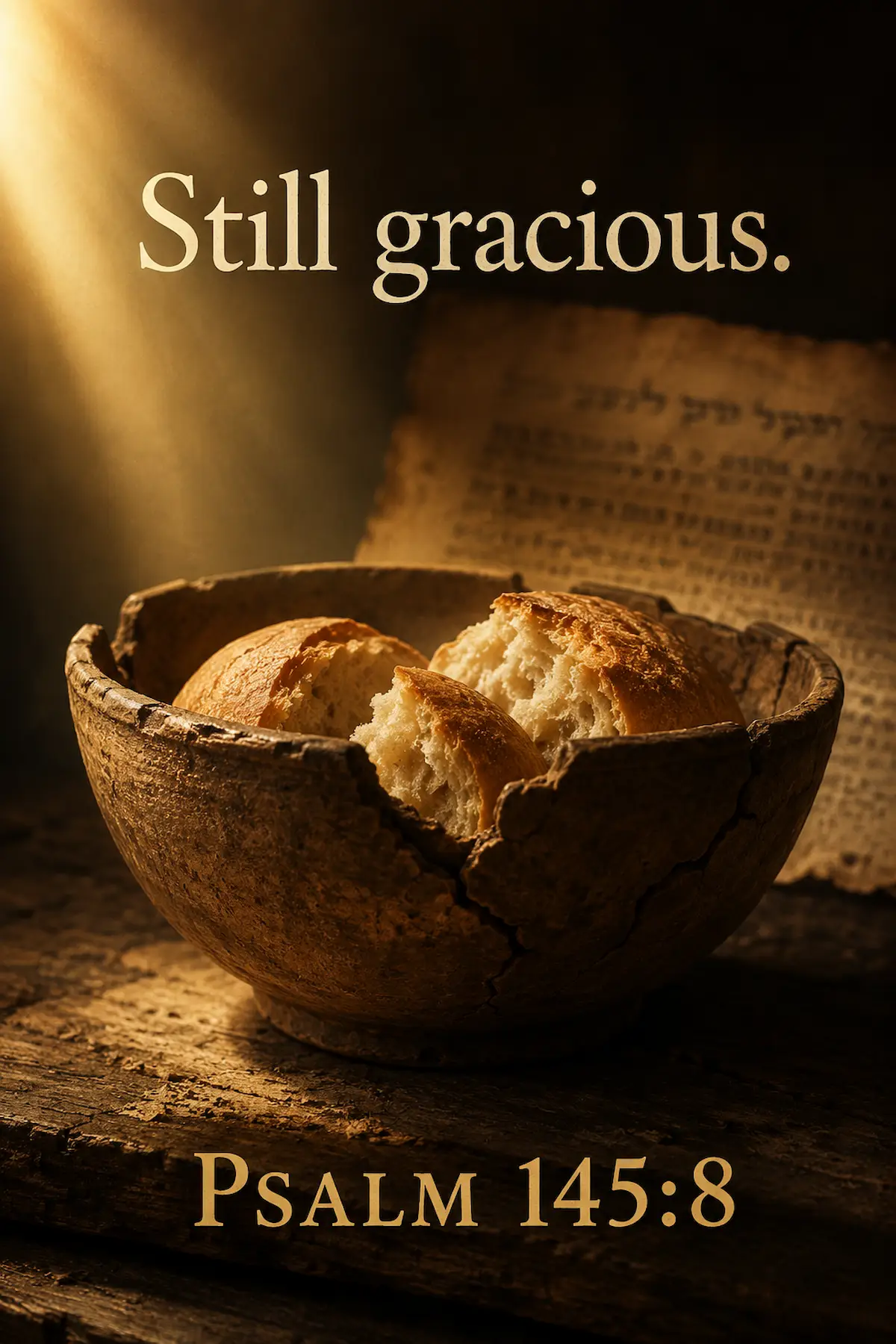
The image of fresh bread inside a cracked clay bowl matters. The bowl is not presented as perfect. Its broken rim is still visible. Yet it is not empty. It still receives provision. It still sits under warm light. It still bears something nourishing.
God’s grace does not wait for you to look unbroken.
Psalm 145:8 speaks directly into that kind of pain. The Lord is not gracious only toward people who feel composed. He is not compassionate only when your faith sounds confident. He is not rich in love only when you can explain your sorrow neatly. He remains gracious when the crack is obvious, when the grief is still tender, and when your own weakness embarrasses you.
Biblical Insight
Psalm 145 is a psalm of praise. David lifts his eyes to the greatness, goodness, mercy, and kingdom of the Lord. This is not a small view of God. The psalm speaks of His mighty acts, His glorious splendour, His abundant goodness, His righteousness, His compassion, and His care for all He has made.
Psalm 145:8 echoes one of the central descriptions of God in Scripture: “The LORD is gracious and compassionate, slow to anger and rich in love.” These words are not decorative. They reveal God’s character. They tell us what kind of God stands over the wounded, the failing, the frightened, the grieving, and the weak.
“Gracious” means the Lord gives kindness that is not earned. “Compassionate” means He is not cold toward human frailty and pain. “Slow to anger” means He is not harsh, volatile, or eager to crush. “Rich in love” means His covenant love is not thin, reluctant, or easily exhausted.
For a grieving Christian, this matters because grief often distorts how God feels toward you. Pain can make you imagine Him as distant. Exhaustion can make you assume He is disappointed in your weakness. Anger, numbness, confusion, and spiritual heaviness can make you fear that you have become too fractured to approach Him honestly.
Psalm 145:8 corrects that fear. It does not say the Lord is gracious only after your emotions become respectable. It does not say He is compassionate only when you handle grief well. It does not say He is slow to anger until your prayers become messy. It does not say He is rich in love only when you feel spiritually strong.
It tells you who He is.
That does not mean this verse removes every consequence of loss. It does not promise that the crack disappears. It does not say grief will no longer hurt. It does not mean broken relationships will automatically heal, empty rooms will feel full, or the body will stop remembering shock. The cracked bowl remains cracked. The broken rim is still visible.
But the verse does mean your brokenness is not the final statement about your standing before God. The Lord’s grace is deeper than your visible damage. His compassion is not frightened by the truth of your condition. His patience is not stretched thin by the slowness of your healing. His love is not rationed according to how strong you look.
The fresh bread in the cracked bowl is a quiet picture of mercy. God can still provide nourishment where damage remains visible. He can still feed the soul that feels ashamed of its weakness. He can still meet you in Scripture, prayer, worship, silence, and ordinary daily obedience, even when you do not feel like a polished vessel.
This matters because grief can tempt you into hiding. You may hide from people because you are tired of explaining. You may hide from God because you fear your sadness has become too much. You may hide from Scripture because you do not want to face promises that feel painful right now.
Psalm 145:8 calls you back to the character of the Lord. Not to a performance. Not to religious pretending. Not to a forced smile. To the God who is gracious and compassionate, slow to anger and rich in love.
The cracked bowl does not need to pretend it has no fracture. It needs to remain under the light and receive what is given.
In Application
- Bring your visible weakness to God without dressing it up in religious language.
- Stop assuming that grief, anger, numbness, or exhaustion make you unwelcome before Him.
- Look for small forms of provision that God has placed in the cracked places: Scripture, food, rest, help, prayer, or one faithful person.
- Return to God’s character when your feelings make Him seem harsher than Scripture says He is.
Practical Journaling
Reflect on Psalm 145:8, then write honestly:
- Where do I feel most like the cracked bowl right now: damaged, exposed, ashamed, fragile, or still carrying what I can?
- What part of God’s character in this verse do I find hardest to believe in my grief: gracious, compassionate, slow to anger, or rich in love?
- Where have I assumed that my brokenness makes me less able to receive from God?
- What “fresh bread” has God placed in my life, even while the broken rim remains visible?
If writing feels too heavy today, pray this one sentence: “Lord, keep me under Your grace while I am still cracked.”
The Faith Recovery Journal explores this and many similar topics.