
Romans 15:13 — When Hope Starts to Return Before You Feel Ready
When Hope Starts to Return Before You Feel Ready
"May the God of hope fill you with all joy and peace as you trust in him, so that you may overflow with hope by the power of the Holy Spirit." — Romans 15:13 (NIV)
Reflection
Hope can feel almost rude when grief is still sitting in the room.
You may not feel ready for sunrise. You may still be living by the small lamp: enough light to read one verse, enough light to breathe through one more hour, enough light to keep the Bible open when your heart feels shut. The first morning after deep sorrow does not always feel like relief. Sometimes it feels like proof that the world has continued without asking your permission.
That is why “Hope returns” has to be handled carefully. Hope does not always come back loudly. It may not arrive as confidence, energy, or joy you can feel in your body. Sometimes it appears as the smallest refusal to close the Bible, the smallest willingness to pray one honest sentence, the smallest recognition that darkness has not swallowed everything.
Start with the free sample
No email. No signup.
Romans 15:13 speaks to people who cannot force themselves into hope. Paul does not tell believers to become hopeful by pretending they are fine. He prays that “the God of hope” would fill them. That matters when grief has emptied you out. Hope is not treated as emotional self-improvement. It is something God gives, sustains, and deepens by the power of the Holy Spirit.
Hope can return before happiness does.
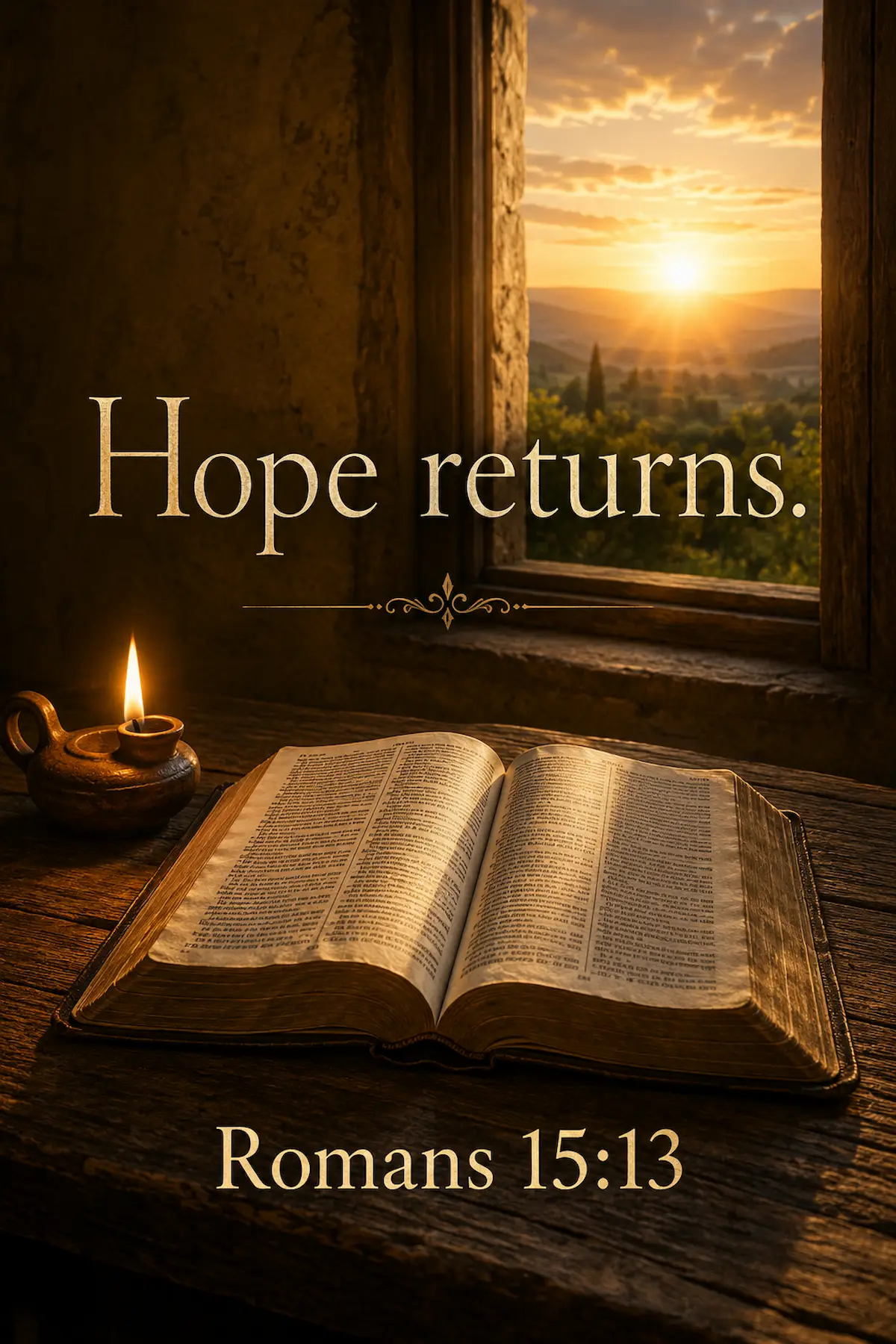
The lamp beside the open Bible matters. The sunrise behind it matters. One light has carried you through the dark. Another light is beginning to appear. You may still ache. You may still miss what cannot be replaced. But the God of hope is not absent from the room where you are trying to believe with a wounded heart.
Biblical Insight
Romans 15:13 comes near the end of Paul’s long letter to the Christians in Rome. The surrounding passage deals with endurance, encouragement, Scripture, unity, and the hope given to both Jews and Gentiles in Christ. Paul has just pointed to the promises of God and the praise of the nations. Then he prays this blessing: “May the God of hope fill you with all ljoy and peace in believing, so that by the power of the Holy Spirit you may abound in hope.”
The verse is not shallow optimism. It is not a religious mood-lift. Paul grounds hope in God Himself. He calls Him “the God of hope,” which means hope does not begin with your changing circumstances, your emotional resilience, or your ability to make sense of suffering. Hope begins with who God is.
Paul also connects joy and peace with “believing.” That does not mean a grieving Christian must feel joyful on command. It does not mean peace will arrive as soon as you say the right words. Believing, in Scripture, is not emotional theatre. It is trust placed in God even when the heart is trembling.
This verse does not promise that grief will quickly lift. It does not promise that the sunrise will make the room stop hurting. It does not promise that joy and peace will erase memory, longing, shock, anger, or exhaustion. It does not ask you to mistake numbness for faith or forced brightness for hope.
It gives a stronger promise than that.
It says the Holy Spirit has power to make hope abound in believers who cannot produce it themselves. That is vital for the grieving Christian. There are forms of pain that drain language, energy, appetite, concentration, and confidence. When you are that empty, being told to “have hope” can feel like being asked to lift a weight you cannot touch. Romans 15:13 does not put the full burden on you. Paul prays for God to fill what has been emptied.
The phrase “abound in hope” does not mean you become untouched by sorrow. Christian hope is not denial. It is not cheerfulness painted over devastation. It is the Spirit-given assurance that God remains true, Christ remains risen, mercy remains real, and the future has not been surrendered to grief.
That is why the image of the lamp and sunrise fits the verse. The lamp is the small light of endurance. The sunrise is the sign that darkness does not own the horizon. The open Bible stands between them, not as decoration, but as the place where God speaks when feeling alone cannot tell the truth.
For a struggling Christian, Romans 15:13 matters because it allows hope to be received before it is strongly felt. You may believe with tears. You may believe with questions. You may believe while still sitting in the chair, tired from the night. The God of hope is not waiting for you to become impressive. He fills weak believers by the power of the Holy Spirit.
In Application
- Do not demand full emotional recovery from yourself before you recognise small signs of hope.
- Keep Scripture open, even if you can only read one verse slowly and honestly.
- Ask God to fill what grief has emptied instead of pretending you can refill it yourself.
- Separate hope from forced happiness. Hope can be real while sorrow is still present.
Practical Journaling
Reflect on Romans 15:13, then write honestly:
- Where do I feel most emptied by grief right now: joy, peace, belief, strength, or hope?
- What small “lamp” has helped me endure the dark, even if it has not removed the pain?
- Where have I confused hope with feeling happy, strong, or fully healed?
- If the God of hope met me beside an open Bible today, what would I ask Him to fill in me?
If writing feels too heavy today, pray this one sentence: “God of hope, fill what grief has emptied.”
The Faith Recovery Journal explores this and many similar topics.