
2 Corinthians 12:10 — What Do You Do When God Doesn't Remove the Burden?
When Relief Does Not Come, Christ's Strength Still Can
"That is why, for Christ's sake, I delight in weaknesses, in insults, in hardships, in persecutions, in difficulties. For when I am weak, then I am strong."
— 2 Corinthians 12:10 (NIV)
Reflection
You asked God to move it, and He did not. The weakness is still there. The pressure is still there. The grief still drags behind you. The limitation still sits in your body, your mind, your circumstances, or your home. You pray, and then you wake up to the same burden again. That can make you wonder what strength is supposed to mean now.
That is exactly where this verse lands. Paul is not talking about a life without pressure. He is talking about a life where Christ’s strength shows up in the middle of pressure that has not gone away. For a grieving Christian, that matters. Some prayers are answered by removal. Others are answered by sustaining grace. That second kind of answer can feel harder to receive, because it does not look like relief.
Start with the free sample
No email. No signup.
There is something blunt and painful about having to keep carrying what you hoped God would take away. Chronic grief does that. Anxiety does that. Loneliness does that. Physical weakness does that. Ongoing family strain does that. You are not imagining the difficulty. Paul names weaknesses, insults, hardships, persecutions, and difficulties because real faith does not require fake language.
But Paul also refuses to measure God’s help only by whether the burden disappears. He has learned that Christ’s strength is not theoretical. It meets him in the exact place where he feels most exposed, least self-sufficient, and most in need. That does not make weakness pleasant. It makes weakness no longer empty.
God’s strength is not absent just because the burden is still there.
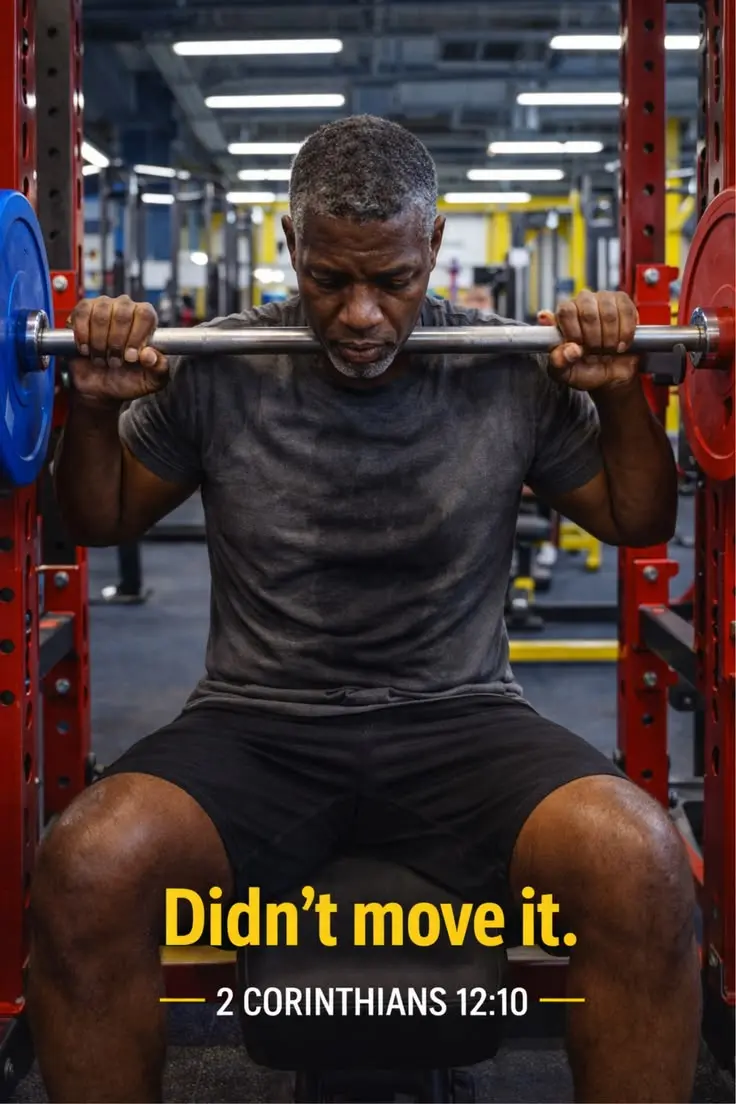
The bowed head, tightened grip, loaded bar, and stark words “Didn’t move it.” all press the same truth: some forms of strength are revealed under weight, not after it vanishes. The gym setting matters too. Strength here is not softness or escape. It is endurance under load. For the grieving believer, that connects deeply with the verse. You may still be carrying what you begged God to remove, yet Christ may be meeting you there with a strength you did not know until you needed it.
Biblical Insight
2 Corinthians 12:10 sits inside Paul’s reflection on what many call his “thorn in the flesh.” Earlier in the passage, Paul explains that he pleaded with the Lord three times to take it away. God did not remove it. Instead, He answered, “My grace is sufficient for you, for my power is made perfect in weakness.” Verse 10 is Paul’s response to that answer.
That context matters. Paul is not saying he enjoys pain for pain’s sake. He is not celebrating insults, hardships, or weakness as good in themselves. He is saying that for Christ’s sake he has learned to accept them as places where Christ’s power is shown most clearly. The burden remains, but it no longer has the final word.
“For when I am weak, then I am strong” does not mean weakness turns into strength by positive thinking. It means Christ’s strength becomes most evident when Paul stops pretending he is enough on his own. The strength is not self-generated. It is received. It is dependent strength, not independent strength.
This verse also does not promise that every painful thing will stay forever. God does sometimes remove burdens. He does heal, rescue, provide, and relieve. But this passage warns us not to assume that removal is the only form of divine help. Sometimes the help is sustaining grace strong enough to hold you together inside what you never wanted.
That is crucial for grieving Christians. Loss often leaves behind ongoing weakness. You may function, pray, work, and even serve others, yet still carry a raw internal limitation. This verse does not accuse you for that. It tells you that weakness is not proof of spiritual failure. It may be the very place where Christ’s strength is being made known.
It also does not mean you should refuse practical help. Paul’s words are not an excuse to stay silent in abuse, neglect treatment, or romanticise collapse. Christian endurance is not passive surrender to harm. It is trustful dependence on Christ while walking faithfully with the support, wisdom, and obedience that truth requires.
In Application
- Tell God plainly what has not moved. Do not hide the burden behind polished spiritual language.
- Stop treating unresolved weakness as proof that God is ignoring you. His sustaining grace may be operating where relief has not yet come.
- Ask a better daily question: not only “Why is this still here?” but also “How is Christ strengthening me under it today?”
- Use journaling to name the load, the prayer, and the places where you are still being upheld even in exhaustion.
Practical Journaling
Reflect on 2 Corinthians 12:10, then write honestly:
- What burden have I asked God to remove that still has not moved?
- How has this ongoing weakness affected my trust, my prayers, and my view of God’s care?
- Where do I most resist the idea that Christ could be strong in me while I still feel weak?
- What would it look like today to depend on Christ’s strength instead of waiting to feel strong first?

Follow on Medium for More Studies
If writing feels too heavy today, pray, “Lord, this weakness is still here, so be strong in me here.”
The Faith Recovery Journal explores this and many similar topics for Christians facing grief, loss, and recovery.