
2 Corinthians 5:17 — New Identity in Christ After Grief
The old life is not your final name
"Therefore, if anyone is in Christ, the new creation has come: The old has gone, the new is here!"
— 2 Corinthians 5:17
Reflection
Grief can make you feel trapped inside an older version of yourself. The person you were before the loss may feel gone, but the person you are now may feel unfamiliar, tired, and hard to recognise. You may believe in Christ and still wonder what “new” could possibly mean when so much feels damaged, confused, or painfully unfinished.
That matters for a grieving Christian. This verse does not describe a polished life, a painless heart, or instant emotional recovery. It describes a real change of identity for the person who is in Christ. Grief may alter how you think, sleep, cope, remember, and function. But it does not get the final right to define who you are. Christ does.
Start with the free sample
No email. No signup.
You may still carry sorrow. You may still feel weak. You may still be haunted by what has been taken from you or by the ways grief has changed your life. Yet 2 Corinthians 5:17 says that if you are in Christ, the deepest truth about you is not your loss, your shame, your fear, or your past. The deepest truth is that you belong to Him and that He has made you new.
Sometimes the hardest part is believing that this applies to you now, not merely someday. The woman on the steps has not yet reached the light in full, but she is already moving toward the One who calls her. That is often what faith looks like in grief: not denial, not performance, but slow, real movement toward Christ under the promise that He is remaking what sorrow could never save.
Grief may change you, but it does not own you.
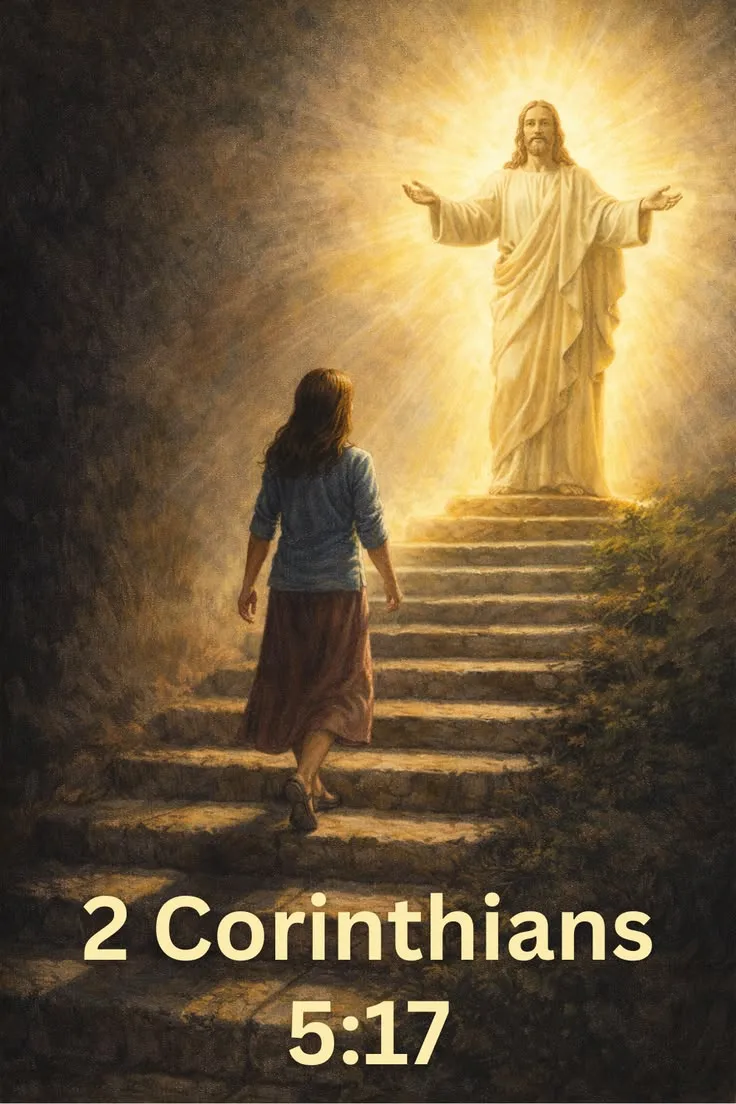
The stone steps suggest effort, ascent, and response. The darkness around the woman is real, but it is not where the eye finally rests. Christ stands in overwhelming light, arms open, receiving rather than threatening. That is why the scene works so well for this verse. New creation is not self-reinvention. It is not climbing into a better version of yourself by force. It is being drawn upward toward the living Christ, who gives a new identity even while you are still coming out of the shadows.
Biblical Insight
In 2 Corinthians 5, Paul is speaking about reconciliation, Christ’s death, and the profound change that comes through union with Him. He explains that Christ died for all so that those who live should no longer live for themselves but for Him. Then he says that from now on, believers regard people differently because something decisive has happened in Christ.
That is the immediate setting for verse 17. “If anyone is in Christ” means being joined to Him by faith. It is covenant language, identity language, salvation language. Paul is not merely saying that Christians should try to improve themselves. He is saying that in Christ, something fundamentally new has begun. The believer has been brought into a new realm, a new standing before God, and a new life governed by Christ rather than the old rule of sin and alienation.
What the verse means is clear: your old status before God has gone. Your condemnation is not your future. Your deepest identity is no longer rooted in the old life apart from Christ. A new reality has begun. You are not merely patched up. You are made part of God’s new creation work through Jesus Christ.
What the verse does not mean is just as important. It does not promise that all painful emotions vanish at conversion or at the moment you remember the verse. It does not mean Christians never struggle with grief, trauma, fear, regret, exhaustion, or inner conflict. It does not mean your personality is erased or your losses are made trivial. Scripture never treats sorrow as unreal. Paul himself knew affliction, weakness, and deep pressure.
For the grieving Christian, this verse matters because grief can distort identity. You may start speaking of yourself only in terms of what happened: widow, bereaved parent, abandoned husband, exhausted carer, shattered son, frightened daughter. Those descriptions may reflect real pain, but they are not the whole truth. If you are in Christ, they do not name you most deeply. “New creation” does.
This newness often unfolds in lived practice. Your identity changes decisively in Christ, but learning to live from that identity takes time. That is why the scene of climbing is so fitting. The woman is not creating the light. She is answering it. In the same way, the grieving Christian does not manufacture new creation by effort alone. He learns, slowly and sometimes painfully, to walk toward what Christ has already declared true.
So this verse gives more than a slogan. It gives a firm ground beneath the grieving heart. You are not doomed to be permanently ruled by the old life, the old guilt, the old rebellion, or the old name. In Christ, the new has come. That does not erase grief. But it does mean grief does not have the right to write your final identity.
In Application
- Identify one false name grief has been pressing onto you, and answer it with what is true of you in Christ.
- Speak honestly about your sorrow without letting sorrow become your full identity.
- Move toward Christ in one practical way today: prayer, Scripture, worship, confession, or quiet surrender.
- Remember that new creation is Christ’s work in you, not a demand to appear emotionally recovered.
Practical Journaling
Reflect on 2 Corinthians 5:17, then write honestly:
- What part of my old life, old identity, or old way of seeing myself still grips me most strongly?
- How has grief changed the way I think about who I am?
- What would it mean for me to believe that being “in Christ” is a deeper truth than what I have lost?
- What is one step upward I can take toward Christ this week, even if I still feel surrounded by shadow?

Follow on Medium for More Studies
If writing feels too heavy today, ask Christ to help you take one step toward the truth of who you are in Him.
The Faith Recovery Journal explores this and many similar topics for Christians facing grief, loss, and recovery.