
Genesis 50:20 — How Do You Trust God After Someone Meant to Harm You?
When Betrayal Leaves Scorched Ground but God Still Brings Life
"You intended to harm me, but God intended it for good to accomplish what is now being done, the saving of many lives." — Genesis 50:20 (NIV)
Reflection
Some wounds do not come from accidents. They come from people. Someone lied. Someone betrayed you. Someone used power badly. Someone made a choice that damaged your life, your trust, your stability, or your peace. That kind of pain is hard in a particular way because it was not random. It was aimed.
Genesis 50:20 speaks straight into that kind of pain. Joseph is not talking about a bad day or a vague disappointment. He is speaking about real harm done to him by real people. He names it plainly: You intended to harm me. Scripture does not force him to soften it. It does not ask him to pretend it was fine. It does not call evil good. That matters when you are carrying grief that came from another person’s sin.
You may be sitting with the aftermath now. You may still be living inside consequences you did not choose. You may be asking what exactly God is supposed to do with damage that has already been done. You may even feel angry when people rush too quickly to the “good” part, as though naming God’s power means ignoring your pain. This verse does not do that. It begins by telling the truth.
Start with the free sample
No email. No signup.
But it does not end there. Joseph also says, but God intended it for good. Not because the harm was good. Not because betrayal was necessary in itself. Not because pain magically turns holy. The point is that God is not trapped by what was done to you. Human evil is real, but it is not sovereign. God is able to work in ground that looks ruined.
That is why this verse matters in grief. Sometimes loss leaves you standing in what feels like burnt-out, cracked land. You look at your life and think, this was not what should have happened. Yet a single living shoot can still rise out of dry ground. A fierce shaft of light can still fall on a place that looks dead. That does not erase the drought. It means the drought does not get the final word.
What harmed you is not stronger than what God can do.
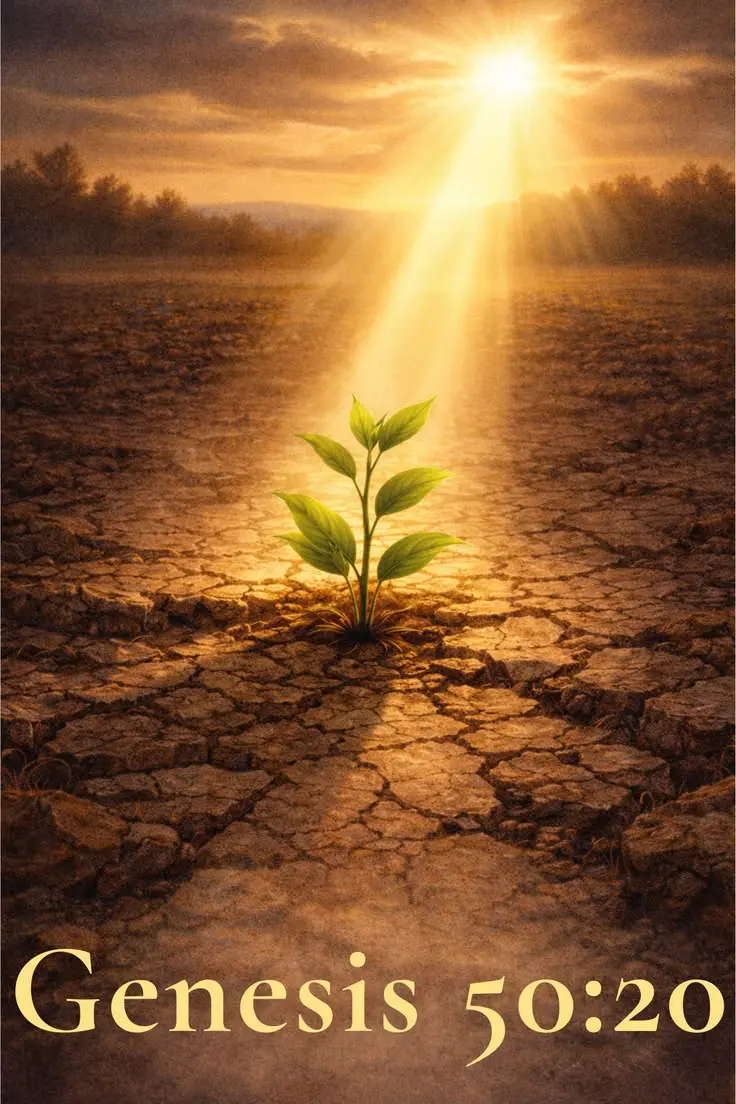
A small green plant stands upright in split, barren earth while a strong beam of golden light pours down from above. The ground is still cracked. The dryness is still visible. Yet life is there anyway. That is the connection to Genesis 50:20. God does not pretend the field was never scorched. He brings living good out of ground that looks beyond repair, and that is often how His work feels in grief too.
Biblical Insight
Genesis 50:20 comes near the end of Joseph’s story. His brothers sold him into slavery. He was taken from his father, stripped of safety, falsely accused, imprisoned, and deeply wronged. Years later, after God raised him into a position where he could preserve many people during famine, Joseph speaks these words to the very brothers who harmed him.
This verse means at least three important things. First, it means evil is real. Joseph does not deny intent. He says plainly, You intended to harm me. Scripture does not require fake language around cruelty, betrayal, or injustice. Second, it means God’s purpose outruns human malice. What others mean for destruction does not set the final meaning of your life. Third, it means good may emerge in ways you could not have planned, controlled, or even imagined while you were in the middle of the pain.
What this verse does not promise is that every wound will make sense quickly, or that every harmed person will see a neat explanation in this life. It does not promise that suffering will feel acceptable once you see some good result. It does not excuse abusers, betrayers, or oppressors. And it does not ask you to call evil good. The verse protects both truths at once: people can truly do harm, and God can truly overrule harm without becoming its author.
For a grieving Christian, that matters deeply. You may not yet see what good God will bring. You may not be ready to speak about redemption with confidence. Genesis 50:20 still gives you something solid to hold: the meaning of your life is not finally decided by the people who hurt you. God still acts. God still sees. God still brings life.
In Application
- Tell the truth about the harm. Do not minimise what happened to make it easier to discuss. Joseph did not deny evil, and you do not have to either.
- Separate the evil from God’s work. The wrong done to you was wrong. God’s power is shown not by approving it, but by refusing to let it have the final word.
- Look for living signs, not complete explanations. A small change, a surviving faith, a new strength, or one preserved relationship may be the green shoot in the cracked ground right now.
- Pray honestly when you cannot yet see the good. You do not need to force triumphant language. You can ask God to bring life from what was meant to break you.
Practical Journaling
Reflect on Genesis 50:20, then write honestly:
- What harm am I still naming too softly, and what would it look like to tell the truth about it before God?
- Where does my life feel like cracked ground right now, and where, if anywhere, can I see even a small sign of living growth?
- What do I fear this wound has permanently taken from me, and what am I asking God to restore, protect, or redeem?
- What would it mean for me to believe that human harm is real but not final?

Follow on Medium for More Studies
If writing feels too heavy today, tell God plainly: “Bring life out of what was meant to harm me.”
The Faith Recovery Journal explores this and many similar topics for Christians facing grief, loss, and recovery.