
Hebrews 10:24—Christian Encouragement for Grief Making You Feel Alone
Spurring On Each Other in Fellowship
"And let us consider how we may spur one another on toward love and good deeds"
— Hebrews 10:24
Reflection
Grief can put you at the edge of the room while life continues loudly nearby. Other people may be laughing, clapping, talking, celebrating, and sharing ordinary warmth, while you sit apart with your hands folded, trying to decide whether you have the strength to enter.
That contrast matters for a grieving Christian. Sometimes the hardest part is not that people are absent, but that they are close and you still feel alone. You may want encouragement, but not noise. You may need love, but not pressure. You may want to be drawn back toward good, but not dragged into performance.
Start with the free sample
No email. No signup.
Hebrews 10:24 does not tell believers to ignore the person sitting at the edge. It calls the church to consider one another. That word matters. Real encouragement begins with attention. It asks, “What would actually help this person love, endure, pray, serve, and take the next faithful step?” It does not assume that applause, energy, or cheerful company automatically reaches the wounded heart.
Grief can also make you resistant to being encouraged. You may pull back before anyone can disappoint you. You may assume the group will not understand. You may tell yourself that your sorrow is too heavy for ordinary fellowship. Some caution may be wise. But total withdrawal can quietly harden into loneliness, and loneliness can weaken love.
Christian encouragement must notice the person outside the circle.
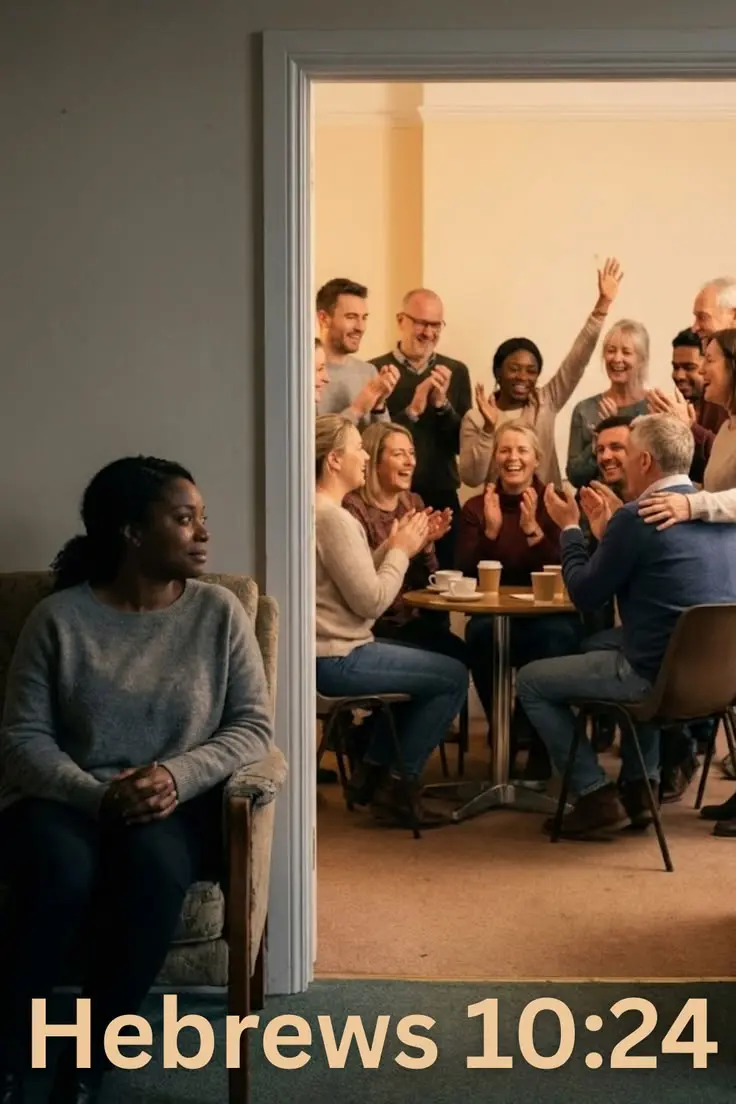
The doorway divides two emotional worlds. On one side, the woman sits in shadow, quiet and guarded. On the other, the group shares warmth, applause, conversation, and visible belonging. Hebrews 10:24 belongs exactly there: not as a command to force the isolated person into the room, but as a call to think carefully about how love reaches across the threshold. The verse asks believers to notice, draw near, and stir one another toward good without crushing what grief has made tender.
Biblical Insight
Hebrews 10:24 sits inside a passage that calls believers to hold firmly to their hope, draw near to God, and remain faithful together. The next verse warns against giving up meeting together and urges believers to encourage one another. The wider concern is perseverance. Christians under pressure must not drift into isolation, fear, discouragement, or spiritual neglect.
The wording is deliberate: “let us consider how we may spur one another on toward love and good deeds.” This is not casual friendliness. It is thoughtful spiritual care. To “consider” someone is to pay attention, to think, to notice what would truly strengthen them. Encouragement is not one-size-fits-all. A grieving person may not need a party atmosphere. They may need a quiet invitation, a truthful prayer, a seat beside someone safe, or one practical act of care.
The phrase “spur one another on” has force. It means stirring, provoking, urging, or pressing someone toward what is good. But in Christian love, that pressure must be wise. The goal is not emotional manipulation. It is not forcing someone to smile, serve, attend, speak, or recover on someone else’s timetable. The goal is love and good deeds: the life of faith expressed through care, obedience, mercy, and faithful action.
This verse does not promise that Christian community will always feel easy. Groups can be intimidating. Church rooms can feel painful after loss. Other people’s laughter may intensify loneliness. Encouragement can miss the mark. Some believers speak too quickly or offer shallow answers. Hebrews 10:24 is not blind to human weakness; it calls believers to do better by thinking carefully about one another.
It also does not excuse permanent withdrawal. Grief may require quiet. It may require distance from noise. It may require rest. But grief should not be allowed to cut the believer off completely from the body of Christ. Isolation can begin as protection and become prison. The Christian life was not given as a solitary endurance test.
For a grieving or struggling Christian, Hebrews 10:24 matters because sorrow often reduces your world. You may stop answering messages. You may avoid gatherings. You may feel unable to contribute anything useful. Yet the verse does not say you must arrive strong before you matter. It says believers are to consider one another. That includes the quiet one, the exhausted one, the one outside the room, the one unsure how to re-enter.
The verse also challenges those who are inside the brighter room. Encouragement is not merely enjoying fellowship with people who are already easy to include. It may mean noticing who has gone silent. It may mean walking across the doorway. It may mean lowering the volume, asking a better question, staying after others leave, or helping someone take one small step toward love and good deeds.
In grief recovery, this is practical theology. Love may need to be stirred back into motion. Good deeds may need to become small and possible again. Encouragement may begin with presence before it becomes action. Hebrews 10:24 calls the church to think deeply about how to help wounded believers remain connected to Christ and His people.
In Application
- Notice whether grief has placed you at the edge of fellowship, and name honestly what makes re-entering feel difficult.
- Ask for the kind of encouragement you can actually receive: quiet prayer, a short visit, practical help, or simple company.
- Do not confuse being unable to join everything with being called to disappear completely.
- Look for one person you can encourage gently, even from your own place of weakness.
Practical Journaling
Reflect on Hebrews 10:24, then write honestly:
- Where do I feel like I am sitting outside the room while others seem connected, joyful, or useful?
- What kind of encouragement would genuinely help me move toward love and good deeds right now?
- Who has noticed me without pressuring me, and how did that affect my grief?
- What is one small act of love or good I can take this week without pretending I am fully strong?

Follow on Medium for More Studies
If writing feels too heavy today, ask God for one wise person who can help you move toward love without forcing you to perform strength.
The Faith Recovery Journal explores this and many similar topics for Christians facing grief, loss, and recovery.