
Hebrews 13:16 — Christian Help in Grief and Hard Places
The Sacrifice of Helping Someone Climb
And do not forget to do good and to share with others, for with such sacrifices God is pleased."
— Hebrews 13:16
Reflection
Grief can make help feel costly from both sides. The person below may hate needing a hand. The person above may already be tired from their own climb. Yet there are moments when love becomes very simple: one person reaches down, another reaches up, and both admit that the path is too hard to manage alone.
This is a strong picture of doing good and sharing with others. Not soft sentiment. Not polished charity. Not a convenient gesture made from comfort. It is costly, physical, practical help offered on dangerous ground. The man above has to bend down. The man below has to receive the hand. Both are involved in the act of mercy.
Start with the free sample
No email. No signup.
For a grieving Christian, this verse matters because sorrow often creates real needs. Someone may need food, transport, prayer, company, childcare, help with paperwork, help facing a room, or simply the steady hand of someone who does not vanish when the path becomes awkward. Doing good is not abstract when grief has made the climb steep.
It also matters for the person receiving help. Grief can make pride complicated. You may feel embarrassed by need, angry at weakness, or afraid of depending on someone who might disappoint you. But Christian sharing is not humiliation. It is one of the ways God teaches His people to carry one another on hard ground.
Love becomes real where someone has to bend down and help.
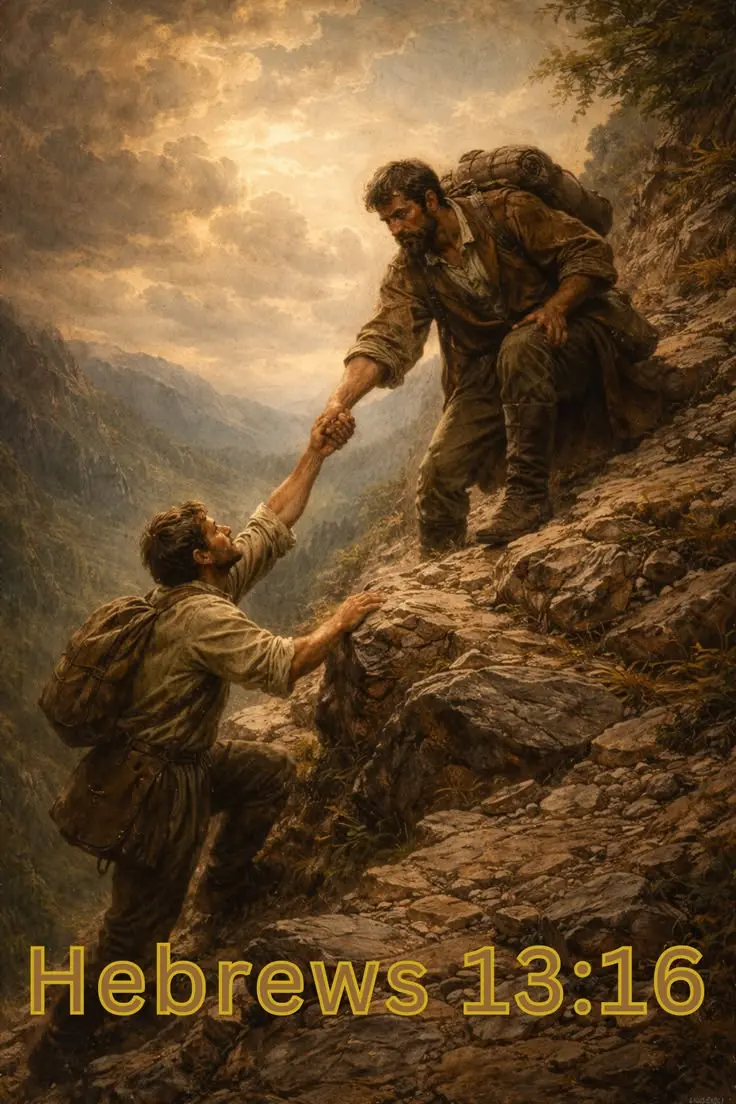
The mountain path, the steep rocks, the heavy packs, and the joined hands all speak to the verse. The help is not decorative. It happens mid-climb, with danger still around them and the summit not yet reached. The light breaking through the clouds does not remove the rough ground. It shows mercy entering the hard place through a human hand. For the grieving heart, that is often how doing good feels: costly, timely, practical, and pleasing to God.
Biblical Insight
Hebrews 13 comes at the end of a letter written to believers under pressure. The chapter contains practical commands: keep loving one another, show hospitality, remember prisoners, honour marriage, avoid the love of money, remember leaders, and bear disgrace with Christ. The faith described in Hebrews is not merely inward conviction. It becomes visible in endurance, worship, obedience, and practical love.
Hebrews 13:16 says, “And do not forget to do good and to share with others, for with such sacrifices God is pleased.” The wording is sober. “Do not forget” implies that believers can forget. Pressure can narrow the heart. Grief can make survival feel like the only task. Fear can make people hoard strength, time, attention, money, or compassion. The verse calls Christians back to visible goodness and shared life.
“Do good” is broad, but it is not vague. It means active mercy, practical obedience, and concrete care. “Share with others” points to generosity, mutual support, and refusing to live as if your resources, strength, or time exist only for yourself. In the life of the church, this includes helping those in need, encouraging the weak, supporting the burdened, and remaining attentive to others even when life is difficult.
The verse calls these acts “sacrifices.” That matters. Christian help can cost something. It may cost time, comfort, money, emotional energy, convenience, or pride. The person giving help may have to bend down from their own position. The person receiving help may have to admit need. This is not the sacrifice that atones for sin; Christ has offered Himself once for all. But it is a sacrifice of worshipful obedience, pleasing to God because it flows from faith and love.
This verse does not mean a grieving person must ignore their limits and serve until they collapse. Scripture does not command self-destruction. Doing good and sharing with others must be held together with wisdom, rest, truth, and honest capacity. Sometimes the good you can do is small. Sometimes you are the one who needs help. Both realities can exist in the Christian life.
It also does not mean every request deserves the same answer. Some needs are real; some demands are manipulative. Some help is wise; some help enables harm. Christian generosity does not cancel discernment. The verse calls believers to remember goodness and sharing, not to abandon judgment.
For Christians dealing with grief, Hebrews 13:16 matters because grief can isolate both giver and receiver. The wounded may withdraw because need feels shameful. The surrounding community may hesitate because they do not know what to say or do. This verse cuts through hesitation by making goodness practical. Reach down. Share what you can. Receive the hand that is offered. Let love take visible form.
God is pleased with such sacrifices. That means ordinary acts of help are not spiritually small. A meal, a ride, a call, a prayer, a bill paid quietly, a shared burden, a hand extended on dangerous ground — these can become offerings before the Lord. Not grand. Not showy. But faithful.
In Application
- Look for one concrete way to do good where grief has made someone’s path harder.
- Share from what you actually have: time, attention, prayer, practical help, money, strength, or presence.
- Receive help without treating need as shame; sometimes you are the one reaching up from the rocks.
- Use discernment, but do not let fear, grief, or inconvenience make you forget mercy.
Practical Journaling
Reflect on Hebrews 13:16, then write honestly:
- Where do I feel like the person lower on the mountain, needing a hand but reluctant to reach up?
- Who near me may need practical help on difficult ground, not just kind words?
- What sacrifice of doing good or sharing would please God without destroying my own limits?
- Where has grief made me forget mercy, generosity, or the needs of others?

Follow on Medium for More Studies
If writing feels too heavy today, ask God to show you one hand to receive or one hand to extend.
The Faith Recovery Journal explores this and many similar topics for Christians facing grief, loss, and recovery.