
Jeremiah 29:11 — Grief in an Uncertain Future
Hope When the Future Feels Closed
"'For I know the plans I have for you,' declares the Lord, 'plans to prosper you and not to harm you, plans to give you hope and a future.'"
— Jeremiah 29:11
Reflection
There are times when the future does not feel open. Grief can make tomorrow look like a room you do not want to enter. You may still sit in church, still keep Scripture near, still fold your hands in prayer, and still feel as if life has narrowed around one absence, one loss, one unanswered question.
That is the emotional centre of this verse for a grieving Christian: not easy optimism, but hope spoken to someone still sitting in sorrow. The woman is not celebrating. She is not smiling through the pain. She is bowed in the place where faith and exhaustion meet.
Start with the free sample
No email. No signup.
Jeremiah 29:11 has often been used too lightly, as if it were a quick guarantee that life will soon become pleasant. But the original promise was given to people in exile. They were not standing at the edge of immediate relief. They were displaced, wounded, and living with a future they did not choose.
That makes the verse stronger, not weaker. God’s word of hope came to people who could not fix their circumstances quickly. The promise did not deny exile. It told them that exile did not have the final authority over their future.
Hope is not shallow because the waiting is long.
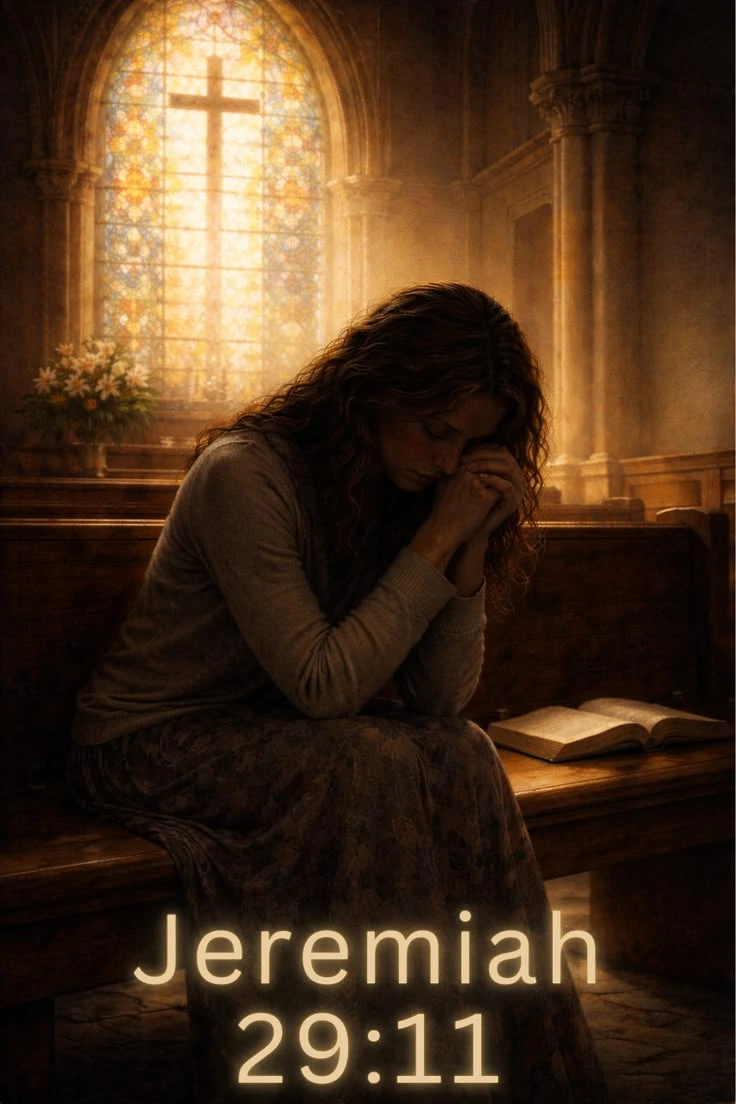
The bowed woman, the open Bible, the empty pew space, and the glowing cross-shaped window all belong together. Her grief is not hidden, but neither is she sitting in total darkness. The light behind her does not erase the heaviness of her posture. It gives the scene its deeper meaning: God’s promise can stand behind the grieving believer even when the heart is still bent low and the future still feels unreadable.
Biblical Insight
Jeremiah 29:11 was spoken to the Jewish exiles in Babylon. False prophets were telling them what they wanted to hear: that their displacement would end quickly. Jeremiah gave them a harder, truer word. They were to build houses, plant gardens, marry, have children, seek the peace of the city, and live faithfully in a place they did not want to be. The exile would not end immediately.
That context matters. This verse is not a blank cheque for personal comfort or quick success. It is not a promise that every painful circumstance will soon reverse. It is not permission to ignore grief, loss, illness, betrayal, or fear because “things will work out.” The people who first received the promise were still in Babylon. The loss was real. The waiting was real. The command to live faithfully under hard conditions was real.
At the same time, Jeremiah 29:11 is not empty encouragement. God says, “I know.” The exiles did not know the full shape of their future, but God did. Their displacement had not made them invisible. Their present distress had not erased His covenant mercy. The Lord spoke of welfare, not harm; hope, not abandonment; a future, not permanent exile.
For a grieving Christian, this matters because sorrow can make the present feel final. The empty chair can feel final. The diagnosis can feel final. The silence after the funeral can feel final. The breakdown of a relationship, a home, or a previous way of life can make the future feel closed. Jeremiah 29:11 does not ask you to pretend that the loss is small. It asks you not to treat the loss as lord.
The verse also corrects impatience with God’s timing. The exiles had to live faithfully while waiting. They had to plant, build, pray, work, and seek peace before they saw restoration. That is not glamorous. It is hard obedience. In grief, faith often looks like that: doing the next necessary thing while still carrying sorrow.
This verse does not promise that every earthly wound will be healed in the way you want. It does not promise that the person who died will return to the table, that every relationship will be restored, or that every sorrow will resolve quickly. Christian hope is deeper than that. It rests in the character of the Lord who knows His people, keeps His word, and refuses to let exile have the final say.
For someone sitting in spiritual exhaustion, Jeremiah 29:11 offers a guarded, serious hope. You may not know how to imagine the future yet. You may not feel able to pray with confidence. You may only be able to sit with Scripture open beside you and your head in your hands. That is still a place where God’s word can speak. The future is not secured by your ability to understand it. It rests in the Lord who knows.
In Application
- Do not use Jeremiah 29:11 to silence your grief; use it to keep grief from declaring the future closed.
- Ask what faithful living looks like in the present place, even if it is not the place you wanted to be.
- When you cannot imagine hope clearly, return to the words “I know” and let God’s knowledge carry what yours cannot.
- Resist quick, shallow interpretations of the verse that demand immediate cheerfulness or easy answers.
Practical Journaling
Reflect on Jeremiah 29:11, then write honestly:
- Where does my future feel closed, damaged, or impossible to imagine right now?
- What part of my grief feels like exile: displacement, waiting, loneliness, fear, or loss of familiar life?
- What would it mean to let God say “I know” over the future I cannot yet understand?
- What is one faithful thing I can do in this hard place without pretending I want to be here?

Follow on Medium for More Studies
If writing feels too heavy today, sit before the Lord and say, “You know the future I cannot see.”
The Faith Recovery Journal explores this and many similar topics for Christians facing grief, loss, and recovery.