
1 Peter 4:10 — Using Your Gifts to Serve Others in Grief
Grace Passed From One Set of Hands to Another
"Each of you should use whatever gift you have received to serve others, as faithful stewards of God's grace in its various forms."
— 1 Peter 4:10
Reflection
Grief can make usefulness feel far away. You may feel emptied out, reduced, and unable to offer much. The things you used to do easily may now take effort. The gifts you once used with confidence may feel buried under fatigue, sorrow, or the simple strain of trying to function.
That is exactly where 1 Peter 4:10 belongs. The verse does not speak of gifts as personal trophies. It says each person should use whatever gift they have received to serve others. Grace is not meant to stop with the person who receives it. It is entrusted, carried, and passed on.
Start with the free sample
No email. No signup.
For the grieving Christian, that can feel difficult. You may not feel gifted. You may feel needy. You may need others to steady you on the ladder or place something warm into your hands. But the verse says “whatever gift you have received.” That leaves room for small gifts, quiet gifts, wounded gifts, practical gifts, and gifts that look unimpressive to everyone except the person who needs them.
Serving others in grief does not mean pretending you are strong. It does not mean ignoring your own limits or making yourself useful so no one notices your pain. It means asking, soberly and honestly, what grace has been entrusted to you today, and how it might serve someone else without denying your own weakness.
Grace received is not meant to die in your hands.
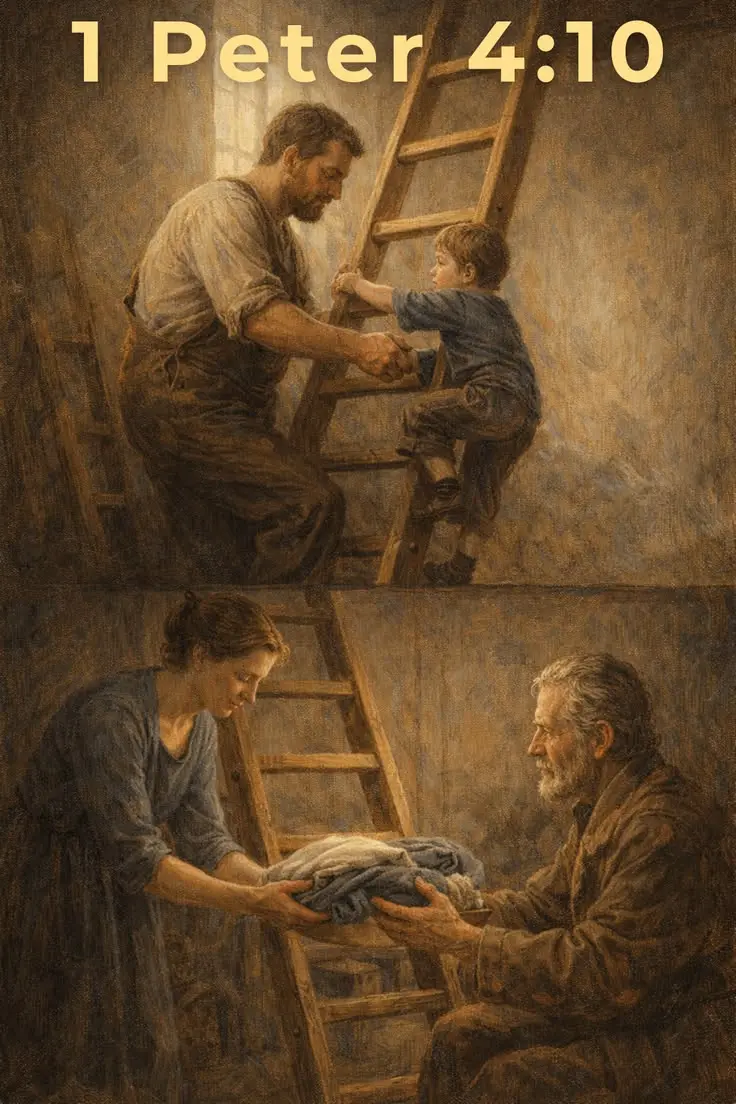
The man steadying the child and the woman handing clothing to the older man show service without spectacle. One gift is protection. Another is provision. Both are ordinary, physical, and needed. The ladders in the room suggest climbing, repair, and support; no one is shown as self-sufficient. For a grieving heart, this matters: even in weakness, grace can still move through your hands, and sometimes you may serve by receiving help with humility before offering it to someone else.
Biblical Insight
1 Peter was written to Christians living under pressure. Peter speaks to believers who are facing suffering, hostility, and the need to live faithfully in a world that does not always honour their faith. The letter calls them to holiness, endurance, humility, sober-mindedness, love, and hope fixed on Christ.
1 Peter 4:10 appears in a section that urges believers to live wisely because “the end of all things is near.” Peter calls them to be alert and sober-minded for prayer, to love one another deeply, to offer hospitality without grumbling, and then to use their gifts to serve others. The Christian life under pressure is not meant to collapse into self-absorption. It remains prayerful, loving, hospitable, and outward-facing.
The verse begins with “Each of you.” That matters. Service is not reserved for the visibly strong, the publicly gifted, the professionally trained, or the emotionally untouched. Every believer has received something from God that can be used in love. The form may vary widely: speaking, organising, cooking, listening, repairing, giving, teaching, encouraging, protecting, writing, visiting, praying, or noticing what others miss.
Peter calls believers “faithful stewards of God’s grace in its various forms.” A steward does not own the gift as a private possession. A steward manages what belongs to another. The gift comes from God, carries His grace, and must be used faithfully. That keeps service from becoming vanity. It also keeps weakness from becoming an excuse to bury everything God has entrusted.
This verse does not mean that grieving Christians must serve beyond their capacity. It does not bless burnout. It does not require you to give what grief has genuinely left you unable to give. Scripture’s call to serve others does not cancel the need for rest, care, recovery, boundaries, and truthful limits. A wounded person may need to receive before they can give.
It also does not mean gifts only matter when they are dramatic. The scene of helping a child climb and handing clothes to an older man captures something deeply biblical: grace often takes practical form. A person may need a steady hand, a clean garment, a cooked meal, a ride, an honest conversation, a repaired door, a prayer, or a quiet presence. These are not small if they carry God’s grace to someone in need.
For a grieving or struggling Christian, 1 Peter 4:10 matters because pain can distort identity. You may begin to see yourself only as the one who has lost, the one who is tired, the one who needs help, the one who has nothing left. The verse does not deny your need. But it also refuses to reduce you to it. You are still a steward. God’s grace has still taken some form in your life.
That can begin very small. You may not be able to serve as before. You may not have the same energy, confidence, or availability. But you may still be able to send one message, pray one honest prayer, make one call, offer one practical kindness, or share one hard-earned comfort with someone else who is climbing badly. Faithful stewardship is not measured by spectacle. It is measured by obedience with what God has actually placed in your hands.
In Application
- Name the gift God has actually entrusted to you, not the gift you wish you had or the strength you no longer have.
- Serve in a way that is faithful and possible, without using service to hide your grief.
- Receive help humbly when you are the one on the ladder or the one needing provision.
- Look for one practical act of grace today: steadying, giving, listening, praying, visiting, repairing, or encouraging.
Practical Journaling
Reflect on 1 Peter 4:10, then write honestly:
- What gift or ability has God entrusted to me that grief has made me overlook or undervalue?
- Where do I need to receive grace through someone else’s service instead of pretending I need nothing?
- What ordinary act of service would match my real capacity today without forcing false strength?
- Who near me needs a steady hand, practical provision, prayer, or quiet encouragement?

Follow on Medium for More Studies
If writing feels too heavy today, ask God to show you one small way grace can pass through your hands.
The Faith Recovery Journal explores this and many similar topics for Christians facing grief, loss, and recovery.