
Hebrews 13:16 — Doing Good Despite Your Grief
Sharing, Though Grief Makes It Hard
"And do not forget to do good and to share with others, for with such sacrifices God is pleased."
— Hebrews 13:16 (NIV)
Reflection
Grief can make even ordinary kindness feel expensive. You may want to care. You may still believe in doing good. But sorrow can drain the strength needed to notice other people, answer messages, prepare food, show up, listen well, or give anything beyond the bare minimum required to survive the day.
That may be beautiful and difficult to look at when your own heart feels heavy. Other people’s gladness can make grief feel more private. Their music can expose your silence. Their community can remind you of the person missing from yours. Hebrews 13:16 does not ignore that cost. It calls doing good and sharing “sacrifices.” God knows that love can feel costly when grief has left you tired.
Start with the free sample
No email. No signup.
Doing good despite grief does not mean pretending you are fine. It does not mean becoming useful so no one notices your pain. It does not mean saying yes to every demand, letting people drain you, or using service to avoid your own sorrow. Christian love is not self-erasure.
But grief can also tempt the heart to shut every door. Pain can make you believe you have nothing left to give. Hebrews 13:16 gently but firmly says otherwise. You may not have much. You may not be able to give what you once gave. But there may still be one small good within reach: a prayer, a message, a meal, a shared memory, a listening ear, a practical kindness, or a quiet act of generosity no one else sees.
God sees the cost of goodness given through grief.
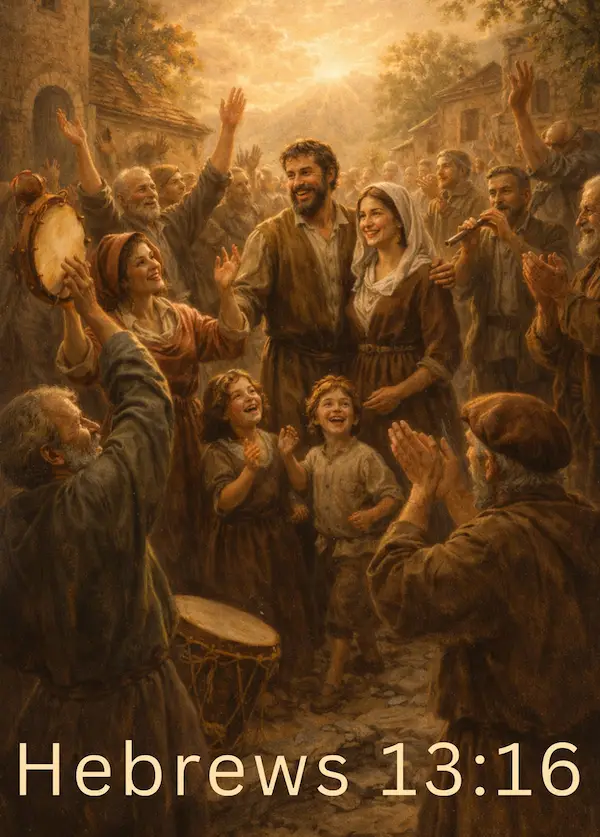
The raised hands, shared music, laughing children, and gathered neighbours show a life where goodness moves outward. No one figure owns the joy. It is carried through the whole community. For someone grieving, the scene does not demand instant cheerfulness. It shows that shared life still exists, and that even a wounded person may re-enter it carefully, offering what little they can without pretending the offering costs nothing.
Biblical Insight
Hebrews 13 comes at the close of a letter written to Christians under pressure. The chapter gives practical commands: keep loving one another, show hospitality, remember prisoners, honour marriage, resist the love of money, remember faithful leaders, and hold fast to Christ. These instructions are not vague moral decoration. They describe Christian faith lived under real strain.
Hebrews 13:16 follows a call to offer God “a sacrifice of praise” through Jesus. Then the writer says, “And do not forget to do good and to share with others, for with such sacrifices God is pleased.” The connection matters. Worship is not only words sung upward to God. It also becomes concrete goodness offered outward to people.
The verse uses sacrificial language carefully. Hebrews has already made clear that Christ’s sacrifice is complete. Christians do not do good to purchase forgiveness, earn salvation, or make themselves acceptable apart from Christ. The sacrifice that saves belongs to Jesus alone. But those who belong to Him now offer their lives in grateful obedience: praise, goodness, sharing, mercy, and costly love.
“Do not forget” is a serious phrase. Forgetting to do good is not always active rebellion. Sometimes fear makes us forget. Sometimes comfort makes us forget. Sometimes grief makes us forget because pain fills the whole room. When you are carrying sorrow, other people’s needs may feel like intrusions. That does not make you wicked. It does mean your heart needs Scripture to call it back outward before grief becomes a locked room.
This verse does not command reckless availability. It does not tell the grieving Christian to ignore exhaustion, accept manipulation, or carry everyone else’s burdens while collapsing privately. Scripture recognises limits. Jesus rested. Elijah needed food and sleep. The body matters. Wisdom matters. Boundaries may be part of faithfulness.
But Hebrews 13:16 does challenge the belief that pain releases us from love altogether. Grief may reduce your capacity, but it does not cancel your calling. The question is not, “How can I return immediately to full strength?” The better question is, “What good can I still do honestly, within the strength God gives today?”
For a grieving Christian, this matters because doing good can keep sorrow from becoming the only active force in the heart. A small act of sharing can reconnect you to the body of Christ. It can remind you that you are not only a wounded person; you are still a brother or sister with something to offer. Not everything. Not endlessly. But something.
The phrase “God is pleased” should steady the weary believer. The Lord is not impressed only by large, visible acts. He sees the quiet sacrifice behind a message sent while grieving, a meal prepared while tired, a prayer spoken through tears, a small gift given when life feels thin, or a moment of attention offered when your own heart aches. Others may not see the cost. God does.
In Application
- Choose one act of good that fits your real capacity today, not the capacity you wish you still had.
- Share something specific: time, food, money, prayer, attention, encouragement, memory, or practical help.
- Refuse both extremes: do not use grief as a permanent wall, and do not use service to pretend you are not hurting.
- Offer the small sacrifice to God, trusting that He sees the cost even when others do not.
Practical Journaling
Reflect on Hebrews 13:16, then write honestly:
- Where has grief made doing good or sharing with others feel harder than it used to?
- What am I still able to give without lying about my limits?
- Where am I tempted either to withdraw completely or to over-serve so no one sees my pain?
- What small sacrifice of love could please God today, even if it feels unimpressive to everyone else?

Follow on Medium for More Studies
If writing feels too heavy today, ask God to show you one small good thing you can do without pretending you are strong.
The Faith Recovery Journal explores this and many similar topics for Christians facing grief, loss, and recovery.