
1 Kings 19:12 — Hearing God's Quiet Voice
In the Still, Small, Quiet Voice
"After the earthquake came a fire, but the Lord was not in the fire. And after the fire came a gentle whisper." — 1 Kings 19:12 (NIV)
Reflection
There are times when the soul expects God to arrive loudly. After grief, shock, exhaustion, or fear, you may look for something dramatic enough to match the scale of your pain. You may want an unmistakable sign, a forceful answer, a visible intervention, or a moment so clear that your trembling heart cannot doubt it.
But grief often leaves you in a cave-like place: withdrawn, watchful, tired, and unsure what to listen for.
Elijah had already seen wind, earthquake, and fire. The Lord was not in them in the way Elijah needed to meet Him. Then came the gentle whisper. That matters for the grieving Christian because pain can make you mistake intensity for truth. You may think God must be absent if He is not dramatic. Scripture shows something more precise: God may come quietly, and the quiet is the mercy.
Start with the free sample
No email. No signup.
If your grief has made everything inside you loud, silence can feel frightening. It can expose the ache you have kept busy enough not to hear. It can make prayer feel empty. It can make you wonder whether God has withdrawn. But 1 Kings 19:12 teaches that quiet is not automatically absence. Sometimes quiet is where the Lord stops competing with the storm and speaks in a way the broken person can actually bear.
The whisper does not mean Elijah’s pain was imaginary. It does not erase his fear, his weariness, or his distorted sense of being alone. God does not flatter Elijah’s despair, but He also does not meet him with spectacle for spectacle’s sake. The Lord’s voice comes with restraint.
God does not have to thunder to be near.
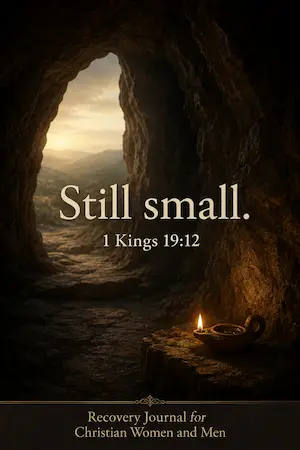
The tiny flame against the cave wall carries the emotional weight of the verse. The deep shadows remain, but the flame is steady. It is not the firestorm Elijah saw before the whisper; it is small enough to draw the eye without frightening the heart. For someone grieving, afraid, or waiting, the scene says this: God’s voice may come without spectacle, and the holy stillness you are avoiding may be the place where you finally hear Him again.
Biblical Insight
1 Kings 19 follows Elijah’s confrontation with the prophets of Baal on Mount Carmel. God had answered by fire, and the false prophets had been exposed. Yet soon after, Jezebel threatened Elijah’s life, and he ran into the wilderness. Under a broom bush, exhausted and afraid, he prayed that he might die. God met him first with sleep, food, and water, then led him to Horeb, the mountain of God.
That context matters. Elijah was not merely having a quiet devotional moment. He was depleted, frightened, isolated, and spiritually strained. He had seen God act with overwhelming power, yet he still collapsed under pressure. The gentle whisper comes not to a relaxed man, but to a prophet whose strength had failed.
At Horeb, Elijah experienced a powerful wind, an earthquake, and a fire. These were dramatic signs, but the text says the Lord was not in them. Then came the gentle whisper. God was teaching Elijah that His presence and speech were not confined to the spectacular. The Lord who can send fire from heaven can also speak with quiet authority.
This verse does not mean God never acts dramatically. Scripture records many moments of unmistakable power. Nor does it mean every inner impression in silence is automatically God’s voice. The gentle whisper must never be separated from God’s revealed character and word. Quiet needs discernment. Stillness needs Scripture. Not every thought that arrives in silence should be treated as divine speech.
It also does not mean that suffering people should be left alone with silence when they need help. Elijah needed food, rest, angelic care, correction, renewed assignment, and the truth that he was not as alone as he felt. God’s whisper did not replace practical care. It came within a larger pattern of mercy.
For grieving Christians, 1 Kings 19:12 matters because sorrow often trains the heart to look only for dramatic rescue. You may want God to break the situation open, reverse the loss, remove the fear, silence the questions, or prove His nearness in a way that cannot be missed. Sometimes He may act visibly. But sometimes He calls you to listen in a quieter register.
The gentle whisper also confronts the exhaustion that demands constant noise. Grief may drive you toward distraction because silence feels too exposed. Yet there are forms of comfort you will not receive while running from quiet. The Lord may use Scripture read slowly, a small prayer, a remembered mercy, a sober conviction, or a still moment where the heart stops arguing long enough to listen.
The verse matters because it shows God meeting a worn-out servant personally. Elijah’s fear was real, but it was not final. His loneliness felt true, but it was not the whole truth. The whisper did not indulge his despair; it drew him back into God’s presence, God’s correction, and God’s continuing work.
For the grieving believer, perfect peace may not arrive as an emotional flood. It may begin as one steady flame in a dark cave: small, quiet, and real. The Lord may not answer every question in the moment you ask it. But He can still speak in the hush after the fire, and His quiet word can steady the heart that has been shaken by too much noise.
In Application
- Stop assuming God is absent simply because He is not answering you dramatically.
- Create one small space of quiet where Scripture, prayer, and honesty can meet without noise.
- Test what you hear in silence against God’s revealed word, not against emotion alone.
- Receive practical care as part of God’s mercy; rest, food, help, and quiet may all belong together.
Practical Journaling
Reflect on 1 Kings 19:12, then write honestly:
- What kind of dramatic answer have I been wanting from God, and why does quiet feel insufficient?
- Where has grief, fear, or exhaustion made my inner life too loud to listen carefully?
- What might one “gentle whisper” look like today: a verse, a conviction, a remembered truth, a prayer, or a moment of stillness?
- What noise, distraction, or fear do I need to set down briefly so I can listen before the Lord?
If writing feels too heavy today, sit quietly for one minute and pray, “Lord, help me hear You in the quiet after the fire.”
The Faith Recovery Journal explores this and many similar topics for Christians facing grief, loss, and recovery.