
Hebrews 13:5 — God Will Not Leave You in Grief
Contentment When Loss Shows You What Cannot Hold You
"Keep your lives free from the love of money and be content with what you have, because God has said, 'Never will I leave you; never will I forsake you."'
— Hebrews 13:5
Reflection
Grief can make security feel fragile. What once looked stable can suddenly look breakable: health, income, home, relationships, routine, confidence, plans, even your own reflection. You may look at your life and feel as if a crack has opened through it, dividing the person you appear to be from the person you feel like inside.
Hebrews 13:5 speaks into that kind of insecurity. It warns against the love of money and calls believers to be content with what they have, not because circumstances are always comfortable, but because God has spoken: “Never will I leave you; never will I forsake you.” The anchor is not what you own. It is the presence of the Lord.
Start with the free sample
No email. No signup.
That matters when grief has made you grasp for control. After loss, money can begin to feel like protection. Possessions can feel like proof that something is still yours. Planning can become a way to avoid the terror of uncertainty. None of those things are evil in themselves. But they cannot promise what only God promises.
Contentment does not mean pretending you have enough emotional strength, money, companionship, or certainty when you plainly feel the lack. It means refusing to make your lack the final truth about your life. The grieving Christian can look honestly at what has been lost and still hear the Lord say, “I will not leave you.”
What you have lost does not cancel the God who remains.
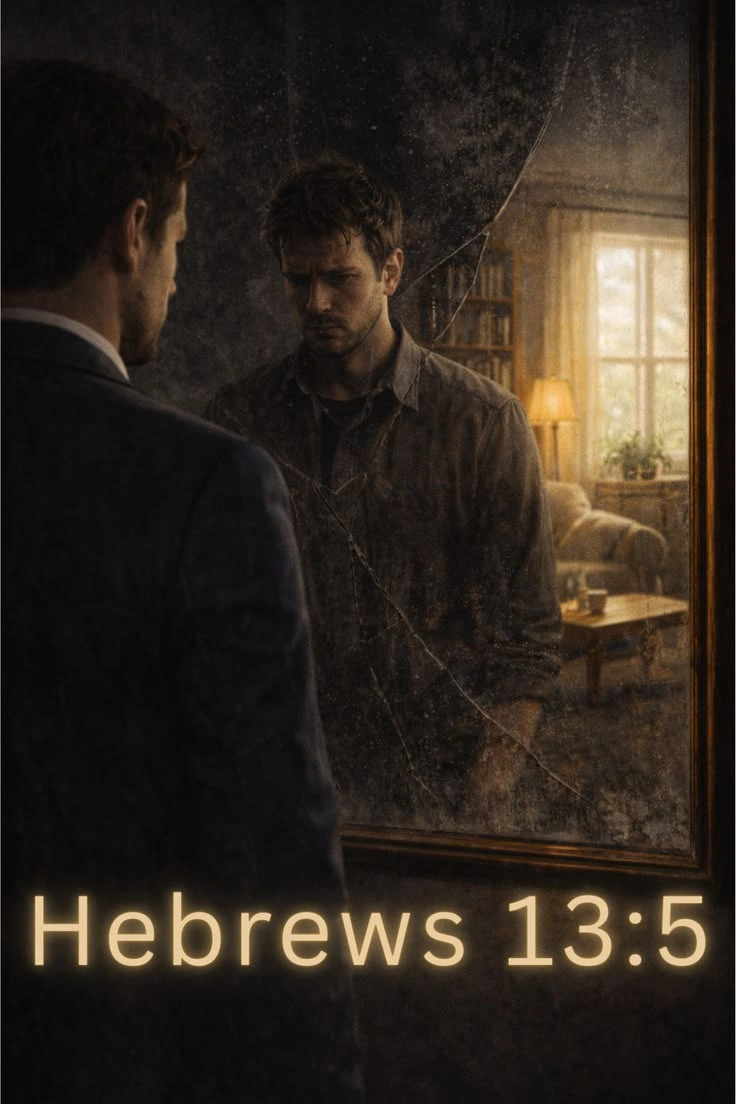
The cracked mirror makes the verse personal. The man is not looking at a bank account or a list of possessions; he is facing a fractured reflection. The warm room behind him suggests ordinary comfort, but the broken glass shows how insecure the heart can feel even inside a furnished life. Hebrews 13:5 speaks directly to that divide: do not build your safety on what can crack, fade, leave, or fail. God’s promise remains steadier than the reflection you can barely face.
Biblical Insight
Hebrews 13 gives practical instructions to believers under pressure. The chapter calls them to love one another, show hospitality, remember prisoners, honour marriage, resist greed, remember their leaders, and remain faithful to Christ. These are not detached moral suggestions. They are commands for Christians learning to live faithfully when life is uncertain and costly.
Hebrews 13:5 joins two matters that often seem separate: money and God’s presence. “Keep your lives free from the love of money and be content with what you have” is not merely financial advice. It exposes the spiritual temptation to seek security in what can be counted, held, stored, or controlled. Money can serve real needs, but the love of money turns provision into a false refuge.
The reason given is crucial: “because God has said, ‘Never will I leave you; never will I forsake you.’” The command to contentment rests on a promise, not on personality, optimism, or denial. God does not simply say, “Be content because you should be stronger.” He anchors contentment in His own presence. He Himself is the reason the believer is not finally abandoned.
This verse does not promise that Christians will never face financial pressure, loneliness, bereavement, illness, or practical need. It does not say that what you have will always feel sufficient in every earthly sense. It does not shame careful planning, responsible work, wise saving, or asking for help. Scripture does not treat poverty, grief, or vulnerability as imaginary.
But Hebrews 13:5 does confront the belief that security can be secured apart from God. In grief, that belief can become especially tempting. Loss teaches you how quickly life can change. The heart then looks for something unbreakable and may wrongly choose money, control, possessions, status, or self-protection. The verse redirects the heart to the Lord’s presence.
For a grieving or struggling Christian, the promise “Never will I leave you; never will I forsake you” matters because grief often feels like abandonment. Someone has died. Someone has left. Someone has failed you. Something dependable has cracked. The verse does not erase those losses. It gives you a deeper truth beneath them: God has not withdrawn Himself from His people.
Contentment, then, is not complacency. It is not passive acceptance of injustice or refusal to act wisely. It is a settled refusal to make lack, fear, or money your master. It says, “I may need help. I may need provision. I may need wisdom. But I am not forsaken.” That is a hard confession when the mirror is cracked, but it is the confession the verse places in your hands.
The promise also speaks to identity. The man in the mirror appears divided between outward presentation and inward damage. Grief can do that. You may look stable while feeling fractured. Hebrews 13:5 does not ask you to trust the image you present or the reflection you fear. It asks you to trust the God who does not leave His people when the glass tells the truth about their cracks.
In Application
- Notice where grief has made you look to money, control, possessions, or planning as your main source of safety.
- Speak honestly about what you lack without turning that lack into the whole truth about your life.
- Return to God’s promise of presence when fear says you have been abandoned.
- Practice one concrete act of contentment today: gratitude, restraint, asking for help, or refusing a fear-driven decision.
Practical Journaling
Reflect on Hebrews 13:5, then write honestly:
- Where does my life feel cracked, divided, or insecure after grief or loss?
- What am I tempted to lean on for safety more than the Lord’s promise to remain with me?
- What does “Never will I leave you; never will I forsake you” confront in my fear today?
- What would contentment look like without pretending my needs, losses, or concerns are small?

Follow on Medium for More Studies
If writing feels too heavy today, pray, “Lord, stay near where fear has made me grasp for safety.”
The Faith Recovery Journal explores this and many similar topics for Christians facing grief, loss, and recovery.