
Kings 19:4 — I Have Had Enough: Exhaustion Before God
God Meets the Worn-Out Heart
"while he himself went a day's journey into the wilderness. He came to a broom bush, sat down under it and prayed that he might die. 'I have had enough, Lord,' he said. 'Take my life; I am no better than my ancestors.'"
— 1 Kings 19:4
Reflection
There is a kind of exhaustion that goes beyond being tired. It reaches the face, the body, the eyes, the will. You are not merely sad. You feel spent. The sentence inside you becomes short and final: “I’m done.” Not because everything has been carefully thought through, but because the weight feels heavier than the strength left to carry it.
That is close to Elijah under the broom bush. He had not simply had a difficult day. He was afraid, isolated, depleted, and done. His prayer was not polished. It was not brave. It was the language of a man who had reached the end of himself: “I have had enough, Lord.”
Start with the free sample
No email. No signup.
This verse must be handled with care. Elijah’s words are serious. He prayed that he might die. Scripture does not turn that into a slogan. It does not mock him. It does not call him useless. It shows a servant of God in collapse, and it shows the Lord meeting him there with practical mercy before giving him more to understand.
For the grieving Christian, that matters. There may be days when the pressure of loss, fear, loneliness, responsibility, regret, or spiritual exhaustion feels unbearable. You may feel ashamed that your faith has not made you sturdier. You may fear that saying “I have had enough” is a failure. But Elijah said it to the Lord. His collapse did not place him outside God’s care.
“I have had enough” can still be a prayer.
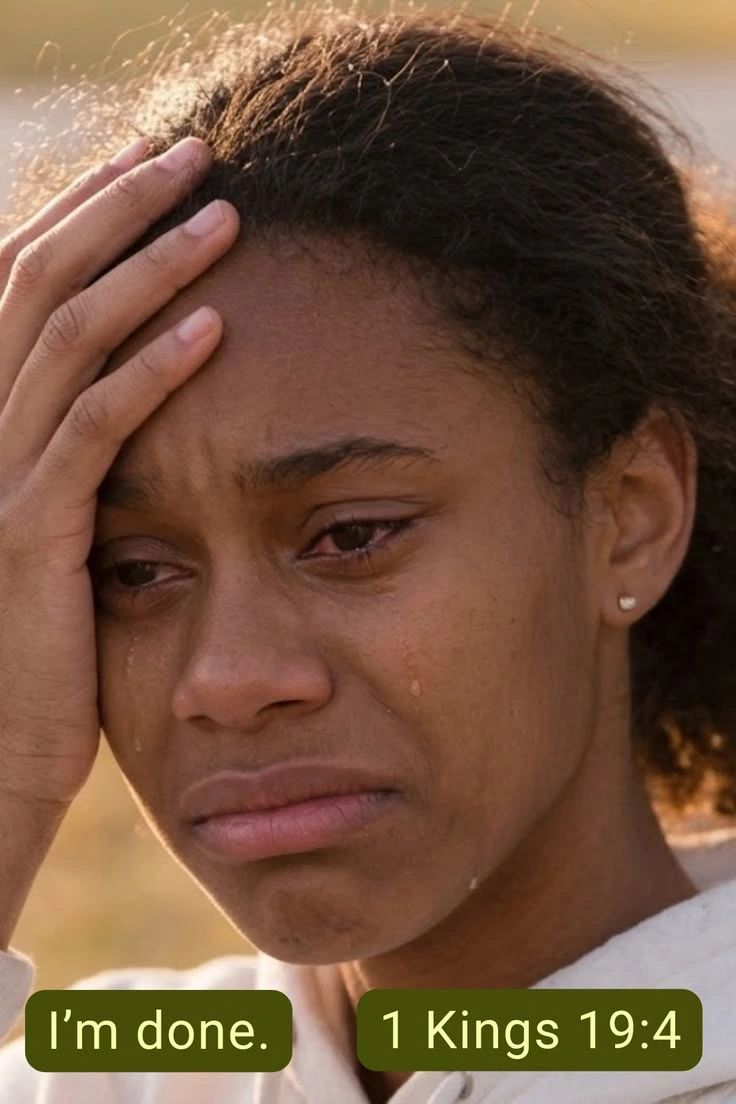
The tearful face, the hand pressed to the forehead, and the words “I’m done” make the emotional meaning plain. This is not mild discouragement. It is the visible strain of someone overwhelmed, frightened, and emptied out. Yet the verse attached to it does not leave the sufferer alone with that sentence. Elijah’s despair was spoken under the hearing of God, and the Lord did not answer first with rebuke. He answered a broken body with sleep, food, water, and patient presence.
Biblical Insight
1 Kings 19 follows Elijah’s confrontation with the prophets of Baal on Mount Carmel. God had answered by fire. The false prophets had been exposed. On the surface, Elijah had just witnessed a dramatic display of God’s power. Yet immediately afterward, Jezebel threatened his life, and Elijah ran into the wilderness afraid.
That context matters because spiritual exhaustion can come after intense obedience, conflict, danger, and strain. Elijah’s collapse did not happen because he had never seen God work. It came after a period of pressure so severe that his body and soul were depleted. He sat under a broom bush and asked the Lord to take his life.
The verse is brutally honest. Elijah says, “I have had enough.” He feels no better than his ancestors. His perspective has narrowed. He is alone in the wilderness, unable to see clearly beyond fear, fatigue, and disappointment. Scripture does not airbrush this. It records the prayer of a prophet who wanted to die.
This does not mean despair is safe or should be romanticised. It is a dangerous place. A person who feels this low needs care, presence, and help. But the Bible’s honesty matters. It tells the suffering believer that God is not shocked by the words that come from the edge. The Lord can hear a prayer that sounds like collapse.
God’s first response to Elijah is also significant. He does not begin with a lecture. An angel touches Elijah and tells him to get up and eat. Elijah sleeps, eats, drinks, sleeps again, and is fed again. The Lord addresses the exhausted body before moving Elijah toward the next stage of obedience and revelation. That is not incidental. Sometimes spiritual despair is tangled with physical depletion.
For a grieving or struggling Christian, 1 Kings 19:4 matters because grief can exhaust the whole person. It can break sleep, drain appetite, disturb the mind, weaken prayer, and make ordinary tasks feel impossible. You may interpret that exhaustion as spiritual failure. Elijah’s story gives a more careful reading. You may be depleted, frightened, and in need of God’s practical mercy.
The verse does not promise that God will remove every burden immediately. Elijah still had to continue. He still had to listen. He still had to be corrected in some of his assumptions. But God did not abandon him under the bush. He came near with provision, patience, and a future word.
It also matters that Elijah speaks to God, not merely to himself. Despair often becomes more dangerous when it turns inward and sealed. Elijah’s words are dark, but they are addressed to the Lord. That is a crucial difference. The prayer is anguished, but it is still prayer. The pain is severe, but it is brought before God.
If you are near that kind of edge, do not stay alone with it. Speak to God, and speak to a safe person. Ask for help. Rest if you are depleted. Eat if you can. Drink water. Let someone know the truth. The Lord who met Elijah under the broom bush is not honoured by you pretending you are fine when you are breaking.
In Application
- Tell God the truth if your real prayer is, “I have had enough.”
- Do not treat exhaustion as proof that your faith has failed; attend to sleep, food, water, and safety.
- Tell one safe person if your thoughts have become dark, frightening, or too heavy to carry alone.
- Take the next small act of care seriously; God may begin with your body before your thoughts become clear.
Practical Journaling
Reflect on 1 Kings 19:4, then write honestly:
- Where am I most tempted to say, “I’m done,” and what has brought me to that point?
- What part of my exhaustion may be physical, emotional, spiritual, or all three together?
- What have I been afraid to say to God because it sounds too dark, weak, or final?
- What is one practical mercy I need today: sleep, food, water, quiet, prayer, company, or help from someone safe?

Follow on Medium for More Studies
If writing feels too heavy today, pray, “Lord, I have had enough; meet me here and help me take the next breath.”
The Faith Recovery Journal explores this and many similar topics for Christians facing grief, loss, and recovery.