
Luke 22:42 — Surrendering to God in Deep Distress
Praying “Not My Will” When You Are Overwhelmed
"'Father, if you are willing, take this cup from me; yet not my will, but yours be done.'"
— Luke 22:42
Reflection
There are moments when obedience does not feel noble or serene. It feels like collapse. You are on the floor emotionally, if not literally. You do not want what is in front of you. You want the cup removed, the pressure lifted, the loss undone, the fear silenced. Yet somewhere in the middle of that struggle, faith still tries to speak.
That matters, because Luke 22:42 is not about easy submission. Jesus speaks these words in Gethsemane, under crushing pressure. He does not pretend the cup is welcome. He asks if it may be taken away. Only then does He say, “yet not my will, but yours be done.” That is not the prayer of someone untouched by anguish. It is the prayer of someone bringing anguish fully into the Father’s presence.
Start with the free sample
No email. No signup.
For the grieving Christian, this verse gives needed permission. You do not have to act as though the cup is light. You do not have to deny dread, sorrow, or resistance. You may tell the Father plainly that you do not want this. Faith is not measured by how little pain you feel. Sometimes it is measured by whether you still turn toward God while feeling all of it.
At the same time, “not my will” is costly. It is not passive resignation and it is not emotional numbness. It is yielded trust offered from inside distress. It says, “I would choose differently if it were up to me, but I place myself in Your hands.” That kind of prayer often comes with tears, fear, and trembling. It is still prayer.
Surrender is often spoken with a breaking voice.
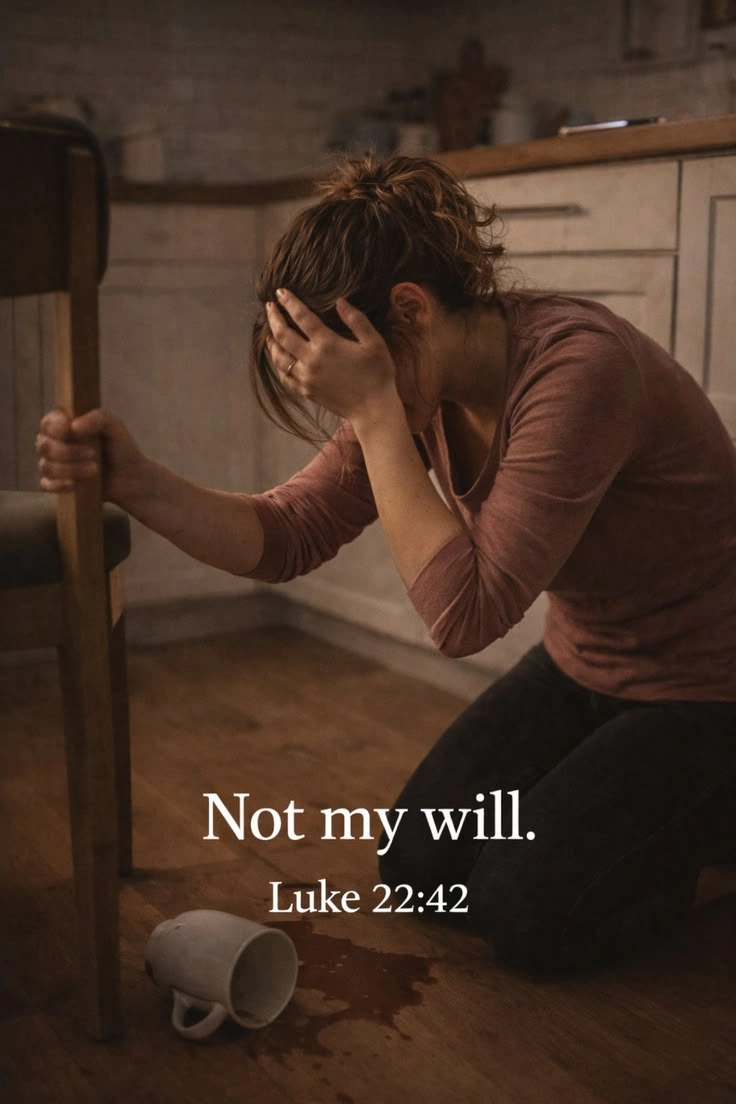
The kneeling figure, the hand over the face, the chair clutched for support, and the spilled mug all work together. This is not theatrical spirituality. It is the look of a person whose strength is giving way in an ordinary room. That makes the verse land harder. “Not my will” is not being spoken from a mountaintop. It is being spoken from the place where life feels messy, heavy, and nearly too much to hold.
Biblical Insight
Luke 22 places Jesus in the garden just before His arrest and crucifixion. He knows what is coming. The “cup” refers to the suffering before Him, including bearing sin and facing the horror of the cross. His prayer reveals both His true humanity and His perfect obedience. He does not deny the dreadfulness of what lies ahead. He names it. He asks whether it may be removed. Then He yields to the Father’s will.
This is important because the verse does not teach that holiness means wanting pain for its own sake. Jesus did not call evil good. He did not pretend suffering was pleasant. He prayed honestly about what He wanted: “take this cup from me.” For a struggling believer, that matters deeply. You may ask God for relief. You may ask Him to remove what terrifies you. That is not disobedience. It is honest prayer.
But the verse also does not reduce prayer to self-expression alone. Jesus does not stop at naming desire. He moves into surrender: “yet not my will, but yours be done.” This is the turning point. Biblical surrender is not pretending you have no will. It is offering your will to God even when it conflicts painfully with what He allows.
Luke 22:42 does not promise immediate emotional peace. In the garden, the suffering was not removed. The cup remained. Surrender did not erase the pain. It aligned Jesus with the Father inside the pain. That is an important distinction. Many Christians fear that if they pray “not my will,” they are simply agreeing to be crushed. The verse is not teaching fatalism. It is teaching trustful obedience under pressure.
For the grieving Christian, this means you may pray both halves of the verse. You may ask for the cup to pass, whether that cup is grief, fear, waiting, conflict, or a burden you cannot carry gladly. And you may also entrust yourself to God when the answer is not the removal you wanted. That does not make sorrow easy. It makes sorrow faced before the Father rather than in defiant isolation.
The verse also guards against shallow ideas of surrender. “Not my will” is not a slogan for suppressing emotion. Jesus was not detached. He was in agony. Real surrender keeps truth and anguish together. It tells God what hurts and still bows. That is why this verse remains so steadying for believers whose obedience feels battered and tearful rather than triumphant.
In Application
- Tell God plainly what you want removed instead of pretending the cup does not frighten you.
- Do not confuse surrender with emotional deadness; honest anguish can still be faithful prayer.
- Identify where you are gripping for support and ask God to meet you there, not only after you feel composed.
- Practice one small act of yielded obedience today, even if your heart is still struggling against it.
Practical Journaling
Reflect on Luke 22:42, then write honestly:
- What is the “cup” in front of me right now that I most want God to take away?
- What emotions rise in me when I think about praying, “not my will, but yours be done”?
- Where does my life currently feel like that kitchen floor moment — overwhelmed, messy, and hard to hold together?
- What would surrendered trust look like for me today, without pretending I am not hurting?

Follow on Medium for More Studies
If writing feels too heavy today, pray, “Father, I do not want this cup, but hold me close as I place it before You.”
The Faith Recovery Journal explores this and many similar topics for Christians facing grief, loss, and recovery.