
Proverbs 17:22 — When Laughter Breaks Through Grief
I needed that.
"A cheerful heart is good medicine, but a crushed spirit dries up the bones."
— Proverbs 17:22 (NIV)
Reflection
Grief can make laughter feel almost suspicious. You may laugh for a second and then feel guilty, as if joy has somehow betrayed the pain you still carry. You may wonder whether a light moment dishonours the person you miss, the wound you live with, or the seriousness of what has happened.
That is the emotional truth of this verse. Sometimes a cheerful heart does not arrive as a grand spiritual breakthrough. It comes as one laugh in a kitchen. One moment when your body remembers how to release pressure. One small mercy that interrupts heaviness long enough for you to breathe. You may not be healed of grief in that moment, but you are not only crushed either.
Start with the free sample
No email. No signup.
Proverbs 17:22 does not mock sorrow. It names the damage of a crushed spirit. That phrase matters. Scripture does not treat inner collapse as imaginary. A crushed spirit can drain strength from the body. It can make food tasteless, sleep thin, conversation difficult, and ordinary days feel physically heavy.
But the verse also says a cheerful heart is good medicine. Not a cure-all. Not denial. Not forced positivity. Medicine. Something received in small doses. Something that helps the person endure. A clean laugh, a warm meal, a kind joke, a gentle absurdity, or a moment of shared relief can be part of God’s ordinary mercy to a tired heart.
Laughter is not betrayal when sorrow has been crushing you.
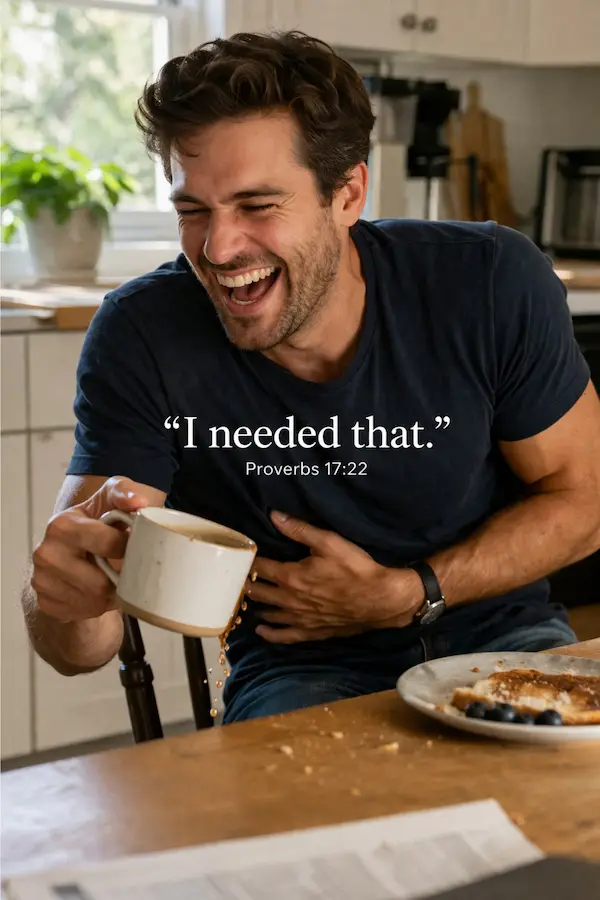
The spilled drink matters because the laughter is not posed or polished. It has interrupted the man’s control. The kitchen, the food, the mug, and the sunlight all make the scene domestic and human, not staged as a religious performance. For someone grieving, that is the point. A cheerful heart may first return through a messy, unexpected moment where you suddenly realise: I needed that. God can use even that small release to keep a crushed spirit from drying up completely.
Biblical Insight
Proverbs gives practical wisdom for living before God in a fallen world. It does not speak in the same way as a promise, law, or narrative. Proverbs often states the general shape of wisdom: how life tends to work under God’s moral order. Proverbs 17:22 gives one of those clear observations about the connection between the inner life and the body.
“A cheerful heart is good medicine” does not mean cheerfulness saves the soul or removes every wound. It recognises that gladness, joy, humour, gratitude, and inward lightness can strengthen a person. The heart and body are not separate machines. What happens inside a person affects how that person bears the day.
The second half is equally important: “a crushed spirit dries up the bones.” Scripture does not shame the brokenhearted for being affected by pain. A crushed spirit has consequences. Long sorrow can exhaust the body. Hidden despair can make someone feel old, brittle, depleted, and inwardly dry. The proverb is honest about that. It does not say, “Just cheer up.” It says the condition of the spirit matters deeply.
This verse must not be weaponised against grieving people. It does not mean you are sinning every time you cannot laugh. It does not mean sadness is failure. It does not mean cheerful people are always spiritually healthier than those who weep. The Bible gives many faithful tears: Job’s anguish, David’s laments, Jeremiah’s grief, Jesus at Lazarus’s tomb, and Christ’s sorrow in Gethsemane.
So the verse does not cancel lament. It gives wisdom about one part of human need. A crushed spirit cannot live on crushing alone. The grieving person needs room for tears, but also room for breath. A laugh does not erase grief, but it may interrupt despair. A cheerful moment does not make the wound fake, but it may keep the wound from becoming the only reality in view.
For a grieving or struggling Christian, Proverbs 17:22 matters because guilt often attacks any return of gladness. You may feel disloyal when you laugh after loss. You may feel that cheerfulness means you are forgetting. But Scripture does not require you to keep your spirit crushed as proof of love. Grief may show that love mattered. Permanent inner drying is not the tribute love demands.
The verse also matters because it encourages ordinary mercy. Not every help comes through dramatic spiritual experience. Sometimes the Lord strengthens a person through a meal, a friend, a joke, a child’s remark, a harmless absurd moment, a shared memory that makes you smile instead of collapse, or a morning when the heaviness loosens for ten minutes. Those moments should not be despised.
Christian joy is not the same as pretending everything is fine. It is rooted in God, but it can appear in simple human forms. The heart may still ache and yet receive a little medicine. That medicine may not cure grief, but it can help the grieving person remain alive to God, to others, and to the goodness that still exists under His hand.
In Application
- Do not punish yourself for laughing; a cheerful moment does not cancel real grief.
- Notice what helps your crushed spirit breathe without leading you into denial, avoidance, or numbness.
- Receive ordinary mercies — food, sunlight, humour, conversation, music, or memory — as small medicine for the heart.
- Let yourself admit both truths: your spirit has been crushed, and God may still give moments of cheer.
Practical Journaling
Reflect on Proverbs 17:22, then write honestly:
- When have I felt guilty for laughing, smiling, or enjoying something since grief entered my life?
- Where do I feel the effects of a crushed spirit in my body, energy, appetite, sleep, or daily habits?
- What small, clean source of cheer has helped me breathe, even briefly?
- What would it mean to receive laughter as medicine without pretending my sorrow has disappeared?

Follow on Medium for More Studies
If writing feels too heavy today, let one honest laugh, smile, or relieved breath count as mercy.
The Faith Recovery Journal explores this and many similar topics for Christians facing grief, loss, and recovery.