
2 Corinthians 12:9 — Finding Strength in Weakness
When Exhaustion Meets Christ's Sufficient Grace
"But he said to me, 'My grace is sufficient for you, for my power is made perfect in weakness.' Therefore I will boast all the more gladly about my weaknesses, so that Christ's power may rest on me."
— 2 Corinthians 12:9
Reflection
Sorrow has a way of stripping away every illusion of personal stamina. When deep loss or prolonged heartache settles into your life, the initial surge of survival adrenaline eventually fades, leaving behind a profound, heavy exhaustion. You find yourself facing daily responsibilities, spiritual expectations, and the raw ache of grief with an empty reservoir. The pressure to appear resilient, to carry the weight without faltering, or to quickly find your footing only deepens the sense of inadequacy.
In those moments of complete depletion, the demand to be strong feels less like encouragement and more like a burden. You may look at your fractured emotional state, your faltering prayers, and your inability to move past the pain, and conclude that your faith is failing. The quiet anxiety that you are not enough for this trial can become as paralyzing as the grief itself, forcing you into a exhausting cycle of trying to manufacture a fortitude you simply do not possess.
Yet it is precisely at the baseline of human insufficiency that the economy of God's grace operates. 2 Corinthians 12:9 shifts the focus entirely away from your capacity to endure and places it squarely on Christ's capacity to sustain. The verse does not offer a formula for bypassing vulnerability; it establishes that your inability to carry the weight is not a barrier to His presence, but the exact place where His strength becomes visible.
Start with the free sample
No email. No signup.
Acknowledging this reality requires a fundamental shift in how we view our limitations during sorrow. It means stopping the agonizing effort to hide our exhaustion from God or to wait until our spirits are recovered before we deem ourselves fit to approach Him. The text invites an honest surrender that ceases the struggle to appear unbroken, allowing the reality of our weakness to be the very ground upon which His mercy rests.
When the illusion of self-sufficiency is finally shattered by the reality of loss, we are left with a choice: to despair over our emptiness or to accept it as the prerequisite for experiencing a sustaining power that belongs entirely to God.
Your inability to carry the weight of this sorrow is the precise place where Christ promises to sustain you.
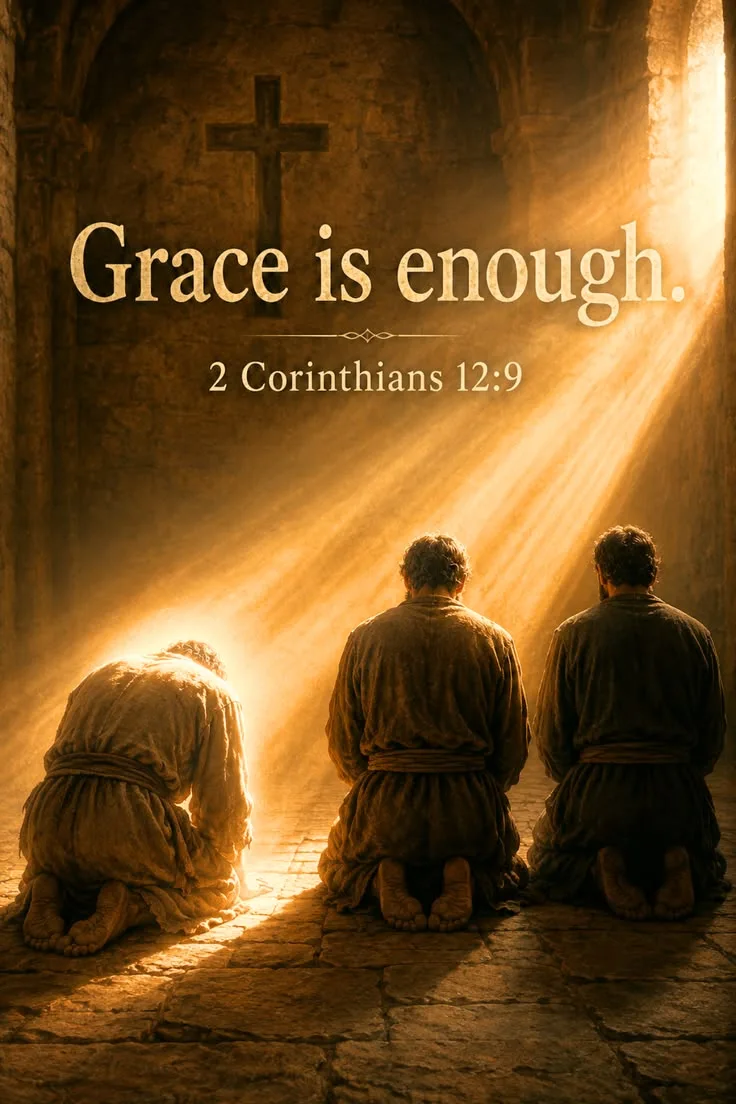
The scene within the stone sanctuary captures this truth with profound solemnity. Three figures clad in coarse, simple robes are positioned on the stone floor, their backs to us, caught in a moment of deep reverence and total reliance. The figure on the far left bows low, hands pressed flat against the ground, shoulders curved under the weight of an unseen burden, while the other two remain on their knees, still and waiting. A singular, intense beam of golden light pierces the dim, ancient space from a high window, cutting diagonally across the darkness to bathe the figures in warmth. High on the stone wall hangs a simple, dark wooden cross, positioned directly beneath the bold text that reads, "Grace is enough. 2 Corinthians 12:9." The mood is one of quiet solemnity, absolute humility, and profound relief—the visual representation of a soul that has stopped striving and has collapsed into the sustaining light of God's sufficiency.
Biblical Insight
In 2 Corinthians 12, the Apostle Paul speaks with extraordinary vulnerability about a profound source of distress—his "thorn in the flesh." He describes it as a messenger of Satan sent to torment him, an affliction so severe that he pleaded with the Lord three distinct times for its removal. Paul did not seek out suffering, nor did he stoically accept it at first; he actively sought relief from a burden that made him feel painfully limited and inadequate for his calling.
The divine response Paul received did not grant the relief he requested. The thorn remained. Instead of removing the affliction, Christ gave him an enduring promise: "My grace is sufficient for you, for my power is made perfect in weakness." The Greek word for sufficient implies a complete adequacy, a defense that is entirely enough to hold a person up, regardless of the severity of the surrounding circumstances.
This verse is often misunderstood as a dismissive platitude, as if God is telling a suffering person that their pain does not matter because they have abstract grace. But in the context of intense sorrow and pleading, the promise is highly specific. It means that God’s unmerited favor and sustaining presence are precisely calibrated to match the depth of the wound. Christ does not promise to erase the reality of the thorn in this life, but He guarantees that the thorn will not be allowed to destroy the soul that relies on Him.
Furthermore, the statement that divine power is "made perfect in weakness" reveals that human limitation is the necessary canvas for God's strength. When we are capable, composed, and uninjured, it is easy to mistake our natural resilience for spiritual maturity. But when grief breaks our natural defenses, any endurance we display is clearly revealed to be the work of Christ. The weakness does not create the power; it creates the vacancy that the power fills.
For the grieving believer, this distinction is vital. The verse does not promise a quick emotional recovery or the restoration of what was lost on this earth. It does not mean your sorrow will suddenly feel light or easy to bear. What it does assure you is that in the very center of your collapse—when you cannot see the next step, cannot control your tears, and cannot find the words to pray—the grace of Christ is actively operating to keep you from falling entirely away from faith.
In Application
- Cease the daily struggle to present an image of emotional or spiritual resilience to God and those around you.
- Identify the specific aspect of your grief that makes you feel most inadequate, and explicitly name it as a place where you need Christ's strength.
- Treat your physical and emotional exhaustion not as a sign of spiritual failure, but as a reminder to rely on a power outside yourself.
- Practice pausing when anxiety rises, reminding yourself that the sufficiency required for today belongs to Christ, not to you.
Practical Journaling
Reflect on 2 Corinthians 12:9, then write honestly:
- Where in my life right now does my own strength feel completely spent and insufficient?
- What am I desperately trying to hold together on my own because I am afraid to admit how weak I feel?
- How does the reality that Christ's power is perfected in weakness change the way I look at my tears and my exhaustion today?
- What would it look like for me to stop fighting my limitations and instead invite Christ's power to rest on my brokenness?

Follow on Medium for More Studies
If writing feels too heavy today, simply record the words, "Lord, my strength is gone; let Your grace be enough for me in this hour."
The Faith Recovery Journal explores this and many similar topics for Christians facing grief, loss, and recovery.