
2 Corinthians 12:9 — When Grace Rests on the Weak
Your Weakness is Upheld by His Perfect Power
"But he said to me, 'My grace is sufficient for you, for my power is made perfect in weakness.' Therefore I will boast all the more gladly about my weaknesses, so that Christ's power may rest on me." — 2 Corinthians 12:9 (NIV)
Reflection
There are times when grief does not leave you standing tall. It bends you. It lowers your head. It drains your strength so thoroughly that even prayer feels like weight. You may still be in the room with others. You may still be trying to do what faith requires. But inwardly you know you are the bowed one.
2 Corinthians 12:9 speaks into that moment with no sentimentality. Paul had asked for relief. He was not pretending not to hurt. He was not celebrating pain for its own sake. He brought his weakness before the Lord, and the Lord answered him with something deeper than removal: “My grace is sufficient for you, for my power is made perfect in weakness.”
Start with the free sample
No email. No signup.
That answer can feel difficult when you are desperate for the burden itself to change. You may want strength to mean quick recovery, relief from pressure, emotional stability, or the return of the person, certainty, or peace you lost. Instead, the Lord says His grace is sufficient. Not theoretical grace. Not decorative grace. Sufficient grace. Enough for what this day requires.
That does not make weakness pleasant. It does mean weakness is no longer wasted. The bowed believer is not disqualified from Christ’s attention. The one who can barely hold it together is not outside the reach of divine power. According to this verse, weakness is not the barrier to Christ’s power resting on you. It is the place where that power is most clearly seen.
Christ’s power does not wait for you to stop being weak.
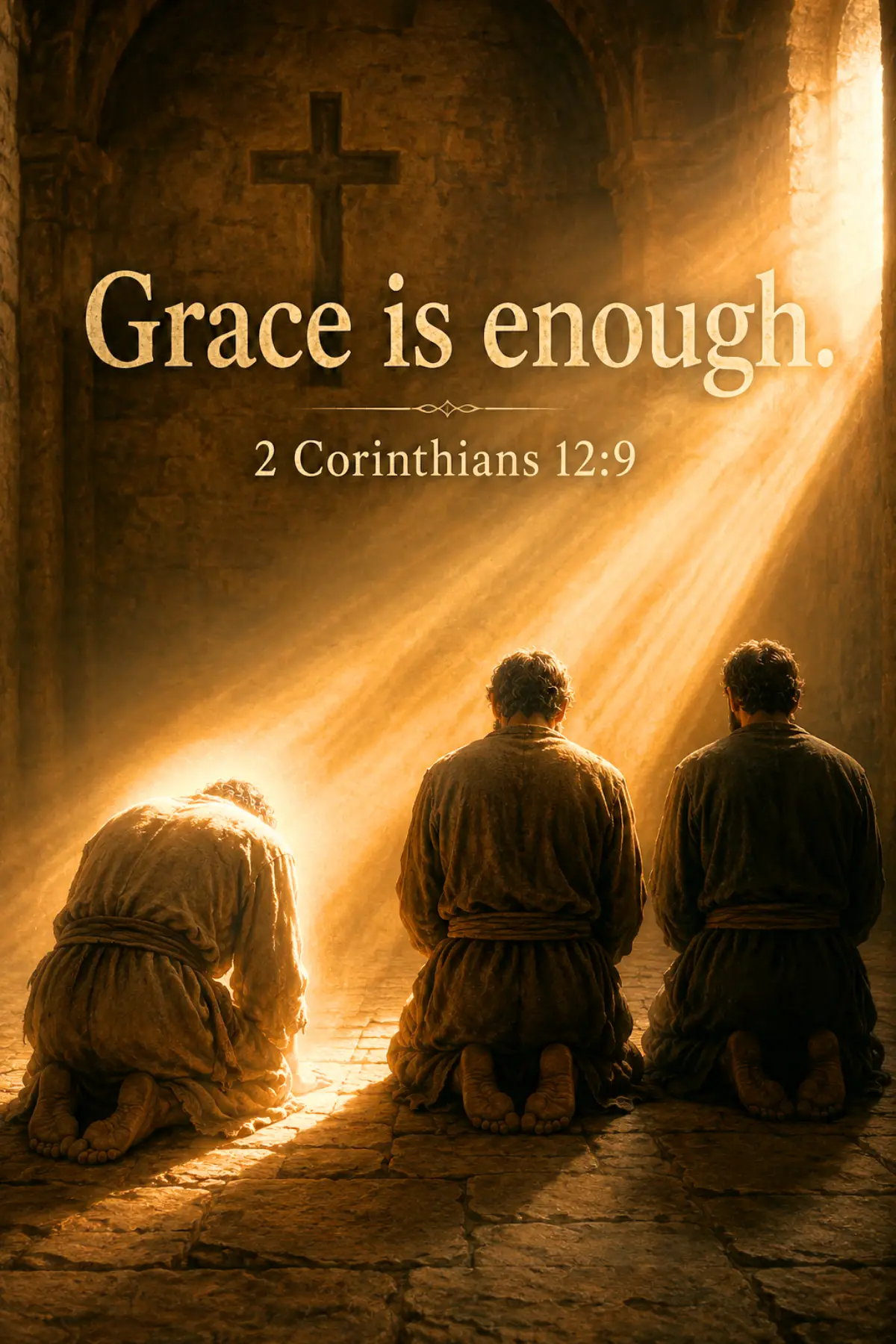
The kneeling figures make the contrast plain. Strength is present in the room, but the brightest mercy falls on the one bowed lowest. The light comes from the right and travels across all three, yet it settles most strongly on the weakest figure, showing that grace is not distributed at random. The rough stone floor and dark background keep the scene solemn and honest. This is not softness. It is the severe comfort of knowing that when grief has bent you low, Christ’s grace can still rest there with particular force.
Biblical Insight
In 2 Corinthians 12, Paul speaks about a “thorn in the flesh,” something painful and humbling that he pleaded with the Lord to remove. He asked three times for it to be taken away. The Lord did not grant the removal Paul requested. Instead, He gave an answer that has shaped Christian understanding of weakness ever since: “My grace is sufficient for you, for my power is made perfect in weakness.”
This verse matters because it refuses two errors. First, it refuses the idea that real faith means never feeling weak. Paul was weak. He admitted it plainly. Second, it refuses the idea that weakness makes a believer useless. Paul learns to speak of weakness differently because Christ’s power rests on him there.
When the Lord says His power is made perfect in weakness, He is not saying weakness itself is good in every sense, or that suffering should be admired for its own sake. He is saying that human inability becomes the stage on which divine sufficiency is more clearly displayed. When self-reliance fails, Christ’s strength is not exposed as inadequate. It is shown to be enough.
This verse does not promise that every painful thing will be removed if you pray long enough. Paul prayed earnestly and still received a “no” to the specific outcome he wanted. It also does not tell you to glorify collapse, neglect care, or refuse help. Grace being sufficient does not cancel rest, wise counsel, friendship, practical support, or the ordinary means by which God sustains His people.
Nor does the verse mean that weakness will feel noble. Grief can bring exhaustion, mental strain, physical heaviness, and spiritual weariness. You may feel embarrassed by how limited you are. You may compare yourself with other believers who seem composed, articulate, or resilient. Paul cuts through that comparison. The issue is not who looks strongest in the room. The issue is where Christ’s power chooses to rest.
For a grieving or struggling Christian, this matters deeply. Loss often exposes how little control you truly have. It strips away the illusion that competence can protect you from sorrow. It may leave you unable to pray with ease, work with focus, or endure with dignity. This verse does not shame that exposure. It tells you that Christ’s grace is sufficient precisely there.
That is why Paul can say he will boast gladly about his weaknesses. He is not boasting in pain itself. He is boasting in the fact that weakness has become a meeting place for Christ’s power. For the Christian in grief, that can mean this: the bent posture, the tears, the mental fog, the inability to carry yourself impressively before others may be the very place where grace proves itself most real.
In Application
- Name the weakness honestly before Christ instead of trying to sound stronger than you are.
- Stop measuring your spiritual state by how upright or composed you appear compared with others.
- Ask specifically for sufficient grace for today’s burden, not only for the burden to disappear.
- Receive help without shame if grief has left you bowed low; dependence is not failure.
Practical Journaling
Reflect on 2 Corinthians 12:9, then write honestly:
- Where do I feel most visibly or inwardly bowed by grief, pressure, or exhaustion right now?
- What have I been asking the Lord to remove, and how have I responded if the burden remains?
- What would it mean for me to believe that Christ’s grace is sufficient at the exact point where I feel least sufficient?
- How might Christ’s power be resting on my weakest place even if I do not feel strong yet?

Follow on Medium for More Studies
If writing feels too heavy today, pray, “Lord Jesus, let Your grace rest on me in my weakness.”
The Faith Recovery Journal explores this and many similar topics for Christians facing grief, loss, and recovery.