
1 Peter 4:10 — Serving Others With the Grace You Still Have
Grace Passed From One Set of Hands to Another
"Each of you should use whatever gift you have received to serve others, as faithful stewards of God's grace in its various forms."
— 1 Peter 4:10
Reflection
Grief can make you question whether you still have anything useful to offer. You may feel reduced by loss, tired by sorrow, or unsure where your old strengths have gone. The things you once gave freely may now feel heavier. Serving others can feel complicated when your own heart is still trying to stand.
The scene shows service in quiet, practical form. At the top, a man steadies a child climbing a wooden ladder, one hand holding the child’s hand while the child reaches upward. Below, a woman offers folded clothing to an older man seated in front of her. The room is warm, worn, and simple. The ladder runs through the centre, connecting the two acts of care. Large text at the top reads “1 Peter 4:10.” The emotional meaning is clear: grace is being handled through ordinary human hands.
That matters for a grieving Christian. 1 Peter 4:10 does not say, “Use the gift you wish you had.” It says, “Use whatever gift you have received.” The wording is mercifully specific. You are not asked to become someone else. You are not asked to serve beyond the grace given to you. You are called to steward what you have actually received, even if grief has changed your capacity.
Start with the free sample
No email. No signup.
Service after loss may look smaller than it once did. It may be one message instead of a long visit. One meal instead of a month of help. One prayer instead of a confident speech. One task done quietly in the background. But small does not mean false. Faithful stewardship is measured by obedience, not display.
This verse also keeps service from becoming self-erasure. The gift is received from God, stewarded before God, and used to serve others. That means you are not the source of grace. You are not the saviour. You are not required to pour from nothing. You are called to pass on what has been entrusted to you.
Grief may change your capacity, but it does not cancel your stewardship.
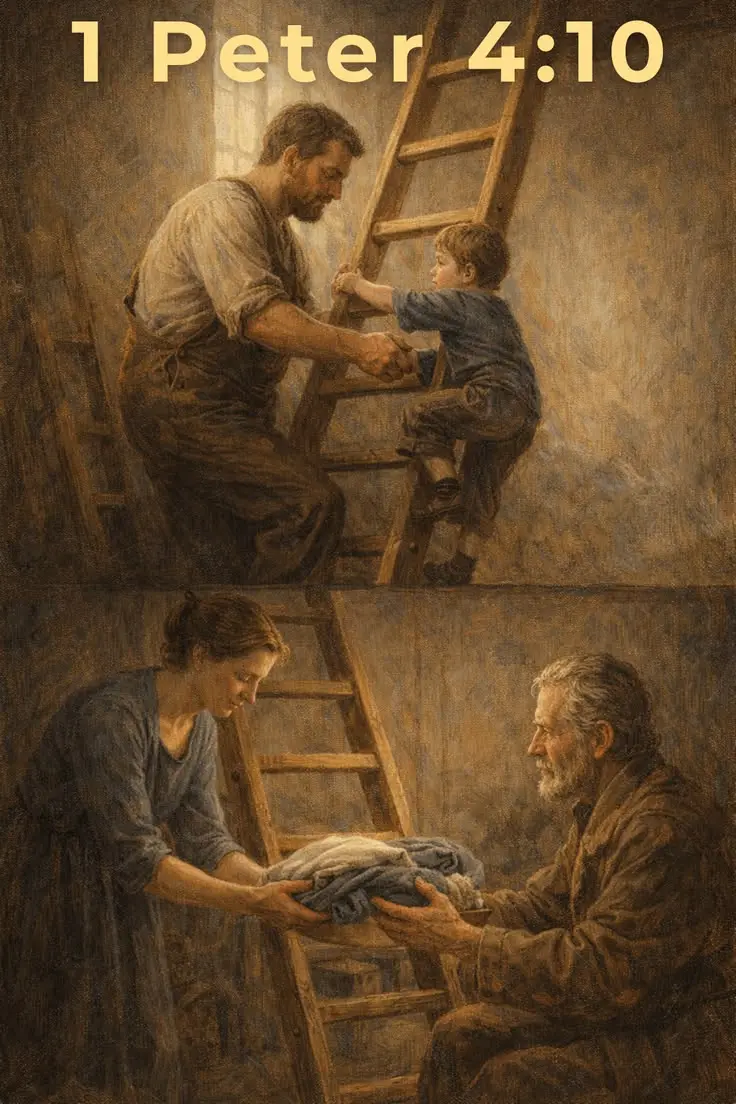
The ladder, the child’s reaching hand, the man’s steadying grip, the folded clothes, and the older man’s receiving hands all point to grace moving through ordinary service. No one is performing on a stage. No one is doing something spectacular. The scene shows help offered at the exact point of need: a child needs steadying, an older man needs clothing, and both receive care through someone else’s hands. For someone grieving, this is important. Your gift may be quiet, practical, and limited, but it can still become a form of God’s grace to another person.
Biblical Insight
1 Peter was written to Christians living under pressure. Peter speaks to believers who are facing trials, suffering, misunderstanding, and the cost of faithfulness. His instruction is not given to comfortable people with unlimited emotional strength. It is addressed to Christians who need endurance, holiness, sober-minded prayer, love, hospitality, and faithful service in difficult conditions.
In 1 Peter 4, the apostle says that the end of all things is near, so believers should be alert and of sober mind for prayer. He then calls them to love one another deeply, offer hospitality without grumbling, and use their gifts to serve others. The context matters. Service is not an optional extra for impressive Christians. It is part of faithful Christian life under pressure.
The phrase “whatever gift you have received” is important. Peter assumes that gifts are received, not self-invented. They come from God’s grace. They may include speaking, serving, practical ability, hospitality, wisdom, encouragement, prayer, generosity, administration, mercy, or quiet faithfulness. The forms vary, but the source is God.
Peter calls believers “faithful stewards of God’s grace in its various forms.” A steward manages what belongs to another. That means the gift is not mainly about personal identity, attention, or self-expression. It is entrusted for use. God’s grace comes in various forms, and believers are responsible to handle that grace faithfully for the good of others.
This verse does not mean every grieving Christian must serve in the same way as before. It does not demand constant availability, public ministry, emotional performance, or overextension. It does not glorify burnout. Scripture recognises weakness, tears, rest, and the need to receive care. A wounded believer may need to accept help before giving much help.
But the verse also refuses the lie that grief makes you useless. Sorrow can shrink your sense of purpose until you believe you have nothing left but pain. 1 Peter 4:10 says otherwise. If you are in Christ, grace has been given to you. That grace may now be expressed differently, more quietly, or in smaller ways, but it is not meaningless.
For a grieving or struggling Christian, this matters because serving others can reconnect vocation to humility. You do not serve to prove you are healed. You do not serve to silence your own pain. You do not serve so that others will admire your strength. You serve because God has entrusted some form of grace to you, and another person may need that grace in a form you can offer.
The verse also protects the receiver. In the scene, the child and the older man both receive help. Christian life includes both giving and receiving. Today you may be the person steadying someone else. Tomorrow you may be the one needing a hand on the ladder. Both positions belong within the household of grace.
That is why 1 Peter 4:10 matters in grief. It gives dignity to small faithfulness. A folded garment, a steady hand, a quiet prayer, a practical errand, a word of encouragement, a skill used gently, a meal shared, a memory honoured — these can all become ways God’s grace reaches another person. Not because you are whole in yourself, but because grace has been entrusted to human hands.
In Application
- Identify the gift you still have today, not the gift you wish grief had left untouched.
- Serve within your real capacity; faithfulness does not require pretending you have unlimited strength.
- Look for one practical need near you where your received grace can become useful love.
- Allow yourself to receive help as well as give it; stewardship does not mean never needing care.
Practical Journaling
Reflect on 1 Peter 4:10, then write honestly:
- What gift, ability, habit, or form of care has God entrusted to me, even in grief?
- How has sorrow changed the way I am able to serve others?
- Where am I tempted either to withdraw completely or to over-serve so I do not have to face my own pain?
- Who near me may need one small act of grace that I can honestly offer today?

Follow on Medium for More Studies
If writing feels too heavy today, ask God to show you one gift you still have and one person who may need it.
The Faith Recovery Journal explores this and many similar topics.