
Psalm 23:1 — The Lord is my shepherd
Where He leads, I will follow, though it hurts
"The Lord is my shepherd, I lack nothing."
— Psalm 23:1 (NIV)
Reflection
Grief can make lack feel like the loudest truth in the room. Someone is missing. A voice is missing. A familiar pattern is gone. The future feels less certain. The heart looks at what has been taken and struggles to hear the words, “I lack nothing,” without flinching.
Psalm 23:1 is not a claim that the grieving believer feels no absence. It is a confession of who the Lord is. “The Lord is my shepherd” comes before “I lack nothing.” The lack is answered first by relationship, not by circumstance. David does not begin with what he has in his hand. He begins with the One who has him in His care.
Start with the free sample
No email. No signup.
That matters when you are being led through places you would never have chosen. You may not want the path ahead. You may not feel ready to move through the gate. You may look at the pasture and still remember the valley. Faith does not require you to call pain pleasant. It calls you to recognise the Shepherd even when His leading hurts.
“I lack nothing” does not mean every longing disappears. It does not mean every earthly need is already resolved. It means the Lord Himself remains the sufficient Shepherd of His people. The grieving heart may still ache, but it is not ownerless, unguided, or abandoned.
Your loss is real, but it must not become your shepherd.
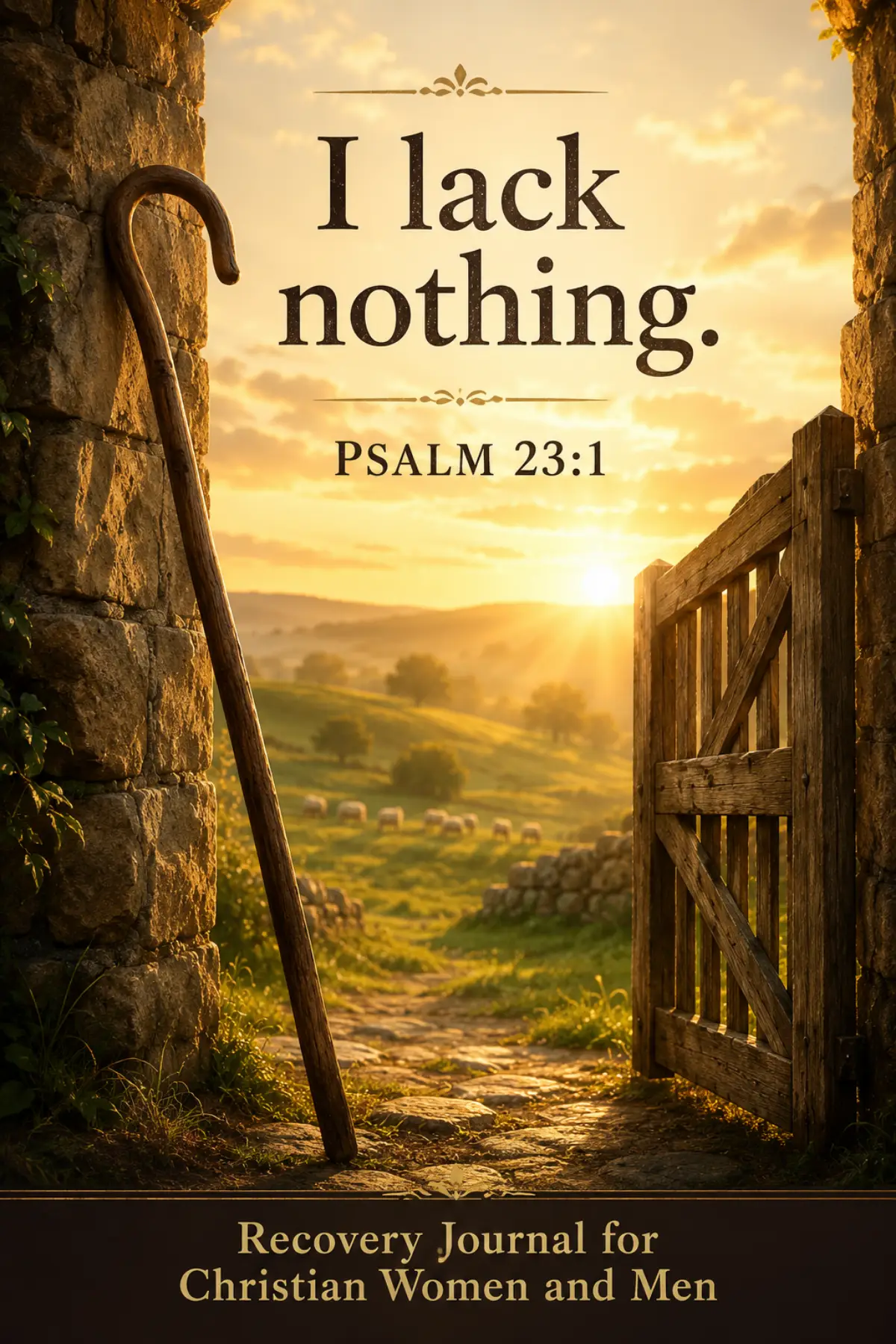
The wooden staff, the open gate, the green pasture, and the sunrise all point to provision that comes under guidance. The staff does not sit beside a closed wall; it rests where the way opens. For someone grieving, afraid, or unsure how to continue, the scene says this: the Shepherd is present at the threshold. You may not know the pasture yet, but you are not being asked to lead yourself into it.
Biblical Insight
Psalm 23 begins with one of Scripture’s most personal confessions: “The Lord is my shepherd.” David knew the work of a shepherd. Sheep need guidance, protection, pasture, water, correction, and care. They are not built to live safely by independent brilliance. They flourish under faithful oversight.
By calling the Lord his shepherd, David places himself under God’s care. This is not vague comfort. It is covenant trust. The Lord leads, provides, restores, guides, protects, prepares, anoints, and keeps. The rest of the psalm unfolds from this opening claim. Green pastures, quiet waters, restored soul, right paths, valley, rod, staff, table, oil, goodness, mercy, and the house of the Lord all flow from the Shepherd’s care.
The words “I lack nothing” must be read in that light. David is not saying he has never suffered, never feared, never needed help, or never passed through danger. The same psalm speaks of the darkest valley and enemies. The confession does not deny trouble. It declares that because the Lord is his shepherd, David is not ultimately deprived of what he needs to be kept by God.
This matters for grieving Christians because grief often turns attention toward absence. That is understandable. Loss creates real lack at the human level. The chair is empty. The phone does not ring. The familiar companionship is gone. The routines have been torn open. Scripture does not ask you to pretend those losses are imaginary.
But Psalm 23:1 speaks beneath those losses. It does not say, “Nothing has been taken.” It says, “The Lord is my shepherd.” That confession changes the deepest question. Not, “Do I feel no lack?” but, “Who shepherds me in the place where lack feels unbearable?”
The verse does not promise that following the Shepherd will always feel gentle. Sheep may be led away from unsafe places they still understand, through paths they would not choose, and toward provision they cannot yet see. The Shepherd’s care can include restraint, correction, waiting, and movement. Comfort does not always mean being left exactly where you are.
It also does not mean you should refuse practical help because “I lack nothing.” The Shepherd often cares for His people through ordinary means: other believers, wise counsel, food, rest, medical care, financial help, truthful conversation, and daily provision. Saying “I lack nothing” is not a command to ignore need. It is a refusal to interpret need as abandonment.
For a grieving believer, this verse matters because it gives identity before emotion. You may feel lost, but you have a Shepherd. You may feel deprived, but you are not outside His care. You may feel afraid of the open gate, but the staff stands there as a sign of guidance. The Lord does not merely point toward pasture. He leads His sheep.
In Application
- Name the specific lack grief has made most painful, and bring it honestly before the Shepherd.
- Do not force “I lack nothing” to mean “I feel no loss”; let it mean “the Lord still shepherds me here.”
- Ask where God may be leading you through an open gate you are afraid to enter.
- Receive practical care without shame; the Shepherd often provides through people, rest, wisdom, and help.
Practical Journaling
Reflect on Psalm 23:1, then write honestly:
- What loss or fear makes it hardest for me to say, “I lack nothing”?
- Where do I need to remember that the Lord is my Shepherd before I assess what I lack?
- What open gate am I standing before, unsure whether I can follow where God leads?
- What form of shepherding do I need today: guidance, protection, correction, rest, provision, or courage?
If writing feels too heavy today, pray, “Lord, shepherd me through the lack I cannot yet understand.”
The Faith Recovery Journal explores this and many similar topics for Christians facing grief, loss, and recovery.