
Psalm 41:3 — What Use is God's Care If He Won't Cure the Illness?
When Care Does Not Bring a Cure
"The Lord sustains them on their sickbed and restores them from their bed of illness."
- Psalm 41:3 (NIV)
*This verse must be handled with care. Psalm 41:3 is not a promise that every illness will be cured immediately in this life if enough people pray with enough faith. If that were so, Christians would not need doctors, nurses, medicine, or hospital beds; they'd only need priests by their bedside. The Lord can heal the sick body in this life, and Christians should pray for that healing with faith. But He may also raise His people fully and finally in the life to come. We do not control the timing, method, or visible outcome of God's healing. We entrust the sick person to Christ, who knows whether His mercy will restore them here, sustain them through suffering, or raise them beyond death.
Reflection
What use is God's care if He will not cure the illness?
It is an uncomfortable question, especially after months or years of pain, weakness, appointments, medication, interrupted sleep, restricted movement, and dependence on other people. A promise of God's care can begin to sound terribly thin when what you want is your body back.
Psalm 41:3 takes us directly to the sickbed. The Lord sustains the sufferer there. The bed has not disappeared. Neither has the illness. God meets a person in the place where strength has already failed.
That distinction matters because prolonged illness can change the question you ask of God. At first, you may pray almost entirely for recovery. Later, another question appears: If I remain ill, will You still hold me?
Start with the free sample
No email. No signup.
The verse answers that question with sustaining care: God can give enough strength for another hour, preserve faith when pain has exhausted emotion, provide people willing to carry practical burdens you once carried yourself, and give courage for another appointment, patience for another night, and sufficient clarity to make the decision immediately in front of you. None of those things is a cure, but they still matter.
Chronic illness can make God's care difficult to recognise because cure is so visible. A scan changes. Pain disappears. Mobility returns. Everyone knows something has happened. Sustaining grace can be quieter. You may recognise it only afterwards, when you realise that something you were certain would destroy you did not.
The word "restores" requires equal care. Restoration may include bodily healing, and Christians have every reason to pray for it. Yet the life of faith cannot depend upon assuming that every sickbed will become an empty bed in this life. God remains sovereign over the form His mercy takes.
This leaves room for a harder kind of trust. You may ask Him boldly for healing while refusing to make your faith conditional upon receiving it. You can tell Him that you hate the illness, fear its future, and want it gone. You can also ask for the grace required if tomorrow looks much like today. There is dignity in that prayer. There is also honesty.
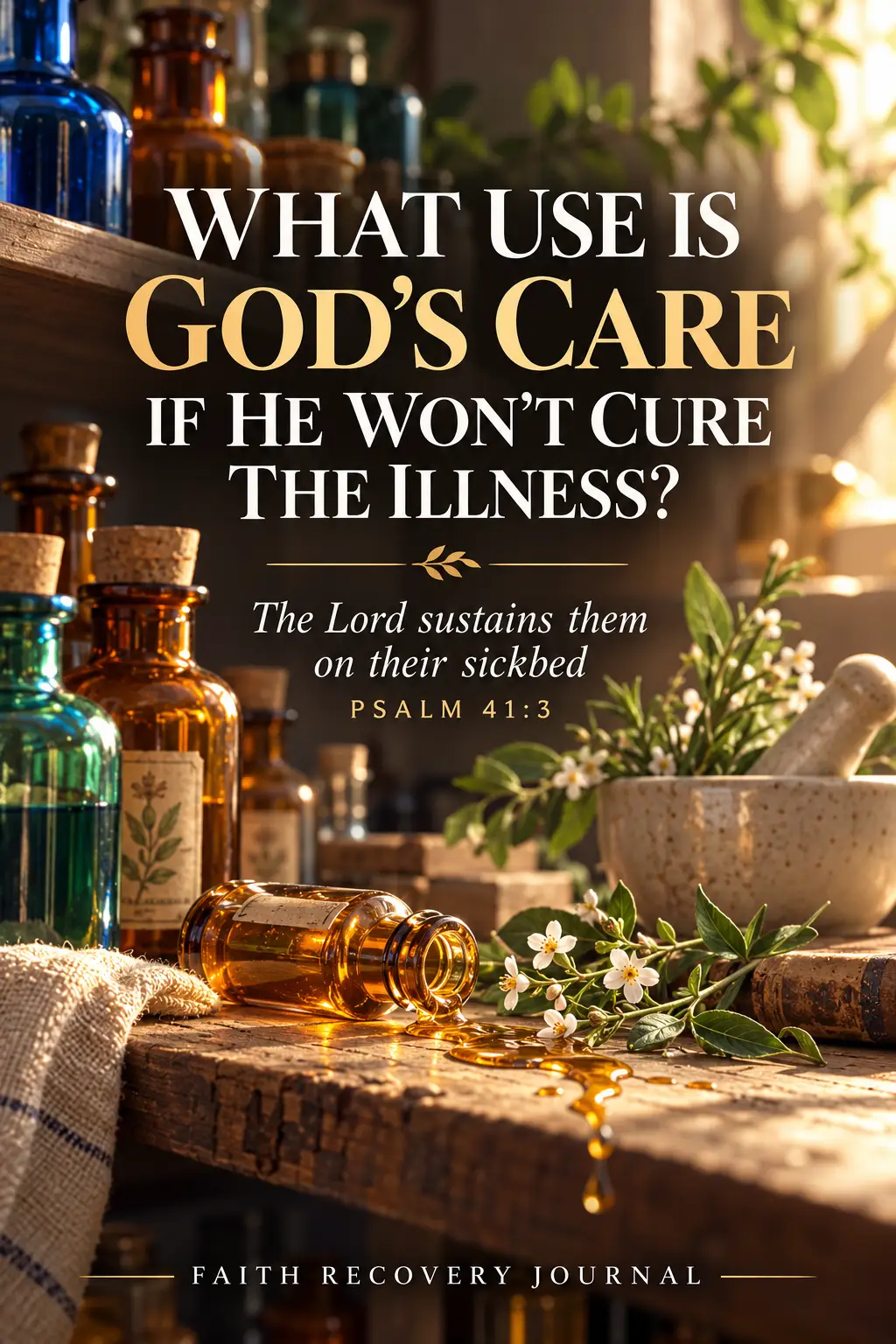
The spilled medicine in the image remains medicine. The bottles, herbs, and mortar belong to the world of attempted treatment, relief, and cure. Yet small flowers are growing among them. The scene reflects how life can continue to appear in places where illness has not disappeared. Psalm 41:3 leaves room for that quieter work of God: sustaining the person who is still sick, preserving what illness has not taken, and allowing grace to grow within circumstances that remain painfully unresolved.
Biblical Insight
Psalm 41 is spoken from inside vulnerability. David knows sickness, enemies, betrayal, and dependence upon God's mercy. The psalm does not treat physical weakness as evidence that God has withdrawn His favour.
The Hebrew verb translated "sustains" carries the sense of supporting, upholding, or maintaining someone who would otherwise fall. That picture is particularly important for chronic illness. The promise centres upon God's active involvement with the weakened person.
The second half of the verse has produced stronger wording in some English translations than in others. That is another reason to resist building a universal doctrine of guaranteed immediate healing upon a single English rendering. The wider biblical witness gives Christians every reason to pray for healing and no warrant to dictate its timing to God.
Psalm 41:3 therefore gives the sick person something substantial to hold. Your condition may alter what you can do, where you can go, how long you can remain upright, and how much help you require. It does not place you outside God's sustaining care.
The Shame Illness Can Create
Long illness can produce a particular kind of shame. You need lifts. You cancel plans. Someone cooks for you, washes for you, waits with you, or changes their own schedule around your limitations. Tasks that once required no thought become negotiations with pain or exhaustion. It is easy to begin interpreting dependence as personal failure.
Psalm 41:3 gives no support to that judgement. The person on the sickbed is precisely the person God is described as sustaining. Needing support places you among the people for whom this promise was written, not among the spiritually defective.
Your life also remains capable of giving. Illness may reduce the forms that giving can take, but a person confined by weakness can still encourage, pray, listen, advise, forgive, comfort, and love. Sometimes those who know most about dependence become unusually attentive to the burdens carried by others.
In Application
- Pray plainly for healing without trying to force certainty about the outcome.
- Ask God what His sustaining care looks like in your circumstances today.
- Notice forms of help you have been tempted to dismiss because they are smaller than a cure.
- Receive necessary care without treating dependence as disgrace.
- Look for one way your present limitations still allow you to encourage someone else.
Practical Journaling
Reflect on Psalm 41:3, then write honestly:
- If your illness continues, what frightens you most about that possibility?
- When you ask God to heal you, what outcome are you imagining?
- Where have you already been sustained in ways you did not initially recognise?
- What kind of help is hardest for you to receive without feeling ashamed?
- What remains available to you for loving or serving someone else?
- What would you like to say to God about the difference between being cared for and being cured?

Follow on Medium for More Studies
Take as much time as you need with these questions. If illness makes writing difficult today, choose one question and hold it before God instead.
The Faith Recovery Journal explores this and many similar topics for Christians facing grief, loss, and recovery.