
Deuteronomy 33:27 — The Everlasting Arms Beneath You
What Holds You When You Cannot Hold Yourself Up?
"The eternal God is your refuge, and underneath are the everlasting arms.
He will drive out your enemies before you, saying, 'Destroy them!'"
— Deuteronomy 33:27 (NIV)
Reflection
You can reach a point where even holding yourself together feels impossible. Not because you are weak in some shallow sense, but because grief has taken more from you than your body, mind, and faith know how to carry. You may still be praying. You may still believe. But you are tired of being upright.
Deuteronomy 33:27 speaks to the part of you that fears there is nothing underneath. The verse does not begin with your strength, your discipline, your emotional stability, or your ability to make sense of the pain. It begins with God: “The eternal God is your refuge.” Before you are told anything about enemies being driven out, you are told where your weight can fall.
That is not a small comfort. Grief often makes the ground feel unreliable. The person who steadied you is gone. The future that had shape has become unclear. The habits that once carried your day no longer work. You may feel as if you are living without a floor beneath you. Scripture answers that fear directly: underneath are the everlasting arms.
Start with the free sample
No email. No signup.
God’s arms are not temporary. They are not fragile. They are not present only when your faith feels strong. The verse does not say, “Underneath are the arms you earned by coping well.” It says the arms are everlasting. They belong to the eternal God, not to your current capacity.
This does not mean you will never shake. It does not mean grief will stop hurting because you quote the verse correctly. It means your collapse is not the deepest reality. Beneath your fear, beneath your exhaustion, beneath the place where your own strength gives out, God has not moved away.
Your weakness is not deeper than God’s hold.
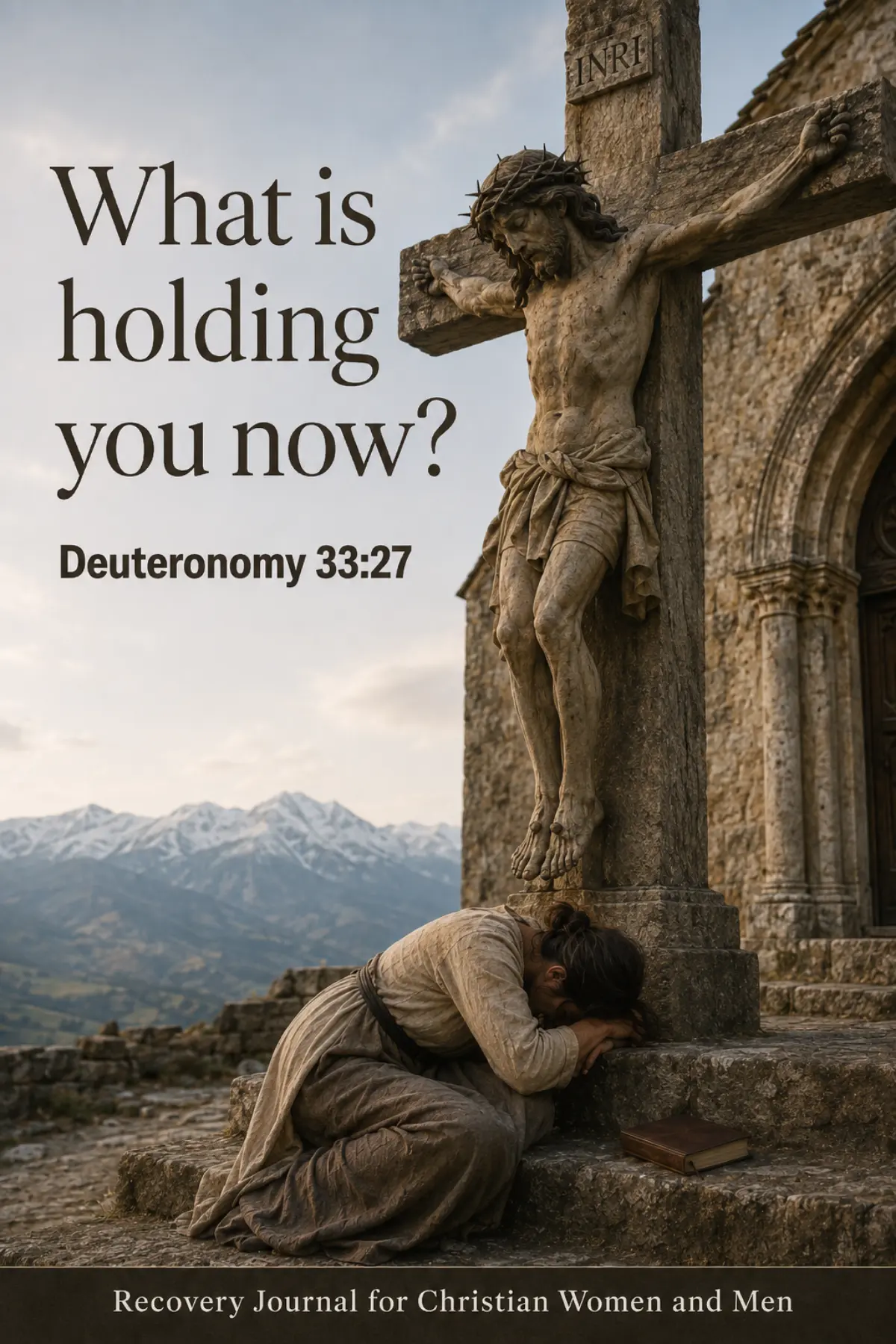
A grieving figure is collapsed at the base of an outdoor crucifix beside an old stone chapel, with a closed book lying nearby, distant mountains behind, and the words What is holding you now? beside Deuteronomy 33:27. The bowed body, the crucified Christ, and the stone beneath the knees all press the same truth into view: when you can no longer hold yourself up, God’s refuge is not abstract, and His everlasting arms are underneath.
Biblical Insight
Deuteronomy 33 records Moses’ blessing over Israel near the end of his life. The people are standing on the edge of a future they cannot control. Moses, the leader who has carried them through wilderness years, will not go with them into the land. They face uncertainty, opposition, memory, failure, and fear. Into that moment comes the blessing: “The eternal God is your refuge, and underneath are the everlasting arms.”
The verse is not spoken into a comfortable setting. It is spoken to people who know what it means to be dependent. Israel has already passed through hunger, thirst, judgement, mercy, wandering, and waiting. They have seen God provide, and they have also seen how quickly fear can overtake them. Moses does not tell them to trust in national confidence, military ability, or emotional courage. He points them to the eternal God.
Calling God “refuge” means He is not merely an observer of distress. A refuge is where the threatened go. A refuge receives weight. A refuge stands between danger and the one who cannot defend himself. For a grieving Christian, this matters because grief often exposes how unsafe life can feel. Loss can make ordinary days feel hostile. Small tasks can feel too large. Silence can feel dangerous. The verse gives a name to the place God offers Himself to be: refuge.
The phrase “underneath are the everlasting arms” is especially tender because it speaks to collapse. It does not picture God only above, commanding from a distance. It pictures God beneath His people, supporting what cannot support itself. The strength of the verse is not that believers never fall low. The strength is that God’s arms are lower still.
The second half of the verse speaks of God driving out enemies before Israel. In its original context, this belongs to God’s covenant action for His people as they enter the land. It should not be twisted into personal revenge language. It does not mean every painful person in your life is an enemy God has authorised you to destroy. It does mean God is not passive toward what threatens His people. He is refuge beneath them and defender before them.
For Christians living with grief, trauma, exhaustion, or spiritual pressure, Deuteronomy 33:27 does not promise an easy life. It does not promise that sorrow will end quickly, that enemies will disappear on your timetable, or that you will always feel carried. It promises something deeper: the eternal God is not temporary shelter, and His support does not expire when your strength fails.
This verse matters because grief asks brutal questions. What is left? Who is here? What holds me now? Deuteronomy 33:27 answers without sentimentality. God Himself is refuge. God Himself is underneath. God Himself is not exhausted by the weight that is exhausting you.
In Application
- Stop pretending you are stronger than you are. Tell God plainly where you feel unable to stand, cope, pray, decide, or continue.
- Use the phrase “underneath are the everlasting arms” as a short prayer when your thoughts are too scattered for longer words.
- Separate God’s refuge from your feelings of safety. You may still feel afraid, but fear does not cancel what God says He is.
- Do not turn the verse into revenge. Ask God to defend, sustain, and deliver you without feeding bitterness toward people who have hurt you.
Practical Journaling
Reflect on Deuteronomy 33:27, then write honestly:
- Where do I feel unable to hold myself up right now?
- What have I been treating as my refuge, and why is it no longer enough?
- What would change if I believed God was underneath me, not merely watching me struggle?
- What fear, enemy, pressure, or memory do I need to place before the God who defends His people?

Follow on Medium for More Studies
If writing feels too heavy today, write only this: Lord, be underneath me where I cannot hold myself up.
The Faith Recovery Journal explores this and many similar topics for Christians facing grief, loss, and recovery.