
Lamentations 3:22–23 — New Mercies in the Midst of Ruin
Why Are You Still Standing When Everything Around You Burned?
"Because of the Lord's great love we are not consumed, for His compassions never fail. They are new every morning; great is Your faithfulness."
— Lamentations 3:22–23 (NIV)
Reflection
You survived something that should have finished you. You know this. You have looked back at the fire, the diagnosis, the funeral, the marriage that ended, the year that gutted you, and you have asked the honest question: why am I still here? Not with gratitude. With confusion. Sometimes with something closer to guilt.
Lamentations was not written by someone who came through unscathed. It was written by a man surveying a city in ashes, a people scattered, a life he no longer recognised. He does not skip the devastation to get to the hope. He names it in detail, at length, before he ever reaches verse twenty-two. The mercy he describes is not offered instead of the ruin. It is offered inside it, on the same ground, in the same breath.
That order matters. If you have been waiting to feel grateful before you are allowed to say you are still standing, you have the sequence backwards. Being consumed and being spared are both real. You do not have to resolve which one defines you before God's compassion counts as true.
Start with the free sample
No email. No signup.
The line "new every morning" is not a promise that the ruin will vanish overnight. It is a promise about the pace God works at. Mercy arrives daily, not all at once. That is a slower rhythm than you want, and it is the one you have actually been given.
You do not need to explain why you are still here. You are allowed simply to notice that you are, and to ask what that means, without forcing it into a tidy answer today.
You were not spared to explain it. You were spared to keep living inside it.
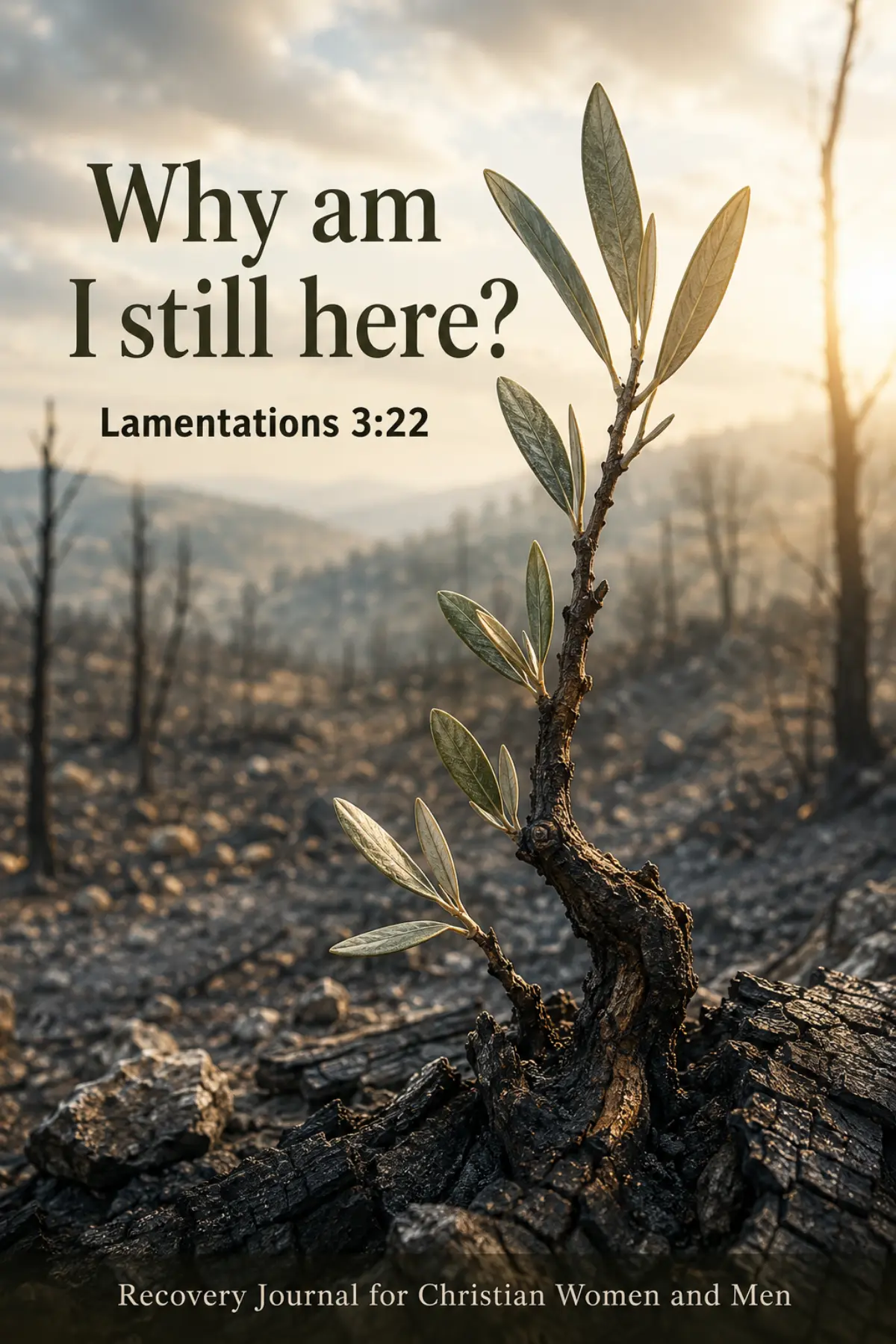
Scorched earth stretches in every direction, blackened trunks standing where a forest used to be, and out of one charred stump a single green shoot climbs toward the light. Nothing about the ground has been undone. The fire happened. The devastation is not staged away or softened. But new growth is rooted in the same burned wood, drawing life from what survived beneath the surface. That is what Lamentations 3:22 is describing: not a landscape restored to how it was, but mercy breaking through the exact place where everything was lost.
Biblical Insight
Lamentations sits in the wreckage of Jerusalem's fall, and its author writes as someone who has lost nearly everything a person can lose: home, temple, community, security. Chapter three moves through raw despair before arriving at verse twenty-two, and the movement is not a resolution of the grief. It is a claim made from inside grief that has not lifted.
"We are not consumed" is a present-tense observation, not a future guarantee. It does not promise that no further loss is coming, and it does not promise the pain will end soon. What it states is a fact about survival itself: something held, when everything else gave way. The verse credits that holding to God's compassion, not to the strength or resilience of the one who endured it.
This matters for a grieving Christian because it removes the pressure to perform recovery as proof of faith. You do not have to feel restored to be within reach of this promise. The promise is for the person still standing in the ash, not the person who has already moved past it.
In Application
- Stop treating your survival as something you need to justify or explain. Let it simply be true, without demanding a reason yet.
- Look for one small mercy that arrived today, not a resolution of the whole loss, just one thing that was new this morning.
- Resist the urge to measure your grief against how quickly others seem to recover. New mercy comes daily, not on a schedule you control.
- Name one thing that is still rooted and alive in you, even if everything visible around it looks burned.
Practical Journaling
Reflect on Lamentations 3:22, then write honestly:
- What has been consumed in your life, and what, against expectation, has not?
- Where have you demanded an explanation for your survival instead of simply receiving it?
- What would one new mercy look like for you tomorrow morning, something small and specific?
- What is still rooted in you that the fire did not reach?

Follow on Medium for More Studies
If writing feels too heavy today, simply say this to God: I do not understand why I am still here, but I am willing to receive whatever mercy is new this morning.
The Faith Recovery Journal explores this and many similar topics for Christians facing grief, loss, and recovery.