
Helping Yourself Through Grief: What Can You Do On Your Own?
There is a surprising amount you can do to help yourself through grief, even when you do not want to talk, cannot afford counselling, have little support around you, or simply need somewhere to begin on your own.
That is not a claim that you should have to cope with everything alone. Grief recovery does not only happen when someone else intervenes - much of it can begin privately, in the things you do to understand what your loss has done to you, make difficult emotions more manageable, preserve what matters, bring your grief before God, and work out what life now requires from you.
For some grieving people, that matters enormously. You may have loving family and friends yet still find that talking to them does not help. You may be tired of explaining yourself, tired of hearing advice, reluctant to expose thoughts that feel too private, angry, confused, or spiritually uncomfortable to say aloud, or you may simply have nobody you trust with that part of yourself.
Helping yourself through grief begins with recognising that private grief work is possible. You do not need to wait until somebody else understands you before you can begin understanding what is happening inside you.
Start by Finding Out What You Are Actually Carrying
Grief can make everything feel wrong at once. That makes it difficult to know what you are supposed to do about any of it.
You may describe yourself simply as "sad", although sadness is only one part of what is happening. Underneath it may be anger, fear, loneliness, guilt, resentment, exhaustion, uncertainty about the future, financial worry, loss of identity, or a growing sense that God has abandoned you.
These are different problems, even when grief has packed them together so tightly that they feel like one. One useful thing you can do on your own is begin separating them.
Instead of asking only, "How do I feel?", try asking what has actually troubled you today. Perhaps waking up alone was the difficult part. Perhaps it was seeing somebody who reminded you of the person you lost. Perhaps you were angry because somebody said something foolish. Perhaps you became anxious while dealing with something your husband, wife, parent, or child used to handle.
The more specific you can become, the more clearly you can see what needs attention. "I feel terrible" gives you very little to work with. Compare that with "I am frightened because I have never dealt with the finances alone", which gives you something concrete, or "I feel guilty every time I enjoy myself", which points to something else again. "I am angry with God because I prayed and the person still died" identifies a different kind of wound entirely.
You do not have to solve each one immediately. Simply telling them apart is already useful because grief becomes harder to examine when every feeling is allowed to remain part of the same dark mass.

Use Writing to Slow Grief Down
Grief journalling is one of the most practical forms of private grief work because it allows you to examine your thoughts without having to explain them to anybody else.
You do not need to be a good writer, write every day, produce paragraphs, keep a chronological record, or turn every entry into something wise. You are using writing to find out what is there.
You can begin with something as simple as:
"What is hurting most today?"
"What keeps returning to my mind?"
"What am I angry about?"
"What am I afraid will happen now?"
"What do I wish I could say?"
"What am I unable to say to God?"
Sometimes the first answer will lead to another one. You may begin by writing that you miss someone and discover that what is troubling you that day is actually fear about living alone. You may write about guilt and eventually realise that you are blaming yourself for something you could not reasonably have known. You may begin with anger towards another person and discover that part of the anger belongs elsewhere.
This does not require a breakthrough every time you write. Grief often repeats itself, so your journal probably will too. What matters is that you are giving yourself somewhere private to examine what keeps returning instead of carrying it all internally.
If you want to understand the process in greater detail, see Grief Journalling - Why and What to Write and Does Journalling Help With Grief? If So, How?.
Start with the free sample
No email. No signup.
Give Your Days Enough Structure to Hold Together
Bereavement can disrupt ordinary life far beyond the emotional pain itself. Sleep changes. Meals become irregular. Concentration becomes unreliable. Tasks that once required little thought suddenly feel unnecessarily difficult.
Some structure can help, provided you do not turn it into another standard against which to judge yourself.
You might decide that certain things need to happen most days: getting dressed, eating something substantial, taking medication if you use it, dealing with one necessary piece of correspondence, going outside if you are able, praying, writing, or contacting somebody you trust.
None of this is meant to produce an impressive routine. Some structure simply keeps grief from quietly dismantling parts of your life that still need maintaining.
It may help to reduce decisions. Eat from a small selection of simple meals for a while. Keep important documents together. Write down appointments instead of trusting memory. Make a short list of necessary tasks rather than repeatedly trying to remember what needs doing.
Grief can impair concentration and memory, so reducing the amount you expect your mind to hold is a practical kindness to yourself.
Learn Your Triggers Instead of Being Ambushed by All of Them
Some grief triggers are obvious. Birthdays, anniversaries, Christmas, funerals, familiar places, photographs, music, and possessions can all bring sorrow sharply back.
Others seem absurdly small until they catch you.
You see the person's favourite food in a supermarket. Their name appears somewhere unexpectedly. You hear a phrase they used. You reach automatically for your phone before remembering that there is nobody to call.
You cannot remove every trigger, nor would avoiding every reminder necessarily help. But you can begin noticing which situations repeatedly affect you and how they affect you.
This is another area where keeping notes can help. You may discover that certain days are consistently difficult, that tiredness makes particular thoughts worse, that one family member reliably leaves you distressed, or that you are avoiding a place because you are frightened of what being there will bring back.
Knowing that does not remove the grief, but it makes some of it less mysterious.
You can then make practical decisions. You might choose not to attend something this year. You might visit a difficult place with somebody rather than alone. You might set aside time afterwards because you know the experience will cost you emotionally. You might also decide that avoiding something has gone on long enough and that you now want to approach it deliberately.
The important thing is that you are making the decision consciously rather than allowing every encounter with grief to take you completely by surprise.
Keep a Relationship With Memory
Helping yourself through grief does not require you to stop thinking about the person you lost.
For many people, part of grief work involves finding ways to remember without every act of remembering becoming unbearable.
You might keep photographs together, write down stories before details fade, preserve letters or messages, cook something associated with the person, visit a meaningful place, mark an anniversary privately, or write about memories as they return.
You can also record details that seem too ordinary to matter until you imagine forgetting them: the way someone laughed, a phrase they always used, the food they disliked, the way they answered the telephone, a ridiculous argument, or something they did that irritated you at the time and is now strangely precious.
Memory after bereavement need not become a shrine in which the person is gradually turned into somebody faultless. Honest memory has room for affection, irritation, gratitude, regret, humour, anger, and contradiction.
That matters because the person you lost was a real person, and the relationship you are grieving was a real relationship.
Deal With Practical Problems as Practical Problems
Grief often arrives with administrative consequences: money, housing, possessions, legal matters, childcare, funeral arrangements, work, correspondence, benefits, accounts, or decisions the person who died would once have helped make.
These problems can become entangled with grief until every task feels emotionally enormous.
Try separating the practical question from everything it represents.
If you need to deal with an account, the immediate task may simply be to find a document or make one telephone call. You do not have to solve your whole future while doing it.
If the house feels impossible to manage, identify the particular thing that needs attention first. Possessions you cannot yet sort through can be left alone unless there is a real reason they must be dealt with now.
There is no prize for making every major decision quickly after a loss — some matters are urgent, and many are not.
Reducing a large problem to its next necessary action can make grief-related practical work much less overwhelming.
Bring Your Actual Grief Before God
For Christians, doing grief work privately also provides an opportunity to examine what the loss has done to faith.
Prayer after bereavement can become difficult. You may still believe in God while feeling abandoned by Him. You may be angry that prayers were apparently unanswered. You may resent hearing that everything happens for a reason. You may feel guilty because Scripture that once comforted you now seems remote.
You do not have to manufacture a more respectable spiritual state before approaching God.
The Psalms contain people complaining, questioning, remembering, pleading, fearing, accusing, praising, doubting, and asking how long suffering will continue. Christian grief has never required the elimination of difficult thoughts before prayer becomes acceptable.
You can therefore pray what you actually have. If your prayer is, "I do not understand why You allowed this", begin there. Say so if you are angry, write it down if you do not know what to pray, and examine a troubling passage of Scripture honestly rather than forcing yourself to call it comforting.
Private prayer and private writing can work together particularly well because writing leaves you with something you can return to. You may later discover that a question has changed, a particular verse has acquired a different meaning, or an anger that once dominated every prayer has become less consuming.
Do Something About Isolation Without Forcing Intimacy
Doing grief work on your own does not require withdrawing completely from other people.
You may not want to discuss your grief, but prolonged isolation can create its own problems. There is a difference between protecting your privacy and disappearing from ordinary human contact.
Sometimes the useful step is small: answering somebody's message, sitting with a family member without discussing anything important, attending church and leaving afterwards without staying to socialise, accepting practical help even when you do not want emotional advice, or telling one person that you are having a difficult week without feeling obliged to explain the entire reason.
You are allowed to decide what kind of contact you can manage. You are also allowed to set boundaries around unhelpful conversations. If somebody repeatedly offers explanations, comparisons, or religious platitudes that leave you feeling worse, you do not have to keep inviting that conversation simply because the person means well.
Do Not Measure Recovery by Whether You Still Grieve
One of the cruellest standards grieving people impose upon themselves is the idea that improvement should eventually mean no longer feeling the loss very deeply — a poor measure. A better question is whether grief still controls the same amount of your life.
You may still miss someone profoundly while sleeping somewhat better. You may still cry while being able to concentrate again. An anniversary may still hurt without destroying the entire week around it. You may still ask God questions while no longer feeling that every question threatens your faith.
Look for changes in how you carry grief, not merely whether grief remains.
Your own written record can be particularly useful here because memory is unreliable. An entry from six months ago may remind you of something that once occupied your thoughts every day but now appears only occasionally.
Equally, you may discover that something has remained exactly as painful as it was. That too is worth noticing.
Grief Journalling Gives You a Practical Place to Begin
Many of the things described above become easier when you have somewhere to record them: what hurts, what keeps repeating, what you are avoiding, what has changed, what you need to do next, what you remember, what you fear, and what you are trying to say to God.
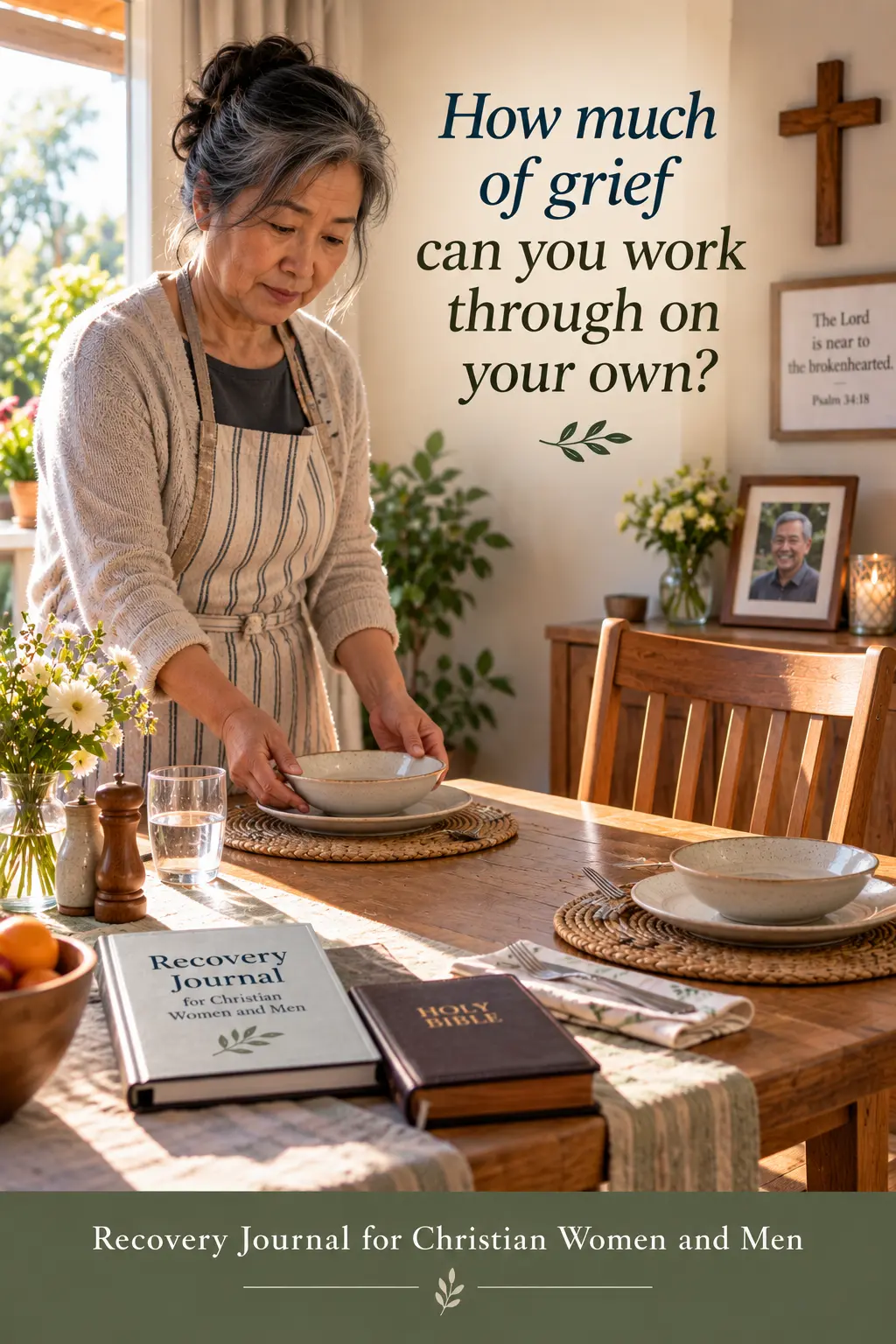
The Recovery Journal for Christian Women and Men was built around that kind of private grief work. It uses Scripture, guided reflection, and writing to help you examine grief without requiring you to complete the work according to somebody else's timetable.
If you want a structured way to do this private grief work, the Recovery Journal for Christian Women and Men can help you examine what your loss has changed, what keeps returning, what you are struggling to carry, and how your grief is affecting your faith and daily life. You can work through it privately, at your own pace, without having to know in advance exactly what needs attention.
Know When "On Your Own" Is No Longer Enough
There is a great deal you can do for yourself through grief. That does not mean there is honour in refusing help when you need it.
A journal cannot respond when your thinking becomes dangerously distorted. It cannot provide medical care, emergency support, legal advice, financial expertise, or the perspective another person may have when you have become trapped inside the same conclusion.
Pay particular attention when grief is making ordinary life increasingly impossible rather than gradually more manageable. If you cannot care for yourself, are becoming dependent on alcohol or drugs to get through the day, are repeatedly overwhelmed by traumatic memories, believe there is no reason to remain alive, or feel that you might harm yourself, private grief work is no longer enough by itself.
Seeking appropriate help in those circumstances does not invalidate anything you have already done for yourself; it simply means that different problems require different kinds of help.
If you are in immediate danger or acute distress, see Free Crisis Hotlines 24/7.
So, What Can You Do On Your Own?
You can begin by finding out what your grief actually consists of instead of treating every painful feeling as the same problem. You can write privately, learn your triggers, preserve memories, reduce practical problems to manageable actions, give your days enough structure to prevent everything from coming apart, and bring your anger, doubt, fear, gratitude, confusion, and questions honestly before God.
You can also pay attention to what changes. Some things may become easier. Others may remain stubbornly difficult. Either way, knowing what is happening gives you more to work with than simply waiting and hoping time will somehow do the work for you.
Helping yourself through grief is not the same as curing yourself of sorrow, and doing things on your own does not mean refusing to need anybody else. What it recognises is that even when nobody else can carry your grief for you, you are not powerless in the face of it.
You can begin working with what your loss has left you carrying, privately and at your own pace, one manageable part at a time.