
Does Journalling Help With Grief? If So, How?
Yes, journalling can help with grief. It cannot make the loss smaller, guarantee recovery, or change what happened. What it can do is give you a way to work with something that usually arrives all at once: memory, fear, question, regret, and emotion, tangled together inside you.
"Try journalling" is common grief advice. Unfortunately, it is often offered without explaining what journalling is supposed to accomplish, how writing could possibly help, or what it means if you try it and feel no better afterwards.
Those are reasonable objections. A notebook cannot bring back the person you lost. Writing down your anger does not necessarily remove it. Identifying a question does not provide an answer, and describing your pain does not prevent you from having to live through it.
Grief journalling can nevertheless give you a practical way to work with some of what grief has left you carrying. It can help you identify what is troubling you, separate one feeling from another, recognise thoughts that keep returning, say what you cannot say elsewhere, and bring some order to experiences that feel confused or overwhelming.
That is help, although it should not be mistaken for a promise that every person will benefit in the same way.
The Honest Answer Is "Yes, but..."
There is evidence that structured writing can reduce grief-related distress, but the evidence is neither absolute nor as simple as some enthusiastic claims about journalling suggest.
A 2025 meta-analysis of 13 randomised controlled trials found that expressive writing produced small reductions in grief and depression overall. The effects were larger when people completed more writing sessions and when a therapist provided feedback. Earlier studies, however, produced mixed results, and some found little or no general benefit from simply asking bereaved people to write about their loss.
That distinction matters because the writing studied by researchers is usually more structured than buying a blank notebook and recording whatever comes to mind. Participants may be given a particular subject, a sequence of writing exercises, a fixed number of sessions, or guidance intended to help them examine specific parts of their grief.
The research therefore does not prove that keeping any kind of journal will help every grieving person. It gives us more modest but still useful grounds for saying that writing can help, particularly when it has a purpose and helps the writer do more than repeatedly describe how terrible everything feels. Journalling is best understood as something you can use to face and examine your grief, not as a guaranteed remedy or a test of how seriously you are trying to recover.
Writing Helps You Identify What Is Actually Hurting
Grief can feel like one enormous pain even when several different things are happening at once.
You may miss the person who died, fear the future, resent someone who failed you, feel guilty about something you said, worry that you are forgetting important memories, and be angry with God. When all of that is experienced as a single emotional weight, it can be difficult to know what you need or what you are responding to at any particular moment.
Writing requires you to begin putting names to things.
"I thought I was upset because I missed her, but I am frightened about living alone."
"I keep calling this guilt, but I am angry about a decision somebody else made."
"I am not only grieving him. I am grieving the future I expected us to have."
"I keep saying that I am fine because I do not want to hear anybody else's opinion."
The first explanation you write may not be the complete one. It does not need to be. Once the thought is visible, you can question it, add to it, contradict it, or discover what sits underneath it.
This is one of the principal ways journalling can help with grief. It turns "I feel awful" into something more specific. You may not be able to change the situation, but it is easier to respond to fear, guilt, anger, loneliness, regret, or exhaustion once you know which of them you are dealing with.
It Gives Unspoken Grief Somewhere to Go
Not everything can be said aloud.
You may have thoughts that would alarm somebody, offend somebody, disappoint somebody, or provoke an answer you do not want. You may be angry with a person everyone else remembers fondly. You may feel relieved that a difficult period has ended and ashamed of that relief. You may resent the behaviour of relatives, friends, church members, doctors, carers, or the person who died.
You may also be tired of explaining yourself. A conversation requires you to consider another person's feelings, reactions, interruptions, advice, and interpretation. Private writing does not.
A grief journal allows you to state what is actually there before deciding what, if anything, you should do about it. Writing an angry thought is not the same as acting upon it. Admitting resentment does not mean you intend to keep it forever. Recording a frightening question does not make the question more dangerous than it was while it remained unspoken.
Sometimes the immediate benefit is simply that you no longer have to expend so much effort pretending the thought does not exist.
Journalling Can Slow Down Repetitive Thinking
Grief often produces thoughts that circle without reaching anywhere.
"What if I had noticed sooner?"
"Why did I say that?"
"Why did God allow this?"
"What am I supposed to do now?"
"Could I have prevented it?"
Thinking the same question repeatedly can create the impression that you are working on it when you are actually returning to the same starting point. Journalling can slow that process down because writing makes you complete the thought rather than merely experience its return.
You can ask what evidence supports a fear, what responsibility genuinely belonged to you, what you knew at the time, whether the question has an answer, and what part of it remains unresolved. You may discover that the same sentence has been concealing several different questions.
Writing does not guarantee that you will reach a satisfying conclusion. Some questions surrounding loss cannot be settled, and grief journalling should never force a false answer merely to make an entry end neatly. What it can do is show you whether you are examining a question, avoiding it, or repeating it without discovering anything new.
There is also an important caution here. Writing can become another form of repetitive thinking if every entry rehearses the same accusation, fear, or imagined alternative without examining it. Helpful journalling does not require every entry to contain a breakthrough, but the journal should give you room to notice when writing is helping you explore your grief and when it is merely keeping you inside the same mental argument.
It Can Reveal What Grief Has Changed
A major loss does not affect only how you feel about the past. It can change your understanding of yourself, your relationships, your future, your safety, and your faith.
You may no longer know who you are without the role you held in another person's life. Plans that once organised your future may no longer apply. Places, routines, anniversaries, possessions, and ordinary decisions may acquire meanings they did not have before.
These changes are not always obvious when they happen. You may initially write about being unable to complete a simple task and only later recognise that the task belonged to a shared routine. You may write about anger towards a friend and discover that the deeper injury is feeling abandoned now that your life has become difficult. You may think you are worried about one practical decision when the real fear is having to make every future decision alone.
Research into structured grief writing has increasingly examined this disruption of identity. One 2026 randomised controlled trial, for example, used a sequence of writing sessions focused on changes to bereaved people's sense of direction, personal worth, relationships, and identity. The study was small and does not settle the wider question by itself, but it illustrates an important point: grief is not only an emotion to be expressed. It can alter the structure of a person's life, and writing may help identify what has been disrupted.
If you want a structured Christian way to examine what your loss has done to your emotions, relationships, daily life, memories, and faith, the Recovery Journal for Christian Women and Men was built specifically to guide you through that work.
Your Earlier Entries Can Show You What Memory Cannot
Grief can make change difficult to see.
You may feel as though nothing has altered because you still miss the person, still have painful days, or still return to questions you were asking months ago. When you reread an earlier entry, however, you may notice differences that memory alone did not preserve.
Perhaps you are still writing about the same fear, but it no longer controls every decision. Perhaps the anger remains, but you can now say precisely whom it is directed towards and why. Perhaps a memory that once ended the entry can now be written in full. Perhaps you have started mentioning other parts of your life again without deliberately trying to sound more positive.
You may also discover that something has not changed. That can be useful information too. A particular event may still produce the same intense reaction. The same guilt may appear in entry after entry despite everything you have written about it. You may repeatedly avoid one subject or stop whenever you approach a particular memory.
A more reliable record of what is changing, what is recurring, and what may need attention from somewhere beyond the page — that is the journal's real value, not proof that you are progressing.
Journalling Is Private, Accessible, and Relatively Inexpensive
One reason grief journalling is worth considering is that it does not require an appointment, an audience, expensive equipment, or the ability to explain yourself to another person before you begin.
You can write when something happens, when a memory returns, when you cannot sleep, when you are angry, or when you finally understand why an apparently ordinary event affected you so strongly. You can stop after one sentence or continue for several pages. You can return to an unfinished thought when you are ready.
That makes journalling a practical form of grief work that many people can undertake for themselves. It can be used alongside prayer, pastoral support, conversations with trusted people, counselling, medical care, or other help. It can also be used when none of those is immediately available. Helping Yourself Through Grief: What Can You Do On Your Own? looks at other forms of private grief work alongside journalling.
Its accessibility should not be confused with unlimited usefulness. A journal cannot diagnose a mental health condition, provide emergency support, challenge every mistaken conclusion, or replace professional help when professional help is needed. It is a tool you can use, not a complete answer to grief.
Start with the free sample
No email. No signup.
What If Writing Makes You Feel Worse?
Writing about grief can be painful because it directs your attention towards something painful. Feeling upset during or immediately after an entry does not automatically mean journalling is harming you. You may have written about a memory, fear, regret, or truth that normally remains partly avoided.
However, there is no virtue in repeatedly overwhelming yourself.
If writing leaves you distressed for long periods, repeatedly pulls you into memories you cannot manage, increases thoughts of harming yourself, or makes ordinary functioning substantially harder, stop. You do not have to continue simply because journalling is supposed to be helpful.
You can write for less time, approach a different subject, use more structure, or avoid writing when you are already exhausted or highly distressed. You can also take what you have noticed to a counsellor, doctor, pastor, or another appropriate source of support rather than trying to resolve it alone.
Journalling can help you face grief, but facing grief does not mean forcing yourself through more than you can safely manage at once. When Grief Journalling Makes You Feel Worse looks more closely at when distress is a reason to change how you write or stop for a while.
What If Journalling Does Not Help You?
Some people think more clearly by writing. Others find it laborious, unnatural, frustrating, or emotionally unhelpful. Some benefit from a structured question but become lost in front of a blank page. Others resent prompts and need to begin with whatever is demanding their attention that day.
You may also find that journalling helps with one part of grief but not another. Writing may clarify your anger without reducing it. It may help you understand why a situation frightened you without making the situation less frightening. It may preserve memories while doing nothing for your loneliness.
None of that makes the writing pointless, but neither should every possible benefit be stretched into evidence that journalling is working wonderfully. Ask a more practical question: "What, if anything, becomes clearer, more manageable, or easier to face because I wrote about it?"
If the honest answer is "nothing", you are allowed to stop. Failing to benefit from grief journalling is not failing at grief.
How Does Christian Grief Journalling Help?
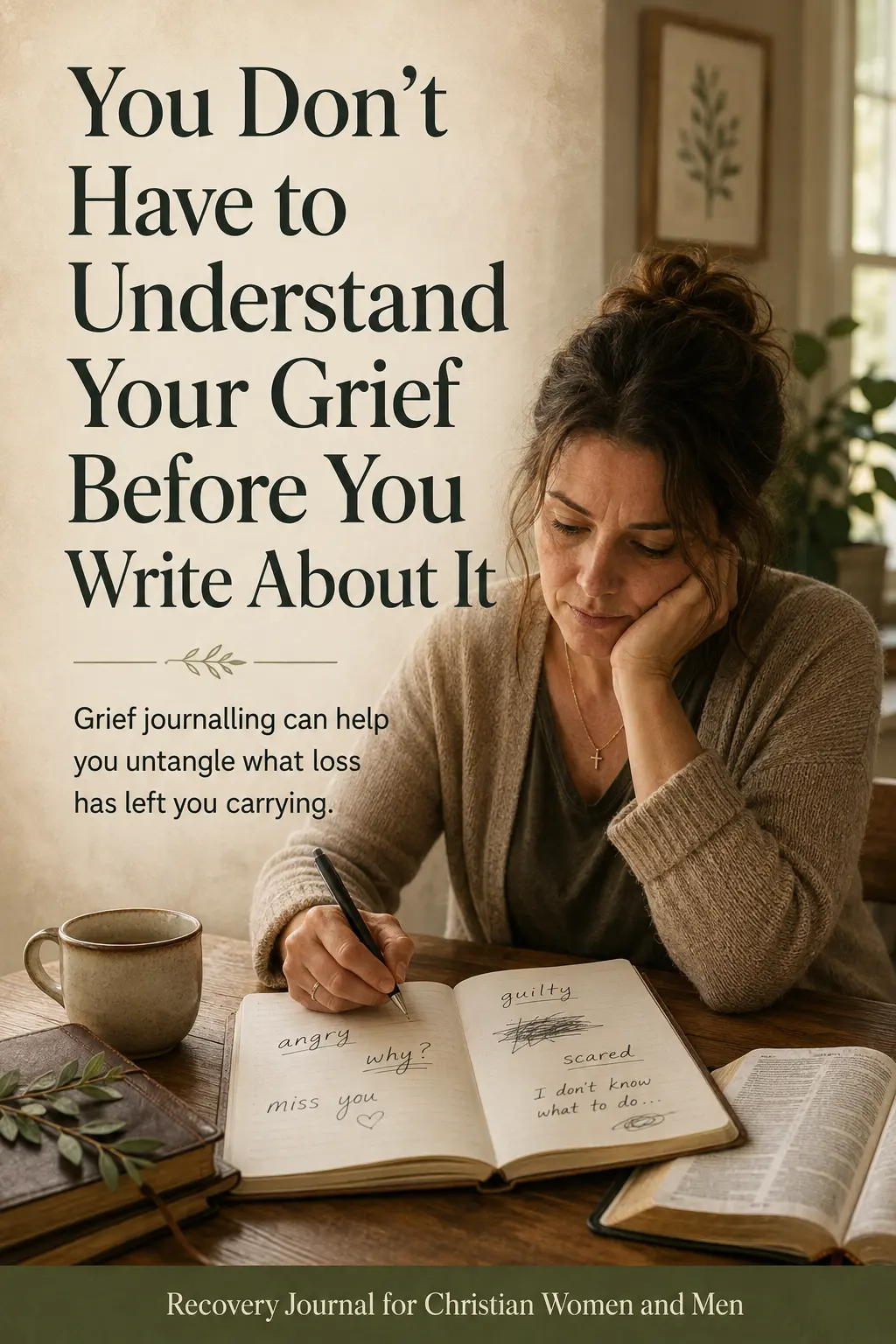
Christian grief journalling adds another relationship to the writing: your relationship with God.
Loss can affect what you believe about His goodness, protection, timing, justice, presence, and willingness to answer prayer. It can expose a distance between what you have been taught to say and what you now genuinely think. Those conflicts are difficult to examine if you believe every Christian reflection must end with certainty and praise.
A Christian grief journal can provide somewhere to write the prayer you can manage rather than the prayer you think you ought to offer. You can examine a passage of Scripture, object to it, ask what it means in the circumstances you are actually facing, or admit that words which comfort somebody else leave you cold.
Scripture does not require grieving people to pretend. The Psalms repeatedly preserve questions, complaints, fear, anger, remembrance, requests for help, and accusations that God appears absent. Their presence in Scripture does not answer every question grief raises, but it demonstrates that bringing distress before God is not the opposite of faith.
Christian grief journalling can therefore help by making the conflict visible. You may discover that you are angry with God, afraid that He has abandoned you, uncertain whether prayer matters, or clinging to one promise while doubting almost everything else. Once that conflict has words, you can begin examining it honestly through prayer, Scripture, reflection, and whatever trustworthy help is available to you.
The value here has nothing to do with how devout an entry sounds. It comes from keeping grief, doubt, anger, and faith from turning into separate conversations, each one hiding something from the others.
How Can You Tell Whether Grief Journalling Is Helping?
You do not have to feel cheerful after writing, produce new insights every time, or notice a steady reduction in pain. Those expectations would turn journalling into another demand that grief may prevent you from meeting.
Look instead for smaller and more concrete signs: naming a feeling more precisely than you could before, understanding why a particular event affected you, telling responsibility apart from guilt or anger with God from fear of admitting it, noticing a thought or trigger that keeps recurring, or finally saying something on paper that you had been concealing even from yourself.
Sometimes the benefit will be practical. An entry may show you that you need to speak to someone, make a decision, ask for help, set a boundary, revisit a memory, or stop demanding an answer that nobody can provide. At other times, the benefit may simply be that a difficult thought now exists on paper rather than continuing to press for your attention without words.
That is enough reason to continue if the writing is helping you. If it is not helping, you can change how you use the journal, leave it alone for a while, or decide that it is not the right form of grief work for you.
So, Does Journalling Help With Grief?
It can — by helping you identify what is hurting, separate tangled emotions, examine repetitive thoughts, express what cannot safely or comfortably be said elsewhere, recognise what your loss has changed, and observe patterns that memory alone may conceal. For a Christian, it can also provide a private place in which grief and faith can meet without requiring either to be falsified.
It cannot reverse the loss, guarantee relief, answer every question, or replace other forms of help. Research suggests that writing has a small overall benefit for grief and that more structured or supported forms of writing may help more than undirected expression alone. Individual experience will still vary.
The most honest answer, then, is a narrower one: deliberate writing gives you an accessible way to work with your grief, rather than carrying every part of it as an unnamed and undivided weight. Not everybody needs to keep a journal for that to be true. If writing helps you see more clearly what your loss has done to you and what you now need, then it is already doing something worthwhile.