
How to Start a Grief Journal When You Don't Know What to Write
You can start a grief journal before you know what you want to say. Begin with whatever is available to you: one fact, one feeling, one memory, one question, or even the sentence, "I don't know what to write."
Grief can make a blank page feel surprisingly difficult. You may have thoughts going round in your head all day and still find that, as soon as you sit down to write, there seems to be nothing you can put into words. You may know that you are angry, frightened, lonely or exhausted without knowing why. You may have so much to say that you cannot find a sensible place to begin.
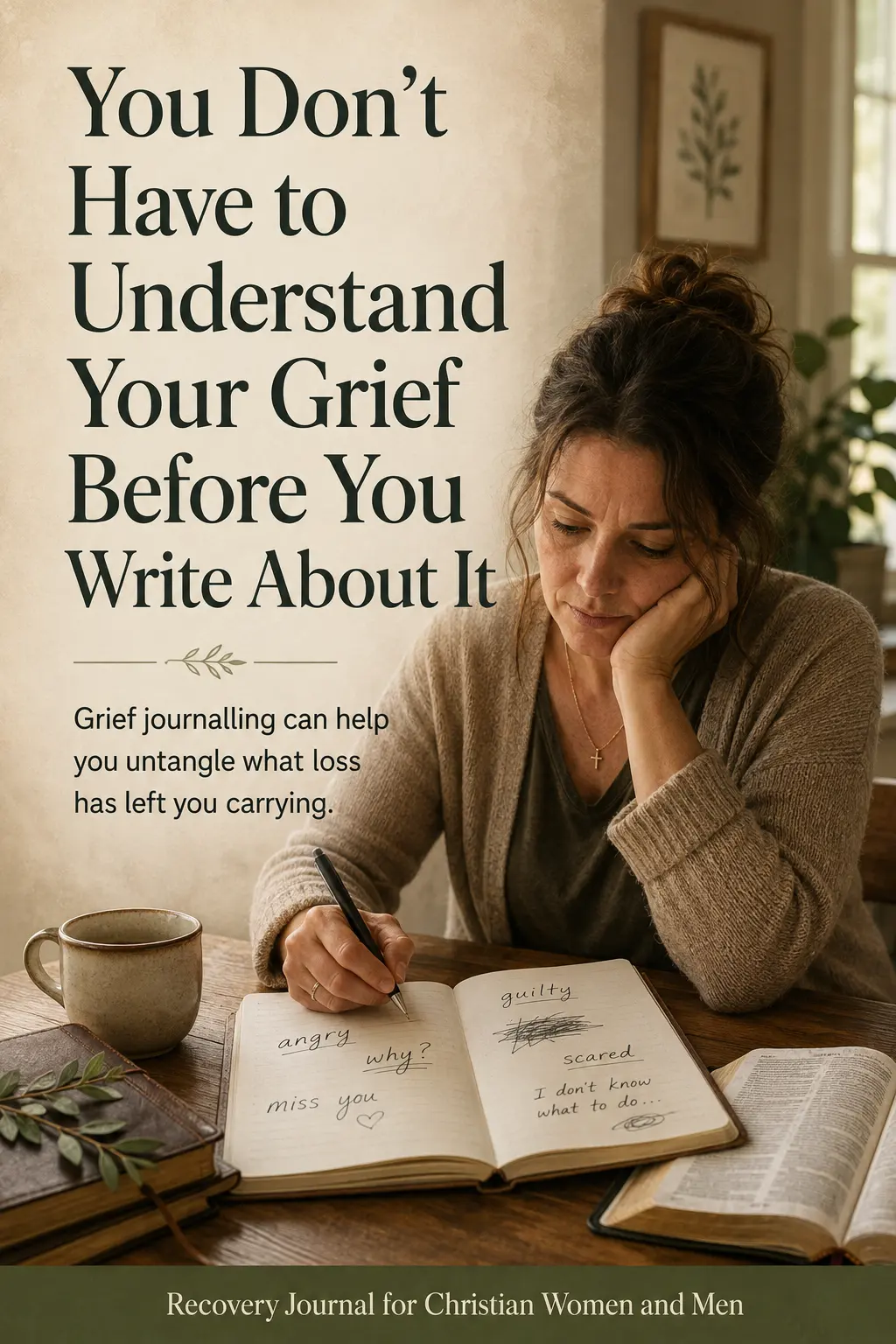
This is common enough to deserve saying plainly: you do not need to understand your grief before you begin writing about it. Part of the value of grief journalling is that writing can help you discover what is happening inside you while you are still trying to make sense of it.
Why can it be so difficult to start a grief journal?
Sometimes the difficulty is simply the size of what has happened. A major loss can leave thoughts, memories, practical worries, fears and emotions arriving together. Asking yourself to explain all of that on a blank page is a considerable demand.
You may also be putting expectations on the writing itself. Perhaps you imagine that a grief journal should contain thoughtful reflections about your loss. You may expect yourself to identify your feelings accurately, write something spiritually meaningful, or come away from each entry having understood yourself a little better — and expectations like that can make starting harder still.
There may also be things you are reluctant to admit, even privately. Your grief may contain anger, resentment, guilt, relief, jealousy, fear or thoughts about God that make you uncomfortable. You can find yourself silently editing what you are about to write before the words ever reach the page.
For a Christian, this can become particularly complicated when grief and faith collide. You may think you ought to trust God more than you currently do. You may feel guilty because prayer seems empty, Scripture no longer comforts you as it once did, or you are angry about what God allowed to happen. A grief journal can eventually become somewhere to examine those things honestly, but you do not have to force yourself into that depth on the first page.
What should you write first when you have no idea what to say?
Start with the most obvious thing you can truthfully write.
That may be:
- "I don't know what to write."
- "I keep thinking about what happened."
- "I miss him."
- "Today has been awful."
- "I feel nothing."
- "I am angry with God."
- "I don't understand why this still hurts so much."
You are allowed to begin there. You do not have to turn the sentence immediately into an explanation.
If you write, "I miss her", you may find another sentence follows naturally: "I especially miss talking to her in the evening." That may lead to a memory. The memory may uncover loneliness, regret or gratitude. Equally, nothing else may come. You can close the journal having written one honest sentence.
The important practical point is that a blank page asks for everything, while an existing sentence gives you something specific to respond to. Once a few words are present, you can decide whether there is anything more you want to say.
Can you start by writing facts instead of feelings?
Yes. This can be particularly useful when feelings seem confused, overwhelming or inaccessible.
You might simply write what happened: "I woke up at five this morning and immediately remembered that he is dead." Or you might describe something from the day, such as "I went shopping and automatically reached for the cereal she used to buy", or record something you noticed about yourself: "I have avoided answering three messages today."
Facts can provide an entrance into grief without requiring you to identify an emotion first. Once the event is on the page, you can look at your reaction to it if you want to.
For example:
"I went shopping and automatically reached for the cereal she used to buy. I put it back. I felt ridiculous standing there staring at a box of cereal, but for a few seconds it seemed to contain our whole Saturday-morning routine."
Small incidents can carry a surprising amount of grief because loss is encountered through ordinary life as well as through the major anniversaries and obvious reminders. Recording those incidents can help you notice where grief is appearing in your days.
What if you can name a feeling but cannot explain it?
Name the feeling and leave the explanation for later.
You might write:
- "I am angry today."
- "I feel frightened."
- "I feel guilty when I laugh."
- "I am lonely tonight."
- "I feel strangely calm, and I don't know what to make of that."
There is no requirement to know immediately where a feeling came from or what it means. You may understand it after another sentence, after several pages, or weeks later when you notice the same feeling returning in similar circumstances.
This is one reason repetition in a grief journal is normal. You may write about the same anger, conversation, memory or unanswered question many times. The fact that you have written about something before does not mean you have exhausted it. Your relationship to the same experience can change, and sometimes repeated writing reveals a pattern that a single entry could not. If you are wondering what writing like this can actually achieve, Does Journalling Help With Grief? If So, How? looks at that question in detail.
Can you write to the person who died?
Many grieving people find it easier to write when they imagine addressing the person they have lost. A letter gives the writing a recipient, which can make the blank page feel less abstract.
You might begin with something as ordinary as "You would have laughed at what happened today", move to something painful such as "I am angry that you did not tell me how ill you were", or simply say what you miss: "I miss being able to ask you what you think."
There may also be things you never had the opportunity to say. A journal can give you somewhere to put those words without pretending that the circumstances can now be changed.
For Christians, writing to someone who has died should also be distinguished from making confident claims about communicating with the dead. You can write because the relationship, memories, love, regrets and unfinished conversations remain psychologically important to you. The journal does not require you to decide that the person can hear what you write.
What small question can help you begin?
If an entirely blank page feels too open-ended, one small question can narrow the task.
Try asking yourself something specific, such as:
- What has been hardest today?
- What do I miss at this particular moment?
- What have I been thinking about repeatedly?
- What am I frightened of right now?
- What do I wish I could say?
- What reminded me of the person I lost today?
- What am I finding difficult to say to God?
You do not need to work through a list of prompts every time you journal. One question is often enough. The purpose is simply to give your mind somewhere to begin.
There will be times when a question produces an answer you did not expect. You may think you are writing about loneliness and discover that you are actually furious, begin with anger and uncover fear, or write about a memory and realise how much comfort it still gives you. Allow the entry to go where your thoughts naturally lead rather than trying to make it conform to the question that started it.

Does a grief journal entry have to be written in full sentences?
No. When coherent prose feels beyond you, reduce the demand.
You can write fragments:
"Tired. Funeral arrangements. Everyone asking questions. Can't think. Miss Mum."
You can make a list:
- Things I miss
- Things I am angry about
- Things I need to do this week
- Things I wish people would stop saying
You can also write a single word and circle it, repeat a sentence, make rough notes, scribble in the margin, or draw something that represents what you cannot yet explain in words.
Some people become inhibited because they want the journal itself to look good. They worry about handwriting, spelling, crossing things out, using the wrong page or producing an entry that seems disorganised. Grief rarely arrives in neat paragraphs. Your private writing is allowed to reflect that.
A page containing six disconnected words may still tell you something valuable when you return to it later.
How long should your first grief journal entry be?
As long as you have something you want to write — that might be several pages, one paragraph, or one sentence.
Setting yourself a demanding minimum can make journalling harder to begin, particularly when grief has already affected your concentration or energy. There is little benefit in forcing yourself through another page simply because you think an entry ought to be substantial.
You can stop after one sentence and return another day. You can also stop midway through a thought if writing is becoming exhausting or distressing. The journal will still be there.
The Recovery Journal for Christian Women and Men was designed around that principle. It has a sequence rather than a schedule, so there is no requirement to complete an entry every day or finish a section within a particular week.
If the hardest part is knowing how to begin, the Recovery Journal for Christian Women and Men gives you a structured starting point. Its guided reflections and writing prompts are designed to help you begin with what is actually present in your grief, even when your thoughts are confused and you do not yet know what to say.
What if you keep writing about the same thing?
Let them. You may write about the hospital repeatedly. You may keep returning to the final conversation you had with someone. You may record the same regret in slightly different words. You may ask God the same question each time you open the journal.
Repetition can show you where your mind keeps returning. Over time, you may begin to notice changes within what initially looks like the same entry. A question may become more specific. Anger may acquire a clearer target. A memory that once produced only pain may begin to include affection or gratitude as well. None of these changes needs to be hurried.
There is also no obligation to produce a tidy conclusion at the end of an entry. "I still don't know" is a legitimate place to finish.
Can prayer be part of grief journalling?
Yes. Written prayer can be especially useful when spoken prayer has become difficult.
You may find yourself unable to form the kind of prayer you once would have prayed. In that case, write what you would say to God if you were completely candid.
"God, I don't understand why this happened."
"I know what I am supposed to believe, but today I don't feel it."
"I am angry with you."
"Please help me through tonight."
"I don't know what to pray."
The Bible contains prayers of praise, confidence and thanksgiving, but it also preserves lament, bewilderment, protest, fear and questions. Christian grief journalling can make room for that wider biblical vocabulary of faith.
You can also copy a verse into your journal and respond to it. Your response does not have to be agreement or inspiration. You may write that you find the verse comforting, difficult, confusing or impossible to feel at the moment. That honest engagement can itself become part of your reflection.
Start with the free sample
No email. No signup.
What if you are simply not ready to write?
Then you may not be ready to write.
Grief journalling is optional. There are times, particularly after a recent or traumatic loss, when writing about what happened may feel too intense. Some people need time before they want to examine their experience closely. Others may find talking, prayer, silence, practical activity or simply getting through the day more manageable for a while.
You do not need to turn an inability to journal into another judgement against yourself.
If you want to keep the possibility open, you can make the smallest possible record. Write the date. Write one word. Put a mark on the page. Then close the journal. You can return when you want to.
If journalling repeatedly leaves you severely distressed, causes you to become trapped in painful thoughts for long periods, or seems to make coping significantly harder, it is reasonable to stop. Writing is a reflective practice rather than a substitute for professional, medical, pastoral or emergency support when you need it.
How do you start a grief journal today?
Choose the easiest entrance available to you: write what happened today, name one feeling, record one thing you miss, describe one memory, write a few words to the person you lost, ask yourself one small question, or tell God what you are actually thinking. If none of those feels possible, write, "I don't know what to write", and see whether another sentence follows.
You do not need to make the page meaningful before you begin. Meaning may emerge from the writing, sometimes immediately and sometimes only when you look back and notice what you have been saying repeatedly.
A grief journal can begin while your thoughts are still untidy, your emotions are difficult to name and your questions remain unanswered. Those are often some of the reasons for keeping one.
So what should you write when you don't know what to write?
Write whatever you can truthfully say from where you are now. It may be a fact, a feeling, a memory, a question, a prayer, a letter, a list or a single unfinished thought. Let the first words be small enough that you can actually put them on the page.
You do not need to understand your grief before you begin. Much of that understanding tends to come later, as a result of the writing rather than before it.