
Romans 1:20 — His Invisible Qualities Clearly Seen
When Grief Makes God Hard to Notice
"For since the creation of the world God's invisible qualities—his eternal power and divine nature—have been clearly seen, being understood from what has been made, so that people are without excuse."
— Romans 1:20 (NIV)
Reflection
Grief can narrow your attention until pain becomes the only thing you can see clearly. You wake up thinking about the loss. Ordinary tasks drag your mind back to it. Even moments of beauty can pass in front of you without quite reaching you. God may feel harder to see because grief has filled so much of your field of vision.
Romans 1:20 makes a strong claim: God's invisible qualities are made known through what He has created. Paul is not saying that creation answers every question about suffering, or that looking at something beautiful will remove grief. He is saying that God's power and divine nature leave evidence in the world He has made. That evidence does not disappear because your ability to notice it has been damaged by sorrow.
This matters when grief has made God feel distant. The problem may not be that there is nothing left to see. It may be that pain has become so dominant that everything else struggles to register. Scripture does not ask you to pretend the loss is smaller. It does give you permission to look outward again, slowly, and ask whether grief has been deciding what deserves your attention.
Start with the free sample
No email. No signup.
There is no shame in admitting that grief has altered what you notice. Severe loss changes concentration, expectation, and attention. You may walk past things that once moved you and feel nothing. You may hear birds, see colour in the sky, watch water move, or feel warmth on your face and still remain emotionally numb. Romans 1:20 does not demand an emotional response on command. It invites a more basic act: notice what is there.
You do not have to force meaning out of every tree, cloud, sunrise, or quiet place. But you can begin allowing the created world to interrupt grief's claim to be the only reality worth seeing. Grief can obscure your view without erasing God's evidence.
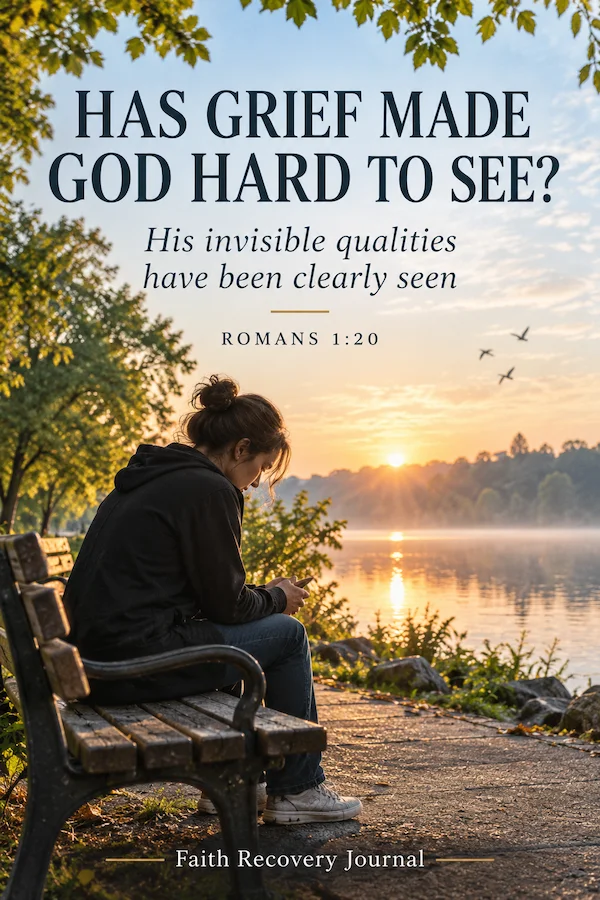
A grieving woman sits alone on a bench beside a lake, her attention lowered while sunrise light fills the water and trees around her beneath the words Has grief made God hard to see? The scene reflects how sorrow can pull your gaze inward even while creation continues to bear witness around you. Romans 1:20 invites you to notice again, without demanding that beauty cancel the grief.
Biblical Insight
Romans 1:20 appears in a serious part of Paul's argument. He is explaining that humanity is accountable to God because creation itself bears witness to its Creator. God's "eternal power and divine nature" are not visible in the way a physical object is visible, but Paul says they are understood from what has been made.
This is often described as natural revelation. Creation does not tell us everything Scripture tells us about God. It does not explain the gospel, the cross, forgiveness, or the resurrection in full. But it does disclose something real. Order, power, life, beauty, scale, dependence, and the existence of the created world point beyond themselves.
That context matters because Romans 1:20 should not be turned into a sentimental promise that nature will make a grieving person feel better. Paul is not writing a therapy technique. He is making a theological claim about God's self-disclosure in creation. For the grieving Christian, the value of the verse is that sorrow does not have the authority to erase what God has made known.
Grief can still interfere with perception. A bereaved person may see the same landscape that once brought delight and now feel nothing. That numbness does not prove God has withdrawn. It proves that grief has consequences. Scripture allows us to distinguish between what is present and what we currently have the capacity to feel.
This is where the verse becomes useful without becoming cruel. It does not say, "Look at the world and stop grieving." It gives you another question: what remains true even while I grieve? The created world still exists. God's power has not ceased. His divine nature has not vanished. The evidence Paul describes remains outside your changing emotional state.
There is also humility in this verse. Creation does not revolve around your grief, even though grief understandably makes your loss feel all-encompassing. The sun still rises. Water still moves. Trees still grow. Birds still cross the sky. None of those things trivialises your pain. They remind you that reality remains larger than the wound.
That can be spiritually important. Grief often narrows the world until everything is interpreted through absence. Romans 1:20 pushes gently against that narrowing. It directs attention toward a God whose power and nature are not dependent on your present ability to sense Him. You may have difficulty seeing Him, yet the witness around you has not gone silent.
In Application
- Notice one created thing today without forcing yourself to feel anything about it. Simply observe what is there.
- When grief tells you God has disappeared, separate that feeling from the question of what remains objectively present around you.
- Use creation as a prompt for attention rather than as an escape from grief. Let one detail interrupt the inward spiral for a few minutes.
- Ask whether sorrow has become the filter through which you interpret everything, and whether Scripture is inviting you to widen your field of vision.
Practical Journaling
Reflect on Romans 1:20, then write honestly:
- What has grief made difficult for me to notice lately?
- When I look at the created world now, what do I actually see, and what do I struggle to feel?
- What visible part of creation still suggests power, order, beauty, life, or endurance to me?
- If grief has made God hard to see, what might it mean to practise noticing without pretending the grief has gone?

Follow on Medium for More Studies
If writing feels too heavy today, look at one thing God has made and simply name what you see.
The Faith Recovery Journal explores this and many similar topics for Christians facing grief, loss, and recovery.