
Psalm 34:4 — Delivered from Fear
When Fear Has Been Holding You Too Long
"I sought the Lord, and he answered me; he delivered me from all my fears."
— Psalm 34:4 (NIV)
Reflection
What has fear been holding? Your sleep? Your body? Your thoughts? Your prayers? Your ability to make even small decisions without feeling as if everything could collapse again?
Fear after catastrophic loss is not ordinary worry. It can feel like a hand around your throat. It can make the future look unsafe, the present feel unstable, and the past keep returning with fresh force. You may know that God is real, yet still feel trapped inside dread.
Psalm 34:4 does not pretend fear is imaginary. David says, "I sought the Lord." That means fear was present enough to send him searching. He needed an answer. He needed deliverance. He needed God to meet him where fear had taken hold.
Start with the free sample
No email. No signup.
Seeking the Lord does not always begin calmly. Sometimes it begins with panic. Sometimes it begins when your hands are shaking and your faith feels thin. Sometimes all you can say is, "Lord, I am afraid." That is still seeking Him.
The verse says the Lord answered David and delivered him from all his fears. It does not say David became fearless by pretending danger was not real. It says fear did not remain his master after he turned toward God.
Fear may be loud, but it is not Lord.
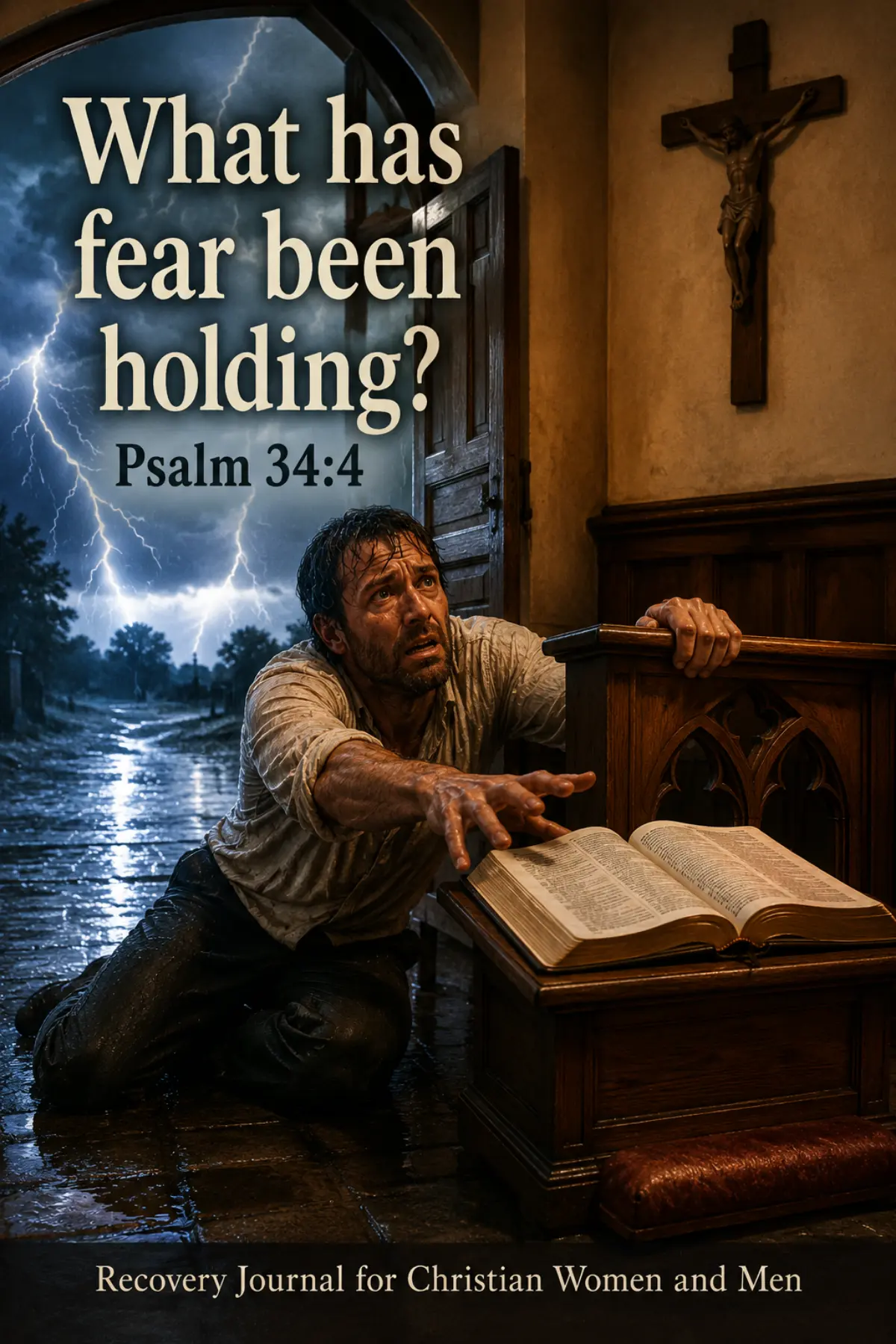
A terrified man has fallen inside a chapel vestibule during a violent storm, yet his hand reaches toward the open Bible while a crucifix hangs on the wall. The fear is still visible, but Psalm 34:4 shows the sacred turn: seeking the Lord while fear is still gripping you.
Biblical Insight
Psalm 34 is traditionally linked to David after a terrifying escape. This is not a psalm written from a comfortable distance. It comes from danger, humiliation, fear, and deliverance. David is not writing as someone who never knew dread. He is writing as someone who had reason to be afraid and found the Lord faithful there.
"I sought the Lord" is important because it shows movement toward God. Fear often drives people inward, into silence, panic, control, avoidance, or despair. David does something different. He seeks the Lord. He brings fear into the presence of God rather than letting fear become the only voice in the room.
The verse also says, "he answered me." God is not shown here as distant, irritated, or unmoved. David's fear does not disgust Him. His need does not repel Him. The Lord answers. That does not mean every frightening circumstance disappears instantly. It means the frightened believer is not speaking into emptiness.
"He delivered me from all my fears" must be handled carefully. This is not a shallow promise that a grieving Christian will never feel afraid again. Scripture itself gives us many faithful people who trembled, wept, cried out, waited, and struggled. Deliverance from fear does not always mean the immediate removal of every frightening circumstance. Often it means fear loses its authority over the soul.
That matters in grief because fear can attach itself to everything. After deep loss, you may fear another death, another phone call, another hospital room, another anniversary, another conversation, another silence from God. Fear multiplies because grief has already proved that terrible things can happen.
Psalm 34:4 does not shame you for that. It gives you a pattern. Seek the Lord. Tell Him the fear. Let Him answer you in His Word, His presence, His people, His timing, and His sustaining grace. You may still feel shaken, but you do not have to let fear decide where you go next.
In Application
- Name the fear plainly. Do not hide behind vague words if what you really feel is dread, panic, or terror.
- Seek the Lord before you try to tidy yourself up. Psalm 34:4 begins with fear present, not fear already solved.
- Let Scripture answer fear directly. When fear speaks, answer it with what God has said, not with forced optimism.
- Notice what fear has been holding. If it has taken your sleep, prayer, appetite, courage, or hope, bring that specific place to God.
Practical Journaling
Reflect on Psalm 34:4, then write honestly:
- What has fear been holding in me since this loss?
- What am I afraid will happen if I stop trying to control everything?
- What would it look like today to seek the Lord while I am still frightened?
- Which fear do I need to place beside the words, "he answered me"?

Follow on Medium for More Studies
If writing feels too heavy today, write only this: "Lord, fear has been holding me, but I am seeking You."
The Faith Recovery Journal explores this and many similar topics for Christians facing grief, loss, and recovery.