
Isaiah 41:13 — God's Hand to Hold
When Fear Asks What Happens If He Lets Go
"For I am the Lord your God who takes hold of your right hand and says to you, Do not fear; I will help you."
— Isaiah 41:13 (NIV)
Reflection
What if He lets go? That is the fear. Not the polite fear you admit in church, but the one that comes when grief has stripped your confidence down to almost nothing. You know the promise, but the ground under you still feels dangerous.
Isaiah 41:13 speaks directly into that terror. God does not merely say, "Be brave." He says He takes hold of your right hand. The help He promises is not distant advice from heaven. It is personal nearness from the Lord your God.
After catastrophic loss, fear becomes physical. It tightens your chest. It follows you into ordinary tasks. It asks whether you can survive another day, another conversation, another memory, another night. God does not shame that trembling. He answers it with His hand.
Start with the free sample
No email. No signup.
This verse does not say you will never feel afraid. It says fear does not get the final word over the one held by God. There is a difference. A grieving Christian can be shaking and still be held. You can be frightened and still be helped.
The promise is not that the waters will feel shallow. The promise is that the Lord your God is not detached from you while you cross them. He takes hold of your hand before He tells you not to fear.
God does not wait for you to stop trembling before He holds you.
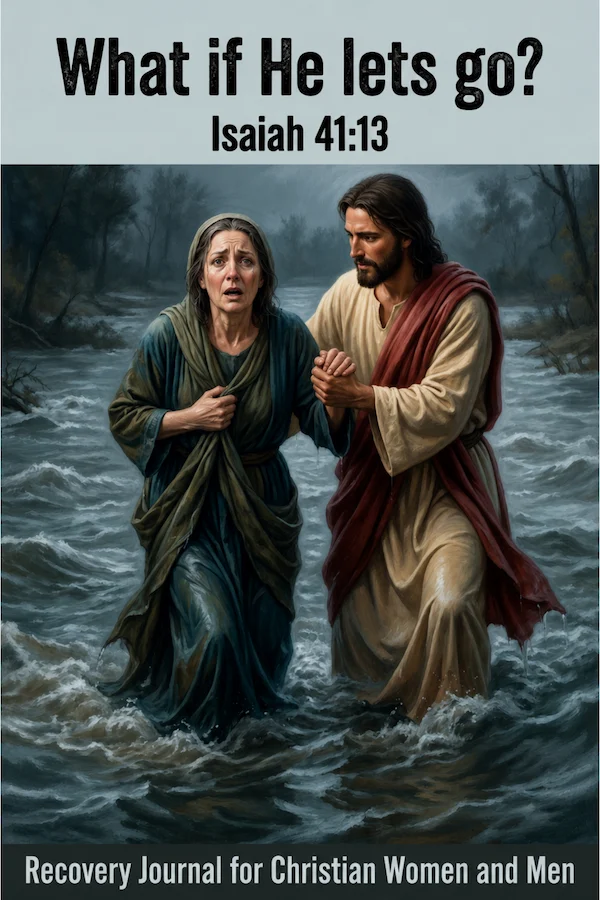
A frightened woman moves through deep, rushing water while Christ holds her hand beside her. The question above her fear is painfully honest: what if He lets go? Isaiah 41:13 answers that fear not with a theory, but with the nearness of God who takes hold, speaks courage, and promises help.
Biblical Insight
Isaiah 41 is spoken to God's people in a time when fear, weakness, and uncertainty pressed heavily upon them. The Lord repeatedly tells them not to fear, but He does not do so as a cold command. He grounds the command in who He is and what He will do.
"For I am the Lord your God" comes before "Do not fear." That matters. The command is not based on your emotional strength. It is based on God's covenant nearness. He identifies Himself as the Lord who belongs to His people and takes responsibility for them.
The phrase "takes hold of your right hand" is deeply personal. It is the language of guidance, steadiness, and rescue. A hand is taken when someone is unsteady, young, weak, afraid, or in danger. God does not mock that need. He meets it.
This verse also keeps help specific. God says, "I will help you." He does not promise to explain every loss. He does not promise that the path will be painless. He does not promise that grief will vanish because you have faith. He promises His help, and that help begins with His grasp.
For a grieving Christian, this matters because fear often becomes tangled with guilt. You may think fear means you are failing spiritually. But Isaiah 41:13 shows God speaking to frightened people without despising them. He does not say, "Do not fear, because your fear is ridiculous." He says, "Do not fear; I will help you."
That means fear is not the place where God abandons you. It is one of the places where He reveals His steadiness. When grief makes you weak, the answer is not to pretend you are strong. The answer is to let the Lord your God hold the hand that cannot hold itself steady.
In Application
- Name the fear honestly. Do not hide it behind religious language. Isaiah 41:13 is for the person who actually needs to hear "Do not fear."
- Notice the order of the verse. God takes hold before He commands courage. His help is not a reward for emotional control.
- Do not confuse fear with abandonment. You can feel terrified and still be held by the Lord your God.
- Let "I will help you" be enough for today. You may not receive every explanation you want, but you are not being asked to cross grief alone.
Practical Journaling
Reflect on Isaiah 41:13, then write honestly:
- What am I most afraid God will let go of in my life right now?
- Where do I need to stop pretending I am steady and admit that I need His hand?
- What would it mean today to believe that God helps me before I feel brave?
- Which words from this verse do I need to carry into the next frightening moment: "takes hold," "Do not fear," or "I will help you"?

Follow on Medium for More Studies
If writing feels too heavy today, write only this: "Lord, I am afraid You will let go, but Your Word says You take hold of my hand."
The Faith Recovery Journal explores this and many similar topics for Christians facing grief, loss, and recovery.