
John 11:25–26 — The Resurrection and the Life
When Death Still Looks Like the Final Word
"Jesus said to her, 'I am the resurrection and the life. The one who believes in me will live, even though they die; and whoever lives by believing in me will never die. Do you believe this?'"
— John 11:25–26 (NIV)
Reflection
Is death the end of this? That is the question grief asks when the body is gone, the room is empty, and every ordinary thing has become unbearable. You may believe in resurrection and still feel the brutality of death in your bones.
Jesus speaks these words to Martha before Lazarus comes out. That matters. He does not wait until the miracle is visible before He tells her who He is. He stands in front of death while death still appears to have won, and He says, "I am the resurrection and the life."
Christian hope is not pretending death is small. Death is an enemy. Loss is not light. The grave is not sentimental. Jesus does not ask Martha to deny the reality of what has happened. He asks her to face Him in the middle of it.
Start with the free sample
No email. No signup.
There are moments when resurrection sounds too far away to help. You do not need a vague idea of comfort. You need Christ Himself. Jesus does not merely speak about resurrection as a future event. He says He is the resurrection and the life.
That does not remove the tears from Bethany. It does not make Martha's grief foolish. It does not make the sealed grave painless. But it means death is not the highest authority standing there. Christ is.
Death feels final, but it does not get to define what Christ has claimed.
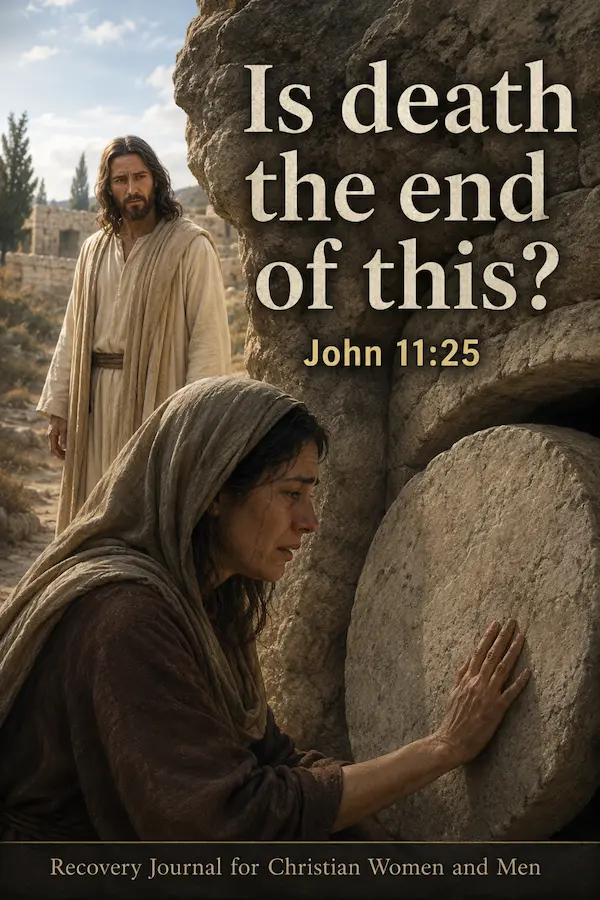
Martha presses her hand against the sealed tomb while Jesus stands nearby, and the stone has not yet moved. That is the pressure of John 11:25: resurrection has been spoken, but grief is still facing what looks final.
Biblical Insight
John 11 brings us to one of the most direct confrontations between Christ and death in the Gospels. Lazarus has died. Martha comes to Jesus with grief, faith, and pain all tangled together. She believes He could have prevented the death. She also believes God will give Him whatever He asks. But her brother is still dead.
Jesus tells her, "Your brother will rise again." Martha answers with orthodox faith: she knows about the resurrection at the last day. But Jesus does not leave resurrection as only a distant doctrine. He brings the promise directly to Himself: "I am the resurrection and the life."
That statement changes the centre of the conversation. Resurrection is not merely an event God will perform someday. Resurrection is bound to the person of Christ. Life is not only something He gives; life is who He is.
This matters when grief has made Christian truth feel abstract. You may believe the doctrine and still struggle to breathe. You may affirm heaven and still ache for the person you cannot touch. You may know the correct answer and still feel crushed by the closed stone.
Jesus does not rebuke Martha for grieving. He speaks to her grief with truth large enough to stand beside a tomb. He does not say death is harmless. He does not say loss is imaginary. He does not say faith means the grave should not hurt. He says that the one who believes in Him will live, even though they die.
John 11:25 does not promise that bereavement will stop feeling savage. It does not promise that every earthly death will be reversed immediately as Lazarus's was. Lazarus's raising was a sign pointing beyond itself to Christ's own death and resurrection. The deeper promise is that death cannot finally hold those who belong to Him.
That is why Jesus ends with a question: "Do you believe this?" He is not asking Martha whether she feels better. He is asking whether she will trust Him while the grave is still sealed. In grief, that question can feel almost unbearable. But it is also mercy. Christ does not ask you to believe in a slogan. He asks you to believe in Him.
In Application
- Do not shame yourself because death still feels brutal. Jesus spoke resurrection truth in front of an actual tomb, not in a painless room.
- Bring your belief and your ache together. Martha did not have to choose between doctrine and grief; she brought both to Christ.
- Remember that Christian hope is personal. Jesus does not merely point to resurrection; He says, "I am the resurrection and the life."
- Let the question stand honestly. "Do you believe this?" is not asking whether you feel strong, but whether Christ remains true while you are still weeping.
Practical Journaling
Reflect on John 11:25, then write honestly:
- Where does death still feel like the final word in my thoughts, prayers, or memories?
- What is hardest for me to believe about Jesus being "the resurrection and the life" while I am still grieving?
- What truth do I know in doctrine but struggle to hold emotionally right now?
- How would I answer Jesus' question, "Do you believe this?" without pretending I feel stronger than I do?

Follow on Medium for More Studies
If writing feels too heavy today, write only this: "Lord Jesus, death still looks final, but You say You are the resurrection and the life."
The Faith Recovery Journal explores this and many similar topics for Christians facing grief, loss, and recovery.