
1 Timothy 5:3 — God Commands His Church to Honour Widows
When Grief Leaves Someone Alone with Practical Need
"Give proper recognition to those widows who are really in need."
— 1 Timothy 5:3 (NIV)
Reflection
Widowhood is not only sorrow. It is paperwork. It is silence at the table. It is money questions. It is letters that must be opened, bills that must be understood, forms that must be answered, and decisions that now have to be made without the person who used to share the weight.
1 Timothy 5:3 does not treat widows as a sentimental subject. Paul gives a command: Give proper recognition to those widows who are really in need. That recognition is not mere politeness. It is honour, attention, and practical care. The church is not allowed to admire grief from a distance while ignoring the needs grief leaves behind.
Start with the free sample
No email. No signup.
This matters because many widows become invisible after the first wave of sympathy passes. People attend the funeral, send messages, bring food, and then return to their normal lives. The widow remains with the empty chair, the changed income, the official letters, the long evenings, and the strange humiliation of needing help with things that once felt manageable.
God sees that. Scripture does not leave the vulnerable to vague goodwill. It gives commands. It tells the church to recognise real need and respond properly. That recognition may be emotional, financial, practical, relational, or spiritual. It may mean listening without rushing. It may mean helping with forms. It may mean checking whether the heating is affordable, whether the food is there, whether the loneliness is crushing, whether the person is quietly slipping through the cracks.
A widow in need is not a church decoration; she is a church responsibility.
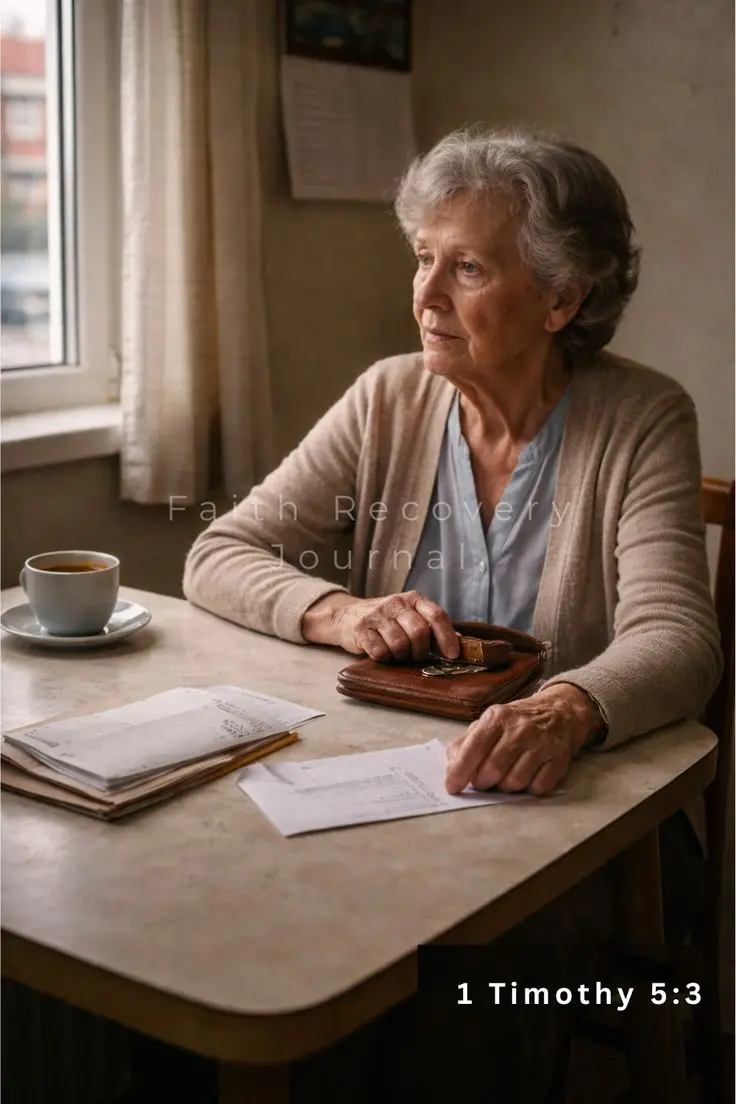
The woman at the table, the purse, the keys, the papers, the cup, and the window all point to the daily weight of bereavement. This is not only the sadness of missing someone. It is the practical vulnerability that can follow loss. The light from the window suggests life continuing outside, while she sits inside with what must now be faced. That is why 1 Timothy 5:3 matters here. God commands His people not to let such need become background noise.
Biblical Insight
1 Timothy 5 is part of Paul’s instruction to Timothy about how the church should order its life. The passage deals carefully with widows, family responsibility, church support, and discernment. Paul is not speaking vaguely about being kind. He is giving pastoral direction for how a Christian community should treat those who are vulnerable and truly in need.
In the ancient world, widowhood often brought severe social and economic danger. A widow could lose protection, income, status, and daily security. Scripture repeatedly shows God’s concern for widows, orphans, and strangers because they were easily overlooked, exploited, or left without support. Paul’s instruction continues that biblical concern inside the life of the church.
The phrase proper recognition includes honour. It is not pity from above. It is not treating widows as burdens. It is the church seeing them rightly before God. A widow who is truly in need is to be recognised as worthy of care, not because she is useful, visible, loud, or socially important, but because God commands His people to honour those who are vulnerable.
The passage also speaks about family responsibility. Later in the chapter, Paul says families should care for their own relatives where they can. That matters because biblical care is not meant to be performative. Responsibility begins close to home. Children, grandchildren, and relatives are not to abandon a widow while expecting the church to carry what they refuse to carry.
At the same time, the church must not use family responsibility as an excuse for indifference. Some widows are truly alone. Some have no reliable family. Some have relatives in name only. Some are surrounded by people yet still neglected. Paul’s instruction forces the church to ask concrete questions about real need, not hide behind assumptions.
This verse does not promise that widowhood will be easy. It does not say recognition removes loneliness. It does not say practical support heals grief. A widow may still miss her husband with a physical ache. She may still feel exposed, displaced, or frightened. But the verse does say that God does not treat that need as invisible. He commands His people to see it and respond.
For grieving Christians, this matters in more than one direction. If you are widowed, this verse speaks dignity over your need. Needing help does not make you shameful. Scripture names your vulnerability and commands honour, not dismissal. If you are part of a church, family, or Christian community, this verse confronts you. Sympathy that never becomes care is too thin. Recognition must take shape in action.
The verse also helps correct a common cruelty: expecting grieving people to ask perfectly for help. Many widows will not want to be a burden. Many will understate their need. Many will say “I’m fine” because they are tired of explaining. Proper recognition means paying attention beyond polite answers. It means seeing the person at the table, not merely hearing the word “fine.”
In Application
- If you are widowed, name your needs without shame. Needing help with money, forms, transport, repairs, meals, or loneliness does not make you weak.
- If you are family, do not wait for crisis before acting. Ask what practical burdens have landed on the widow’s table and take responsibility where you can.
- If you are part of a church, move beyond sympathy. Proper recognition may require regular contact, practical support, advocacy, and quiet consistency.
- Do not romanticise grief. A cup of tea, a purse, keys, and unpaid papers can be part of mourning too. Honour must include the ordinary burdens loss creates.
Practical Journaling
Reflect on 1 Timothy 5:3, then write honestly:
- Where do I see real need in widowhood, grief, or isolation that I have been tempted to overlook?
- If I am the one in need, what practical burden am I carrying alone because I am ashamed to name it?
- Who in my family, church, or community needs proper recognition rather than polite sympathy?
- What one concrete act of honour could I offer this week: a call, a visit, help with paperwork, transport, food, prayer, or financial support?

Follow on Medium for More Studies
If writing feels too heavy today, ask God to show you one real need that should not remain unseen.
The Faith Recovery Journal explores this and many similar topics for Christians facing grief, loss, and recovery.