
What Should a Genuine Grief Journal Look Like Inside?
A genuine grief journal should give the bereaved person something useful to work with inside: enough guidance to help them begin, enough freedom to write what is actually true, and enough space to continue when a subject needs more than one page. There is no single correct layout, but the interior should do considerably more than place comforting quotations beside lines for writing.
That needs saying because "grief journal" can describe very different products. Some are essentially blank notebooks with bereavement-related covers. Some contain a quotation or prompt every few pages. Others are highly structured workbooks. A Christian grief journal may add Scripture without giving the reader much help in examining what the passage has to do with grief.
None of those features automatically makes a journal poor. A blank notebook can be exactly what somebody wants, and a single prompt can sometimes be enough to begin useful writing. The question here is narrower: if a book presents itself as a genuine guided grief journal, what should you reasonably expect to find when you open it?
The answer depends partly on the kind of guidance the journal promises. There are many sensible ways to design one. The pages shown in this article come from the Recovery Journal for Christian Women and Men, so this article uses them as one worked example and explains why they were designed that way. They are an example rather than a template every other grief journal ought to copy.
The Inside Should Help You Do Something With Your Grief
A useful first test is simple: look past the cover and ask what the interior actually enables you to do.
Good grief journalling can help you identify what is troubling you, distinguish one feeling from another, examine recurring thoughts, preserve memories, put difficult questions into words, and notice what has changed over time. For a Christian reader, it can also provide somewhere private to bring grief into contact with Scripture, prayer, doubt, anger, gratitude, and questions about God.
The pages therefore need to support reflection rather than merely look consoling. Attractive typography, calming colours, illustrations, and generous white space can make a journal pleasant to use, but design should serve the reader's work.
A quotation such as "Be strong" followed by twenty blank lines may be attractive, but the bereaved reader has still been left to decide what the quotation means, whether it applies, what part of their experience deserves attention, and where to begin writing.
A guided grief journal should usually provide more help than that.
Here Is One Way to Structure a Grief-Journal Spread
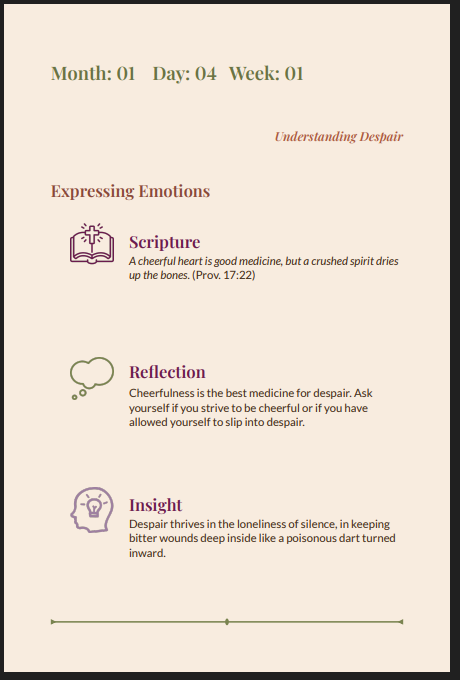
The page above shows a typical left-hand, or verso, page from the Recovery Journal. It begins by locating the reader within the sequence, then identifies a broad area of grief and a more specific theme. The example shown belongs to "Expressing Emotions" and focuses on "Understanding Despair".
The body of the page then moves through three elements: Scripture, Reflection, and Insight.
The Scripture provides the biblical starting point. The Reflection asks the reader to consider something about their own experience rather than merely admire or agree with the verse. The Insight adds a short interpretive thought intended to help the reader look at the subject from another angle.
That order is deliberate. The reader arrives at the facing page having already been given a subject, a piece of Scripture, a question to consider, and a small amount of interpretive guidance.
Another journal could sensibly arrange those ingredients differently. It might begin with the reader's experience and introduce Scripture afterwards, use one substantial prompt instead of separate Reflection and Insight sections, or devote the whole spread to a single question. The important point is that the printed material gives the writer something meaningful to engage with.
If you want a broader explanation of why deliberate writing can help with grief, Does Journalling Help With Grief? If So, How? examines what journalling can realistically do and where its limits lie.
The Facing Page Can Move From Reflection Towards Response
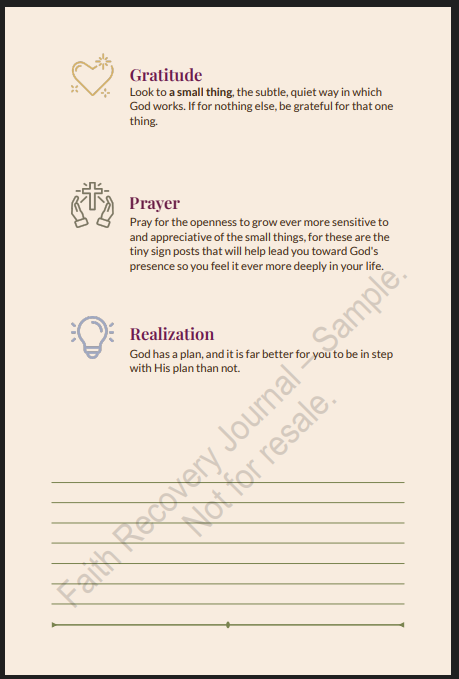
The facing, or recto, page continues the sequence rather than simply repeating the first page in a different form. In this example it moves through Gratitude, Prayer, and Realization before leaving a fixed area for personal writing. Each element has a distinct purpose.
Gratitude broadens attention beyond the immediate pain without demanding that the reader feel cheerful or grateful for the loss itself. Prayer places the subject explicitly before God. Realization offers a final thought or question which may help the reader decide what they want to write.
The ruled area belongs to the reader. By this point, the journal has supplied considerable structure, but it has not supplied the reader's answer.
That distinction matters. Guidance becomes intrusive when the book has already decided what the writer ought to conclude. A prompt about despair should be capable of receiving "I still feel hopeless today" as an honest answer. A section on prayer should allow somebody to write that prayer feels impossible. Scripture should be permitted to provoke a question as well as provide comfort.
A genuine Christian grief journal should be able to accommodate the actual state of the reader's faith rather than rewarding only answers which sound devout.
Start with the free sample
No email. No signup.
A Good Page Does Not Have to Be Sparse
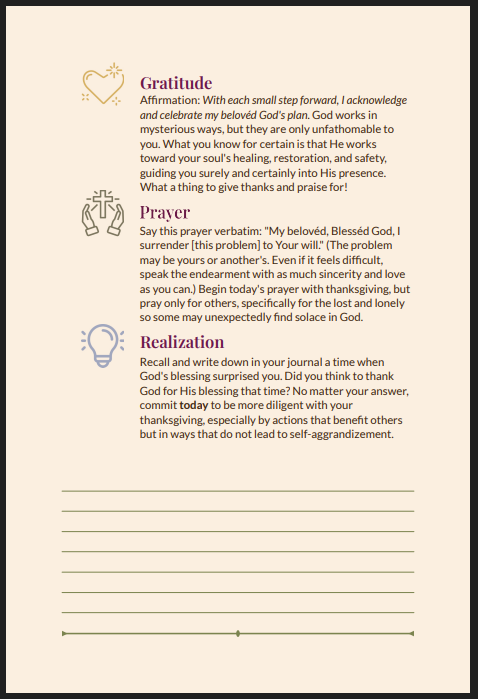
Some grief-journal pages will naturally contain more printed material than others. The page above is considerably denser because the Gratitude section contains a developed affirmation, the Prayer supplies a full prayer, and the Realization section needs enough explanation to make the exercise clear.
Density itself is therefore a poor measure of quality.
A page can contain several paragraphs of worthwhile guidance and still be useful. Equally, a sparse page can waste most of its space on decoration and offer very little help.
The better question is whether the printed material earns the space it occupies: whether it clarifies the subject, helps the reader think, gives enough context for the exercise to make sense, and keeps the prayer or reflection specific enough to have some relationship to grief.
In the Recovery Journal, the amount of personal writing space remains the same across the daily pages in both volumes, even when the guidance above it becomes denser. That consistency was deliberate. A subject which needs more explanation should not quietly take away the reader's normal response area.
Other designs may make a different choice. Some journals devote most of every page to handwriting and keep guidance extremely brief. Others alternate between teaching pages and almost entirely blank writing pages. Both can work if the reader understands what the structure is asking them to do.
The Writing Space Has to Be Usable
This sounds obvious until you look inside some journals.
Prompts can be excellent while the physical space provided to answer them is wholly inadequate. A question about guilt, anger, the death of a child, a broken relationship, or loss of faith may be followed by four short lines. The journal has invited serious reflection and then designed the page as though the answer should fit on a postcard.
There is no correct number of lines because grief entries vary enormously. One day the honest response may be two sentences; another subject may produce several pages.
The routine writing area should nevertheless be large enough to be genuinely usable. Line spacing, margins, type size, and contrast also matter. A journal intended for sustained use should not make handwriting unnecessarily cramped or force the printed guidance into tiny type simply to fit more onto a page.
The physical design is part of the method. If the journal constantly makes the writer fight the page, the design has failed regardless of how thoughtful the prompts are.
There Should Be Somewhere to Continue
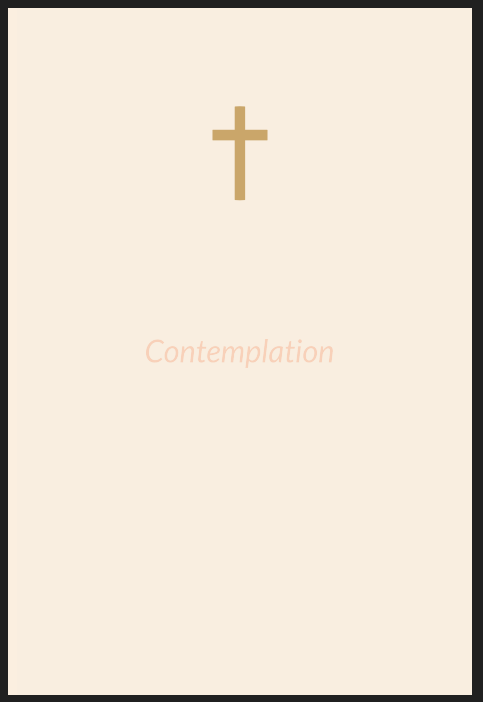
Even a generously designed daily entry cannot predict how much somebody will need to write.
A subject may unexpectedly open into a memory, letter, prayer, argument, confession, or train of thought far longer than the standard space allows. The writer should not have to compress an important entry merely because the designed spread has ended.
A good grief journal should therefore provide additional writing space somewhere within the book, or make continuation easy in some other way.
The Recovery Journal uses separate "Contemplation" pages for this purpose. They give the journaller somewhere to continue an entry, write outside the normal daily sequence, record a longer prayer or memory, or follow something which has emerged from an earlier reflection.
The page itself is deliberately open. Its heading indicates its purpose without supplying another exercise.
This is an important balance in guided journalling. Structure helps the reader begin, but there also needs to be somewhere the guidance recedes and the writer can continue independently.
Prompts Should Be Specific Enough to Help and Open Enough to Answer Honestly
A useful prompt reduces the size of the blank page.
"Write about your grief" gives almost no direction. A question such as "What has been hardest today?" or "What are you frightened will change now?" provides a more definite entrance.
The danger lies at the other extreme, where a prompt quietly contains the answer it expects.
A question asking "What has God taught you through this loss?" assumes that the reader can already identify a lesson. "How has this experience strengthened your faith?" assumes strengthening has occurred. A bereaved Christian may have an honest answer to either question, but somebody whose faith has become confused or damaged needs room to say that too.
Good prompts invite examination rather than compliance. They can direct attention towards fear, guilt, anger, memory, relationships, identity, practical change, or Scripture without deciding what the writer will find there.
This is one of the principal differences between purposeful grief journalling and a collection of inspirational questions.
Scripture Should Have a Job to Do
In a Christian grief journal, Bible verses should contribute to the reflection rather than function as decoration.
A familiar verse placed above an unrelated writing prompt may make the page look Christian without helping the reader understand either the passage or their grief. A useful connection requires more thought.
Scripture can provide language for lament, expose assumptions, challenge a conclusion, offer comfort, raise a difficult question, or place an individual experience within a larger biblical picture. The Psalms are particularly valuable because they contain confidence, praise, fear, complaint, remembrance, pleading, and questions about God's apparent absence.
The reader should be allowed to engage with the verse honestly. Sometimes the response may be gratitude or reassurance. On another day the writer may record confusion, disagreement, anger, or inability to feel what the passage seems to promise.
Christian journalling becomes less useful when Scripture is used to shut down the very thoughts the journal is supposed to help bring into the open.
The Interior Should Cover More Than Sadness
Grief is too large a subject for every prompt to ask some variation of "How are you feeling today?"
A well-designed journal should recognise that bereavement can affect memory, identity, relationships, routine, concentration, fear, guilt, anger, faith, practical responsibilities, and expectations about the future. Different losses will make different areas important, but the journal should offer enough range for the reader to encounter more than one emotional vocabulary.
This is where structure can justify itself. A blank notebook naturally follows whatever is already demanding attention. A guided journal can place neglected subjects in front of the reader and ask whether they matter.
That does not mean every conceivable aspect of grief needs its own exercise. A journal becomes bloated when it tries to demonstrate comprehensiveness by asking dozens of slightly different questions about the same thing.
If you are unsure whether you want this degree of guidance at all, Grief Journalling - Why and What to Write explains what can go into grief writing even when you begin with an ordinary notebook.
The Journal Should Explain Enough Without Taking Over
A guided journal occupies an awkward middle ground. Give too little guidance and the reader may wonder why they did not simply buy a notebook. Give too much and the writer can feel like a spectator while the author fills the pages.
The best balance will vary according to the purpose of the book. A workbook can reasonably contain longer explanatory passages and more formal exercises. A guided journal normally needs enough material to orient and prompt the writer while preserving substantial ownership of the page.
The Recovery Journal's approach is one example: the printed sections establish a theme, introduce Scripture, offer reflection, prayer, and interpretive material, then hand the response back to the reader.
The Recovery Journal for Christian Women and Men was designed around that balance across two volumes, with a consistent daily structure and additional contemplation pages when the standard writing area is not enough.
You Should Be Able to Tell What the Book Is Asking of You
Good structure should reduce uncertainty rather than create more of it.
The reader should be able to understand what a section is for, whether an instruction is optional, where personal writing belongs, and how to continue when more space is needed. A journal does not need a complicated manual, but its internal logic should become clear quickly.
Consistency helps. Repeated headings and familiar page architecture allow the reader to concentrate on the subject rather than repeatedly learning how to use the book.
Variety still has a place. Themes can change, prompts can become longer or shorter, and different forms of prayer or reflection can appear. The framework should be familiar enough that the reader knows where they are while the content remains responsive to the subject being examined.
Beware of a Journal That Looks More Useful Than It Is
The easiest grief journals to market visually are often the easiest to misunderstand.
A beautiful cover, tasteful typography, botanical decoration, soothing quotations, and pages headed "Hope", "Healing", or "Gratitude" can create the impression of substance before the reader has examined what the book actually asks them to do.
Look at several interior pages before buying whenever sample pages are available, read the prompts, check how much writing space is provided, and see whether the Christian material engages seriously with grief rather than merely adding Bible verses to generic encouragement. Notice whether difficult subjects are still allowed to feel difficult.
A good journal should survive inspection once the cover has ceased doing the selling.
So, What Should a Genuine Grief Journal Look Like Inside?
There is no mandatory page design. A genuine grief journal may be sparse or comparatively dense, highly structured or gently guided, explicitly Christian or designed for a broader audience.
Its interior should nevertheless justify the name. It should help the writer engage with grief, provide guidance that leaves room for honest answers, offer enough usable writing space, and give longer thoughts somewhere to continue.
The four pages shown here illustrate one way of doing that: structured material prepares and focuses the reflection, the reader receives a consistent place to respond, and additional contemplation pages remain available when the writing needs more room.