
Grief Journalling Prompts and How to Use Them
Grief journalling prompts can help when you want to write but cannot find a useful place to begin. A good prompt narrows your attention enough to make writing possible while leaving you free to answer honestly. It cannot remove grief or guarantee insight, but it can help you examine one part of your loss instead of facing the whole thing at once.
Lists of grief prompts are easy to find. Some contain twenty questions, others fifty or a hundred. That may look generous, but somebody already overwhelmed by grief can easily find a huge menu of questions more burdensome than helpful. The difficulty was never a shortage of possible things to write about.
A useful prompt gives you a manageable starting point. Once you begin writing, you may follow the question closely, move away from it, contradict the assumption behind it, or discover that something else matters more. The prompt has still done its job because it helped you begin. If the difficulty comes before you can even choose a prompt, How to Start a Grief Journal When You Don't Know What to Write offers several literal ways to begin.
What Makes a Grief Journalling Prompt Useful?
The strongest prompts tend to be open enough for a real answer and specific enough to prevent the blank-page problem. "Write about your grief" leaves almost everything to you. "What have you found hardest about today?" gives your mind somewhere definite to look.
A prompt should also allow an unwelcome answer. If a question quietly assumes that you have found meaning, accepted what happened, forgiven somebody, or become grateful for the experience, it may pressure you towards an answer you do not actually have.
For example, "What has your loss taught you?" may eventually be useful for some people, but it can be a poor question when the honest answer is, "Nothing I wanted to learn." A better prompt leaves room for that response rather than making insight a condition of completing the entry.
The same principle applies to Christian grief journalling. A prompt about God should allow anger, silence, doubt, confusion, gratitude, trust, or some mixture of them. The purpose is to help you examine your relationship with God under the pressure of grief, rather than produce the answer a good Christian is supposedly expected to give.
Do Not Try to Answer Every Prompt
You do not need a new prompt every day, and you certainly do not need to work through a long list in order.
Choose the question that catches your attention. Sometimes that will be the one you immediately want to answer. At other times, the useful question may be the one you instinctively want to avoid because it touches something you have been circling for days.
There is still no obligation to force yourself through it. You can write one sentence, stop halfway, return later, or decide that the subject needs to wait. Grief journalling becomes less useful when the prompt starts behaving like an assignment.
Repeated prompts can also be valuable. Asking the same question several weeks apart may show that the answer has changed, become more specific, or remained stubbornly the same. The repetition itself can tell you something about what continues to demand attention.
Six Grief Journalling Prompts Worth Using
You do not need fifty prompts. Six well-chosen questions can take you into very different parts of grief, and each can be reused whenever it becomes relevant again.
1. What Is Hurting Most Today?
This is deliberately narrower than asking how you feel about your entire loss.
The answer may concern the person you miss, but it may also involve loneliness, paperwork, an anniversary, something somebody said, a practical problem, or a fear about the future. Perhaps nothing dramatic happened and the difficult part was simply waking up and remembering again.
Try to identify the particular thing that has your attention today. If you begin with "everything", keep writing until the answer becomes more specific.
You might discover that the pain you first called sadness contains anger, uncertainty, guilt, exhaustion, or resentment. You may also find that today's difficulty has very little to do with yesterday's.
This prompt works because grief changes from moment to moment. You are taking a smaller piece of it and giving that piece enough attention to become clearer.
2. What Keeps Returning to My Mind?
Grief has a habit of revisiting particular memories, questions, conversations, images, and imagined alternatives.
You may keep replaying a hospital scene, something you wish you had said, the moment you received bad news, or a decision you still question. A much happier memory can become repetitive too, especially when you are frightened that details will eventually fade.
Write down what keeps returning, then examine the reason it may still have such a strong hold on your attention. You may be searching for an answer, blaming yourself, trying to preserve something important, or repeatedly encountering a question that has no satisfying resolution.
There is value in distinguishing genuine examination from mental repetition. Writing may show whether you are discovering anything new about the thought or simply returning to the same point each time.
If the subject becomes too distressing to work with, stop. You can return another day or choose a different question. A prompt is useful only while it helps you examine your grief within what you can presently manage.
Start with the free sample
No email. No signup.
3. What Do I Wish I Could Say?
Loss often leaves speech unfinished.
You may want to apologise, complain, ask a question, explain something, say thank you, or tell the person who died what has happened since their death. There may also be things you wanted to say while they were alive but never found the right moment to express.
Write the words as plainly as you can.
You may find it helpful to write directly to the person, though there is no requirement to turn the entry into a letter. Ordinary prose works just as well if that feels more natural.
The subject may be tender, angry, affectionate, embarrassing, ordinary, or contradictory. A real relationship contains more than one kind of feeling, and grief does not require you to revise the past into something tidier.
This prompt can also be used for living people. You may have something you wish you could say to a relative, friend, pastor, doctor, colleague, or somebody else connected with the loss. Writing privately first can help you work out what you actually want to communicate before deciding whether to say it aloud.
4. What Am I Afraid of Now?
Grief frequently changes the future as much as it changes the present.
The fear may be practical. You may be worried about money, living alone, raising children, managing responsibilities that were previously shared, or facing an important event without the person who died.
Other fears are more difficult to define. You may worry that you will forget them, that the pain will never ease, that enjoying life again would somehow betray them, or that another loss is waiting around the corner.
Write the fear down as specifically as possible. Once it has words, you can begin distinguishing the parts that require action from those that require patience, support, prayer, further information, or simply acknowledgement.
Specificity matters here. "I am frightened about the future" gives you little to examine. "I am frightened about making every financial decision alone because my husband always handled our money" identifies a concrete problem alongside the grief surrounding it.
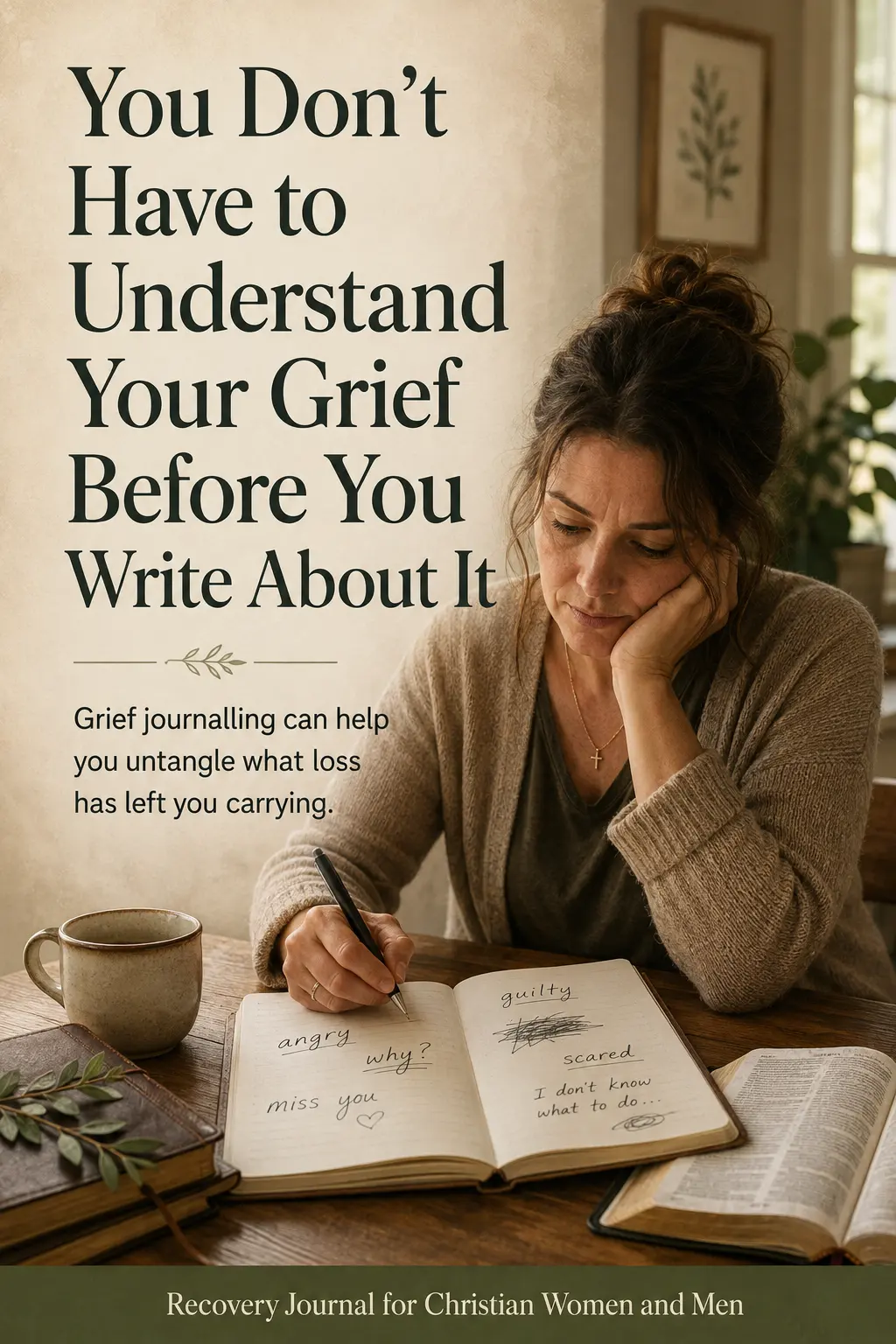
5. What Am I Angry About?
Anger is common in grief and may be directed towards several places at once.
You may be angry with the person who died, medical staff, relatives, friends, yourself, circumstances, or God. Sometimes the target changes as you write because the first answer was only the easiest one to admit.
Private writing gives you room to state the anger before deciding what you think about it.
You can ask what happened, what you believe should have happened instead, whether somebody genuinely wronged you, and whether any part of the anger is connected to fear, guilt, helplessness, or disappointment.
An angry journal entry can conclude without forgiveness, peace, or a lesson learned - those may come later, or they may not. What matters immediately is understanding what has provoked the anger and what place it currently occupies in your grief.
6. What Do I Want to Say to God About This?
This question can produce very different entries depending on the day.
You may want to ask for help, complain, thank God for something, accuse Him of seeming absent, ask why a prayer went unanswered, or admit that you have very little desire to pray at all.
Scripture already contains prayers spoken from distress. The Psalms preserve people asking how long suffering will continue, wondering where God is, remembering His past faithfulness, requesting help, and sometimes remaining troubled while they pray - which gives Christian grief journalling considerable room for honesty.
You might begin by writing directly to God, respond to a particular passage of Scripture, or record the tension between what you believe and what you presently feel. A verse that once comforted you may now trouble you; another may acquire a depth it never had before your loss.
The value lies in bringing your actual grief into your engagement with God rather than writing around the parts that seem spiritually inconvenient.
How Far Should You Follow a Prompt?
There is no fixed length for a useful response.
Sometimes a prompt may produce several pages because one thought opens into another. On another day, you may write three sentences and realise you have said everything available to you.
Follow the question while the writing is revealing something worth examining. You can stop when you begin repeating yourself without discovering anything further, when fatigue sets in, or when the material becomes more than you want to handle at that moment.
You can also abandon the prompt halfway through. If "What am I afraid of?" suddenly leads into a memory of your mother's kitchen, write about the kitchen. The prompt was only the starting point.
This freedom matters because grief rarely arranges itself according to categories. Fear may lead to memory, memory to guilt, guilt to prayer, and prayer to anger. The writing becomes useful through those connections.
What If You Cannot Answer the Prompt?
"I don't know" is a legitimate beginning.
You may genuinely have no answer, or you may need a little time before the answer becomes clear. Write what you do know. Perhaps you cannot identify why you feel angry, but you can describe when the anger appeared. You may not know what you want to say to God, but you can write about why prayer currently feels difficult.
Sometimes the resistance itself is useful material. A question may annoy you because it feels premature, irrelevant, sentimental, or too close to something you would rather leave alone.
Write that objection if you want to. A good grief prompt does not deserve obedience merely because somebody printed it in a journal.
There will also be days when you do not want to write at all. Leave the journal closed. A practice intended to help you examine grief should not become another obligation that produces guilt when you cannot face it.
Using Prompts in a Structured Grief Journal
A structured grief journal can make prompts more useful by placing them within a wider line of thought. Instead of presenting an isolated question, it can use Scripture and reflection to establish the subject before asking you to write about your own experience.
That context matters because a prompt such as "What are you angry about?" can lead almost anywhere. A guided section dealing specifically with anger towards God, guilt after bereavement, loneliness, memory, or fear gives the question a clearer purpose.
The Recovery Journal for Christian Women and Men uses Scripture, reflection, and guided writing in this way. The questions form part of a sequence, while the journal's undated structure allows you to remain with a difficult entry for as long as you need.
When Prompts Stop Being Helpful
A prompt can become unhelpful when you repeatedly force yourself through material that leaves you more distressed without producing greater understanding. You may also find that writing becomes circular, with every question leading back into the same accusation, fear, or imagined alternative. When Grief Journalling Makes You Feel Worse looks more closely at when increased distress means the practice needs changing.
Change the subject when that happens. Write about something less intense, use a more concrete question, leave the journal alone for a while, or discuss what you have noticed with somebody you trust.
Some people find prompts restrictive from the beginning. They write more freely when they start with whatever has their attention that day. Others need structure every time they open the page. Your own response matters more than somebody else's rule about the correct way to journal.
Pay attention to what the writing actually does for you. A useful prompt may help you name something more precisely, recognise a recurring pattern, understand why a particular event affected you, or put into words something that had remained difficult to express. When none of that is happening over time, changing the way you journal is reasonable.
You Do Not Need Fifty Grief Journalling Prompts
The usefulness of a prompt has very little to do with the size of the list it came from.
A handful of questions can be reused throughout grief because your answers will change with circumstances, anniversaries, memories, relationships, faith, and time. "What is hurting most today?" may produce an entirely different entry next month. "What am I afraid of now?" can remain relevant long after the particular fear that first led you to ask it has disappeared.
Choose prompts for their relevance rather than their novelty. Stay with a question when it still has something to show you, and leave it alone when it does not.
Grief journalling prompts are most useful when they reduce the difficulty of beginning and then get out of the way. You supply the important part: what actually happened, what you actually feel, what you remember, what you fear, what you cannot resolve, and what you are prepared to bring honestly onto the page and before God.