
Guided Grief Journal, Blank Notebook or Grief Workbook?
A blank notebook, guided grief journal, and grief workbook can all provide useful ways to write after a loss, but they ask different things of you. A blank notebook gives you complete freedom, a guided journal gives you questions and direction, and a workbook usually asks you to work through more structured exercises. None can remove grief or guarantee that writing will help, so the useful question is which kind of structure suits what you need from the page.
The distinctions are not always as tidy as the labels suggest. One publisher may call something a "grief journal" when it contains dozens of structured exercises; another may call a book a "workbook" even though most of its pages consist of open-ended prompts and writing space. Some guided journals contain teaching material, while some workbooks leave considerable room for personal reflection.
It therefore makes more sense to look inside the book than to rely on the title on the cover. The amount of guidance, the kind of questions being asked, the freedom you have to depart from them, and the assumptions behind the material matter more than whether the publisher chose the word "journal" or "workbook".
There is also no universal best choice for grief. A person who already knows what they need to write may find prompts intrusive, while somebody staring helplessly at a blank page may be grateful for exactly that degree of direction. Your preference can also change. You may begin with a guided journal and later move to an ordinary notebook, or use both for different purposes.
What Does a Blank Notebook Give You?
A blank notebook gives you almost no structure beyond the existence of pages.
You decide when to write, what to write about, how much to write, whether to use sentences at all, and whether yesterday's subject has anything to do with today's. You can write about the person who died, describe an argument, copy a prayer, record a memory, make a list, complain about somebody, work through a practical decision, or leave three weeks between entries without having fallen behind.
That freedom can be extremely useful when you already have something pressing for attention. You do not need a prompt asking about anger when what you urgently need to write about is fear. You do not need to complete an exercise about memories when your mind is occupied by a financial problem or an unanswered question about God.
A blank notebook also gives you privacy from somebody else's framework. Nothing on the page tells you what grief is supposed to look like, which subject should come next, or what kind of answer is expected.
The difficulty is equally obvious: the notebook gives you nothing to push against.
When grief has affected concentration, left your thoughts confused, or made even simple decisions tiring, "write whatever you want" can become a surprisingly demanding instruction. You may have a great deal happening inside you and still have no idea where to begin.
Some people also discover that complete freedom leads them back to the same form of entry every time. They record what happened during the day, repeatedly describe how terrible they feel, or return to one familiar subject because nothing on the page invites them to look elsewhere. That may still be useful writing, but freedom by itself does not guarantee range or depth.
Who Is a Blank Notebook Best Suited To?
A blank notebook tends to suit people who already have a reasonably clear sense of what they want from journalling. You may be accustomed to writing, prefer following your own thoughts, dislike being directed by prompts, or want somewhere private to record whatever grief brings up that day.
It can also suit somebody who wants the journal to do several jobs at once. The same notebook might contain memories, prayers, angry entries, practical lists, notes from conversations, questions about Scripture, and reflections written months apart.
Cost and availability are advantages too. You do not need a specialist product. A cheap notebook can be sufficient if the useful part for you is simply having somewhere to write.
Freedom becomes less helpful when you repeatedly open the notebook and cannot begin, or when you suspect that your writing keeps circling the same few thoughts without helping you examine them any further. In that situation, adding some structure may be more useful than abandoning journalling altogether.
Start with the free sample
No email. No signup.
What Does a Guided Grief Journal Add?
A guided grief journal supplies starting points. Those may take the form of questions, short reflections, themes, Scripture passages, sentence beginnings, or invitations to examine a particular aspect of your loss.
The main advantage is that you do not have to decide from scratch what to write about every time you open the book.
A useful prompt can narrow an enormous subject into something manageable. "How has this loss changed your daily life?" gives your mind somewhere more specific to go than "Write about your grief." A question about anger may help you distinguish anger with yourself from anger with somebody else. A prompt about memory may bring forward an incident you had not thought about for months.
Good guidance can also widen the range of subjects you examine. Left entirely to yourself, you may write often about missing the person but rarely about how the loss has changed your identity, relationships, confidence, routines, future expectations, or faith. A structured sequence can place those areas in front of you without deciding in advance what you should think about them.
The prompt should still leave room for your actual answer. A guided grief journal becomes less useful when its questions quietly demand a particular conclusion, assume that everybody grieves in the same way, or turn grief into a sequence of emotional tasks that must be completed correctly.
Guidance Should Help You Think, Not Supply Your Answer
The quality of a guided journal depends heavily on the quality of its guidance.
Some prompts are so broad that they add little to a blank notebook. Others are so prescriptive that they leave little room for the reader's circumstances. Questions such as "What positive lesson has your loss taught you?" may force meaning onto an experience when the honest answer is that you have found no positive lesson at all.
Better prompts create a subject for reflection while leaving the substance of the response with you. They may ask what has changed, what you fear, what you miss, what you wish you could say, what repeatedly troubles you, or how a particular passage of Scripture meets the circumstances you are actually living through.
That distinction matters especially in Christian grief journalling. Scripture can provide language, challenge, context, lament, promise, and material for genuine reflection. It should not be used to close a difficult question before the grieving person has even had room to state it.
A Christian guided journal should therefore have room for entries such as "I do not understand this verse", "I am angry with God", or "I cannot pray today". The Psalms contain praise alongside complaint, confidence alongside fear, and repeated questions about God's apparent absence. A journal drawing on Scripture has ample biblical precedent for allowing distress to remain distress while it is being examined.
When Is a Guided Grief Journal Likely to Help Most?
Guidance is particularly useful when you want to write but repeatedly do not know how to start. It can also help when your grief feels like one undivided mass and you need questions that help separate memory, anger, guilt, fear, loneliness, faith, practical disruption, and other parts of the experience.
People who find a completely blank page intimidating may also prefer knowing that there is already a subject waiting for them. The prompt removes one decision without removing the freedom to answer in your own way.
A guided format can also make looking back more useful. If entries have addressed recurring themes over time, later rereading may show how your responses to similar questions have changed. You may notice that the same fear has weakened, that anger has become more specific, or that a question about God has changed even though it remains unanswered.
The Recovery Journal for Christian Women and Men uses Scripture, guided reflection, and writing space to provide that kind of structure while allowing you to work through grief at your own pace.
What Is a Grief Workbook?
A grief workbook usually places more emphasis on organised exercises and instruction than a journal does, although publishers use the term loosely.
It may ask you to complete inventories, identify patterns, rate experiences, work through a sequence of activities, answer sets of questions, or learn a particular model for understanding grief. There may be explanatory material followed by exercises designed to apply what you have just read.
That can be useful when you want more than prompts. A workbook may help you examine a defined problem methodically, particularly when you prefer clear tasks over open-ended reflection.
For example, rather than merely asking you to write about guilt, a workbook might help you identify what you believe you did wrong, separate what you knew then from what you know now, examine what responsibility actually belonged to you, and record what remains unresolved. The structure itself is doing more of the work.
The trade-off is that a workbook usually asks you to enter somebody else's framework more fully. That framework may be excellent, unsuitable for you, or useful only in parts.
Some grieving people appreciate being led through a defined process. Others quickly feel as though they are doing homework about the worst thing that has happened to them.
A Workbook Can Create a Stronger Sense of "Doing It Properly"
Structure has a psychological cost as well as a benefit.
A numbered exercise, progress sequence, or set of boxes to complete can create the impression that there is a correct way through the material. You may begin wondering whether you gave a sufficiently thoughtful answer, whether you should finish one exercise before moving to another, or whether leaving several pages blank means you have avoided something important.
That response depends partly on the design and partly on the reader. Some people find visible structure reassuring; others experience it as another obligation at a time when ordinary life already contains too many demands.
Before choosing a workbook, look at how easily you can ignore, skip, postpone, or adapt its exercises. A grief resource should remain useful even when you decide that a particular exercise has nothing to offer you.
Also look at the language surrounding progress. Be cautious when a book implies that completing its exercises will move you predictably towards closure, acceptance, healing, or another defined endpoint. Grief can change greatly over time without following the architecture of a workbook.
How Much Structure Do You Actually Want?
The most useful distinction among these three formats is the amount of structure they provide.
- Blank notebook: you supply the subject, questions, direction, and form.
- Guided grief journal: the book supplies subjects or prompts, while you supply the substance and direction of your response.
- Grief workbook: the book usually supplies both the subject and a more defined process for examining or working through it.
Those are tendencies rather than strict categories, but they provide a practical way to compare books.
Ask what usually happens when you try to write. If ideas come easily once you sit down, a blank notebook may already give you everything you need. Struggling to find a starting point or range of subjects points towards guided prompts, and wanting clearer exercises for examining particular problems points towards a workbook.
Your answer need not apply permanently. A guided journal may help you learn what kinds of questions are useful to you, after which you become comfortable continuing in a blank notebook. You may use a workbook for one difficult subject while keeping a separate journal for everything else.
Look at the Space the Book Gives You to Answer
This is an easily overlooked practical difference.
A grief journal can contain excellent questions and still be frustrating if it gives you four lines to answer something that requires two pages. A workbook may divide your thinking into boxes that suit the exercise but not the way your thoughts actually unfold.
Before buying, look at sample pages if they are available. See how much of each page is instruction and how much is yours. Notice whether you can continue writing elsewhere when you need more space, whether the design invites short answers or sustained reflection, and whether there is room to return to a subject later.
Also consider whether you like writing directly into a designed book. Some people do. Others hesitate because the book feels too attractive, formal, or permanent to spoil with crossed-out sentences, angry handwriting, unfinished thoughts, and entries they may later disagree with.
A grief journal needs to tolerate actual grief writing. Your entries may be untidy, repetitive, contradictory, mundane, angry, devout, doubtful, or unfinished.
Consider the Author's Assumptions About Grief
Every structured resource contains assumptions, even when they are not stated openly.
A book may assume that grief moves through identifiable stages, that forgiveness should be a central goal, that the reader wants to preserve a continuing bond with the person who died, or that meaning should eventually emerge from suffering. A Christian resource may assume a particular theology of providence, prayer, heaven, suffering, or divine purpose.
You do not need a book whose assumptions match every belief you hold, but you should know what framework you are entering.
Read the introduction and several prompts before committing to the whole resource. Pay attention to whether difficult emotions are treated as material for examination or as problems the author is eager to correct. Notice whether the book allows "I don't know" to remain an answer and whether its Christian content makes room for lament, doubt, anger, and unanswered prayer.
A resource intended for catastrophic loss should also be capable of speaking seriously about catastrophic loss. Generic positivity, gratitude exercises imposed regardless of context, or repeated pressure to discover benefits in bereavement can become particularly alienating when the reader is dealing with the death of a child, spouse, parent, sibling, or another devastating loss.
You Can Combine the Formats
There is no practical reason to choose one format and exclude the others.
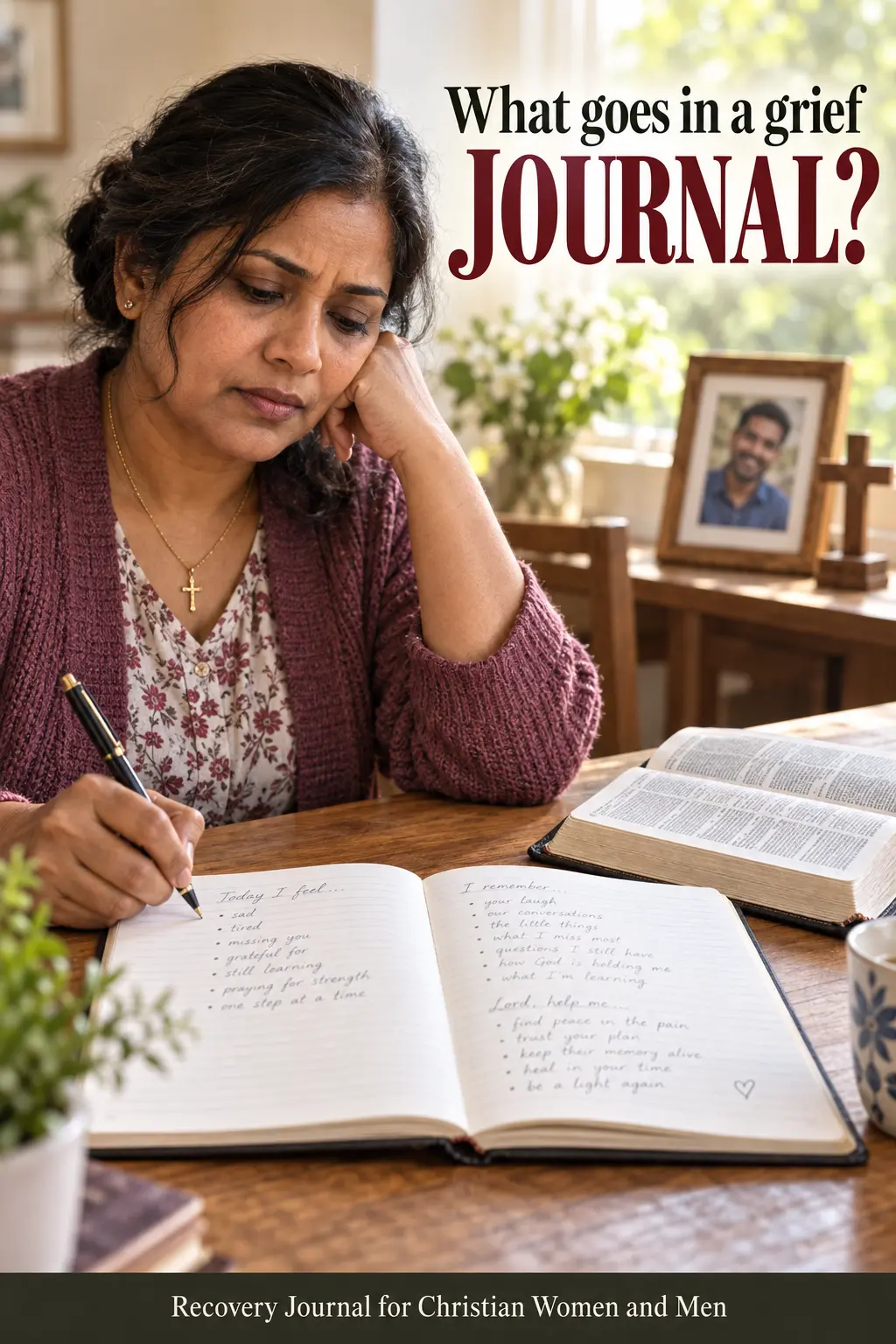
You might use a guided grief journal for deliberate reflection and keep a blank notebook beside it for subjects that arise unexpectedly. A workbook may help with a specific difficulty while your ordinary journal remains the place where you write about daily life, memories, prayer, or whatever else is demanding attention.
You can also borrow the strengths of one format while using another. If you prefer a blank notebook but sometimes become stuck, keep a small list of prompts inside the cover. If a guided journal asks a question that needs far more space than it provides, continue the answer in another notebook and note the date or page number.
The format should serve the writing rather than becoming a rule about where particular thoughts are allowed to go.
Which Is Better for Christian Grief Journalling?
Christian content does not automatically make one format better than another.
A blank notebook gives you complete freedom to write prayers, copy Scripture, argue with a passage, record questions about God, or ignore explicitly spiritual material on a day when something else requires your attention.
A guided Christian grief journal can place Scripture and faith-related questions in front of you deliberately. That may help when grief has disrupted prayer, changed how you read familiar passages, or exposed questions you had never needed to confront before.
A Christian workbook may go further by teaching a particular way of understanding grief or by asking you to complete exercises around faith, forgiveness, lament, identity, or hope.
The important question is what the Christian material actually does. Scripture should contribute to the reflection rather than decorate the page. Prompts should allow honest engagement rather than rewarding the answer the author apparently wants. A grieving Christian may believe deeply in God while also feeling abandoned, furious, doubtful, unable to pray, or bewildered by passages that once seemed straightforward.
A useful Christian resource has room for that conflict because Scripture itself has room for it.
So, Which Should You Choose?
Choose according to the amount and kind of structure that helps you write.
A blank notebook suits freedom, spontaneity, and people who already know what they want to put on the page. A guided grief journal is useful when questions and themes help you begin, broaden what you examine, or give shape to private grief work. A grief workbook suits people who want more instruction and defined exercises around particular parts of grief.
Ignore the label on the cover when the contents tell a different story. Look inside, examine the prompts or exercises, consider the assumptions behind them, and ask whether the book gives you enough freedom to write what is actually true for you.