
How Often Should You Journal? (Why Journalling Does Not Mean Writing Every Day.)
There is no ideal number of times you should write in a grief journal each week. Journalling is most useful when you write often enough to notice, examine, and record what your grief is doing, without turning the practice into a daily obligation that produces guilt when you miss a day.
The idea that a journal ought to be used every day is understandable. Diaries are often dated, habit advice tends to favour daily repetition, and many guided journals are divided into one-entry-per-day formats. That structure can be useful for some purposes, but grief rarely cooperates with it.
Some days your loss may occupy almost every thought. On others, practical life takes over and you have little desire to write. A difficult anniversary may produce several entries in a week, followed by a quieter period when nothing seems urgent enough to put on paper. Your need to write can also change as grief changes.
The useful question is therefore less about achieving a particular frequency and more about whether your journalling is helping you notice what actually needs it.
Why Daily Journalling Can Become a Burden
A grieving person may already be struggling with tiredness, poor concentration, disrupted sleep, responsibilities that used to be shared, and the ordinary work of keeping life functioning after loss. Adding "write in journal" to a compulsory daily checklist can turn something intended to help into another task waiting to accuse you at bedtime.
This becomes especially unhelpful when the empty pages are dated. Missing Tuesday leaves Tuesday blank. Wednesday then begins with evidence that you are already behind. Several missed days can make returning feel like catching up with homework, even though grief recovery has no legitimate timetable of that kind.
That pressure can also distort the writing itself. You may open the journal because the date says you should rather than because anything needs examining. The result is often a thin entry written to satisfy the routine:
"Nothing much today. Still sad. Tired. Will try again tomorrow."
There is nothing wrong with a short entry when that is genuinely all you have to say. The problem begins when you are producing entries chiefly to prevent blank pages from appearing.
Your journal should remain available to your grief. It does not need attendance taken.

Write When Something Has Your Attention
One sensible way to decide when to journal is to notice when a thought, feeling, memory, or event continues asking for your attention after the moment itself has passed.
Perhaps somebody made a casual remark that upset you more than you expected. A memory has returned several times during the day. You feel unusually angry and cannot yet identify why. An approaching anniversary has begun affecting your sleep. A passage of Scripture has troubled or comforted you. You have caught yourself avoiding something connected with the person who died.
Those are natural occasions to write because there is already material present. The journal gives you somewhere to slow the experience down and examine it.
You may also choose to write during quieter periods simply because you want to take stock. Looking back over the previous week or month can reveal changes that are difficult to notice while living through them. An occasional deliberate review can therefore be as useful as writing in response to a strong feeling.
Frequency Can Change With the Stage and Intensity of Grief
There may be periods when you write frequently because grief is producing more material than you can comfortably hold in your head. Early bereavement, anniversaries, family disputes, clearing possessions, legal matters, changes in living arrangements, and sudden reminders can all increase the need for somewhere private to think.
At another point, the journal may sit untouched for days or weeks. That gap does not automatically indicate avoidance, loss of commitment, or a problem with the practice. You may simply have less that needs writing down.
Grief also changes its emphasis. A person who initially writes mainly about shock may later find themselves writing about loneliness, altered family relationships, faith, identity, or the future. The amount of writing may rise again when one of those subjects becomes pressing.
It is therefore perfectly reasonable for your journalling frequency to be irregular. A grief journal records a changing experience, and the pattern of use may change with it.
You Can Journal Several Times in One Day
Daily journalling does not have to mean one entry at a set time. On a particularly difficult day, you may want to write more than once.
A short entry in the morning may record anxiety about something ahead. Later, an event may occur that deserves attention of its own. By evening, you may want to return to what you wrote earlier and see whether your fears matched what actually happened.
Several brief entries can sometimes be more useful than waiting until the end of the day and trying to reconstruct everything from memory. Grief can change quickly, and recording a reaction close to the time it occurs may preserve details that disappear later.
There is equally no requirement to keep doing this once the immediate need has passed. The number of entries should follow the usefulness of writing rather than an arbitrary quota.
Start with the free sample
No email. No signup.
What If You Keep Writing the Same Thing?
Frequent writing sometimes reveals that the same subject is appearing again and again. You may repeatedly write about one memory, one question, one regret, or one source of anger.
Repetition by itself does not tell you whether you are journalling too often. Grief naturally revisits unresolved material, and repeated entries can show how persistent a particular concern remains.
The more useful question is whether the writing is developing. You might begin to notice new details, distinguish guilt from responsibility, identify why a memory keeps returning, or recognise that one apparently simple question contains several different concerns.
When every entry simply repeats the same words without increasing clarity, a pause may be useful. You can leave the subject alone for a while, choose a different prompt, reread earlier entries, or spend some time doing something other than writing about grief.
A journal can help you examine repetitive thought, but constant recording can also become another way of remaining inside it. Frequency should support reflection rather than merely increase the number of pages devoted to the same mental loop.
How Long Should a Journalling Session Last?
Frequency and duration are related because a person who writes for five minutes may reasonably journal more often than somebody who spends forty minutes on a difficult entry.
There is no standard session length that suits every grieving person. Some subjects can be dealt with in a few lines. Others need time because one thought exposes another and the entry gradually becomes more complex.
Stop when you have said what you need to say for now. Fatigue, loss of concentration, increasing frustration, and the sense that you are merely repeating yourself are all reasonable points at which to close the journal.
You can return later. An unfinished entry is not a failed entry, and there is no requirement to resolve a difficult subject in one sitting.
Scheduled Journalling Can Still Be Useful
An irregular approach will suit many grieving people, but some benefit from setting aside a regular time because otherwise the journal disappears beneath work, family obligations, tiredness, or avoidance.
A weekly session, for example, can provide a deliberate opportunity to review what has happened and notice anything that deserves more attention. Someone else may prefer two short periods during the week or a quiet Sunday afternoon when interruptions are less likely.
Regularity can also help people who know they tend to postpone difficult reflection indefinitely. A planned time gives the practice a place in ordinary life without demanding daily performance.
The schedule should remain flexible enough to serve you. Missing the appointed evening does not create arrears. You can write the next day, later in the week, or wait until the next planned session.
Prompts Can Help You Decide Whether There Is Something to Write
Sometimes you know you want to journal but cannot identify a subject. A prompt can test whether something is waiting beneath the surface.
You might ask yourself what has been hardest since your last entry, what keeps returning to mind, what you are avoiding, what you miss most at present, or what you want to say to God about the way things are now.
If one of those questions immediately produces material, write. If none does, closing the journal is also a perfectly reasonable result. You have checked in with yourself and found nothing that presently needs pursuing.
Prompts are particularly useful when the absence of an obvious subject makes you assume there is nothing worth examining. They can also prevent frequent journalling from becoming repetitive because they direct your attention towards a particular aspect of grief rather than asking you to summarise the whole experience each time.
A Structured Journal Should Allow You to Pause
A guided grief journal can create a difficulty when its structure looks like a calendar. Readers may assume that "Day 12" must be completed on the twelfth day and that "Week 6" must begin six weeks after they started.
For grief work, that is unnecessarily rigid.
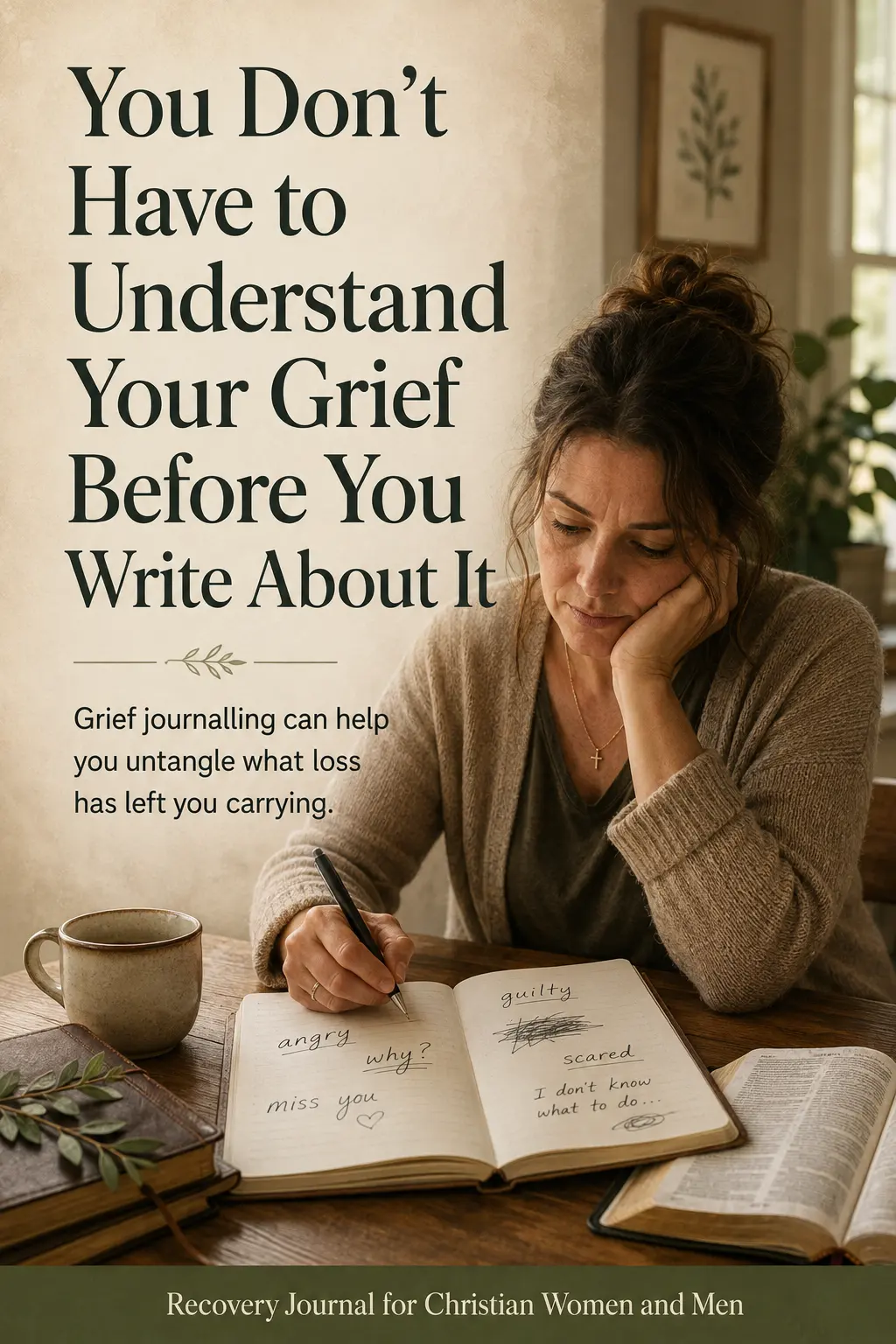
The Recovery Journal for Christian Women and Men was deliberately designed without calendar dates. It has a sequence because the subjects build upon one another, but you decide how quickly you move through that sequence. An entry may take ten minutes, two days, or several returns before you are ready to continue.
The absence of dates also removes the idea of missed days. If you close the journal on Thursday and do not open it again until the following Wednesday, there is no empty run of pages telling you that you have fallen behind.
That design reflects a simple reality: grief recovery cannot sensibly be measured by whether you maintained a perfect writing streak.
Christian Grief Journalling Does Not Require Daily Devotion
Christians can easily add another layer of guilt to journalling by treating it as though every entry were a devotional obligation. Missing a day may then feel spiritually significant rather than merely practical.
Prayer, Scripture, and journalling can certainly belong together, but a grief journal does not need to become a daily demonstration of faithfulness.
You may spend one session wrestling with a Psalm because its words match your own distress. Another entry may consist mainly of anger, confusion, or a memory connected with the person you lost. At another time you may write a prayer, record gratitude, or admit that you currently have very little to say to God.
The Psalms themselves reflect changing states of mind. Some move through complaint, remembrance, petition, and praise; others leave considerable tension unresolved. That range is useful for grief journalling because it gives you permission to bring the experience you actually have rather than forcing every session into the same spiritual pattern.
A week without writing says nothing about what has happened to your faith. It simply means you did not open your journal that week.

When Frequent Journalling Starts to Feel Counterproductive
Pay attention to what happens after you write.
A difficult entry may leave you upset for a while because you have deliberately concentrated on painful material. That alone does not make the session harmful. The more important issue is whether the practice repeatedly leaves you less able to function, more agitated for long periods, or trapped in the same distress without gaining any clearer understanding of what is happening.
Frequency may be part of the problem if you are repeatedly opening the journal whenever anxiety rises and discovering that writing only feeds the anxiety. In that situation, reducing how often you journal may help. You can also change the subject matter, use shorter sessions, introduce more structure, or take a break from writing altogether.
Journalling should remain one tool among several ways of dealing with grief. Spending time with other people, attending to practical life, praying without writing, resting, exercising where appropriate, engaging with ordinary interests, and seeking suitable support can all matter as well.
If the journal begins occupying so much time and emotional attention that the rest of your life is shrinking around it, reconsider how you are using it.
What About Long Gaps?
People sometimes return to a grief journal after weeks or months away and feel that they ought to explain the absence. You owe it no explanation.
Begin with whatever brought you back. Perhaps something happened yesterday. Perhaps an anniversary is approaching. You may have found the journal while tidying a drawer and realised that you wanted to read what you wrote before. The reason can be as ordinary as suddenly having something you want to put into words.
A long gap can itself be interesting when you look back. You may notice that a subject which once demanded frequent entries gradually stopped appearing. Alternatively, the return to writing may show that something you thought had settled has become difficult again.
Either observation gives you information. Neither requires you to fill the missing months retrospectively.
How Often Should You Journal?
Write often enough for journalling to remain useful and available to you. For one person that may mean several times a week; for another, once a week, occasionally, or in clusters around particularly difficult periods.
Use the journal when there is something you want to understand, preserve, question, pray about, or examine more carefully. Leave it closed when writing would add nothing useful, and return without guilt when you have something to say again.
The best frequency is the one that lets the journal serve your grief without allowing the journal itself to become another burden.