
Psalm 56:3 — How do you trust God when grief mocks you?
When Fear Makes Trust Sound Almost Absurd
"When I am afraid, I put my trust in you."
— Psalm 56:3 (NIV)
Reflection
You can know the verse and still feel afraid. You can read the words, repeat them, write them down, and still find grief answering back with its own cruel evidence. The loss happened. The absence remains. The future looks unsafe. Trusting God does not always feel like a peaceful choice. Sometimes it feels like saying something true while pain mocks you for saying it.
Psalm 56:3 does not pretend fear is imaginary. David does not say, “I am not afraid.” He says, “When I am afraid.” That matters. The verse begins inside fear, not after fear has been conquered. It gives the grieving believer a sentence for the moment when fear is still present and trust has to be chosen without emotional proof that everything will be all right.
The wound here is the feeling that trust has become unreasonable. You may believe God is faithful and still feel frightened by what has already happened. You may know God’s promises and still tremble at the thought of another loss, another phone call, another diagnosis, another silence, another day you do not know how to face. Grief does not merely hurt. It argues. It asks why you should trust after what you have seen.
Start with the free sample
No email. No signup.
That is why this verse is so spare. It does not give a long explanation. It does not answer every accusation fear raises. It gives one act of direction: when I am afraid, I put my trust in You. The fear is real, but it is not allowed to become the final authority. The danger is real, but it is not treated as more ultimate than God.
Trust, in this verse, is not the same as pretending. It is not denial. It is not religious cheerfulness. It is the deliberate placing of your frightened self before God. It is choosing where your fear will go. Not because grief has stopped speaking, but because grief is not Lord.
Fear may be present, but it does not have to rule.
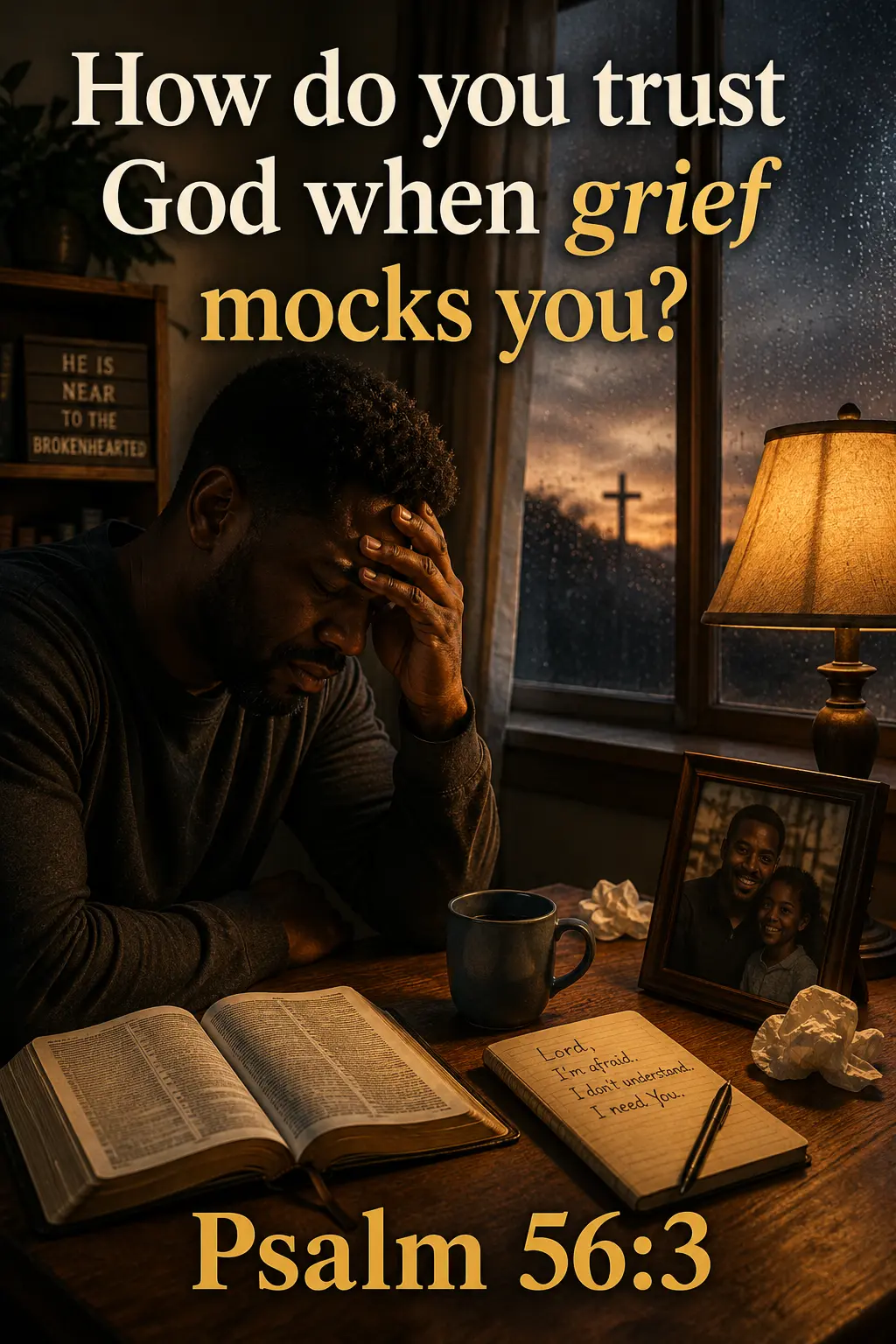
A grieving man sits at a wooden table with an open Bible, a handwritten prayer, a framed photograph, rain against the window, and a cross outside in the fading light. The scene reflects how trust often begins while fear is still present: not with easy confidence, but with the honest prayer, Lord, I’m afraid. I don’t understand. I need You.
Biblical Insight
Psalm 56 comes from a dangerous and humiliating moment in David’s life. The heading connects it with the time when the Philistines seized him in Gath. David is not writing from comfort, safety, or distance. He is under pressure from enemies, surrounded by threat, and forced to reckon with fear as a real condition of his life.
That context matters because Psalm 56:3 is often quoted as though it were a simple calming phrase. It is more rugged than that. David is not offering a decorative thought for nervous moments. He is confessing trust while danger still exists. He is afraid, and he says so. Scripture does not edit out that fear in order to make faith look cleaner.
The verse is important because it joins fear and trust in the same sentence. Many grieving Christians assume those two things cannot coexist. They think fear means trust has failed. They think anxiety proves unbelief. They think a faithful person should feel steady, composed, and spiritually certain. Psalm 56:3 says otherwise. It gives a faithful sentence spoken from within fear itself.
“When I am afraid” is not a confession of defeat. It is honesty before God. David does not hide the condition he is in. He does not perform bravery for God. He names the fear, then places trust in the Lord. That order is vital. The verse does not require the believer to become fearless before trusting. It teaches trust in the very moment fear is present.
“I put my trust in you” is also personal. David does not put trust in an outcome, a timetable, a feeling, or an explanation. He puts his trust in God. That distinction matters deeply in grief. You may not be able to trust that life will return to what it was. You may not be able to trust that tomorrow will feel easier. You may not be able to trust your own strength. But Psalm 56:3 calls you to entrust yourself to God Himself.
This verse does not promise that nothing frightening will happen. It does not say that trust removes grief, prevents future pain, or makes the consequences of loss disappear. David’s life did not become free from danger because he trusted God. Trust did not erase the threat. It gave fear a place to go.
For the grieving Christian, that is not a small thing. Fear after loss often has reasons behind it. You are not frightened because you are foolish. You are frightened because something has shown you how fragile life is. Psalm 56:3 does not scold you for knowing that. It gives you a way to speak from inside that knowledge without surrendering your whole inner life to fear.
The verse also teaches that trust is active. “I put my trust in you” is not merely a feeling that arrives. It is a placing, a turning, a handing over of fear to the Lord again and again. Some days that act may be small. It may be one written sentence. It may be one whispered prayer. It may be opening Scripture when your mind is tired. It may be admitting, without pretence, that fear is present and God is still the One you are turning toward.
In Application
- Name the fear plainly. Psalm 56:3 begins with “When I am afraid,” not with pretending fear has vanished.
- Separate trust from emotional certainty. You may trust God while still feeling shaken by grief.
- Use the verse as a short prayer when your mind cannot manage anything longer: Lord, when I am afraid, I put my trust in You.
- Ask where your fear goes first. Let Scripture redirect it toward God rather than letting grief become the loudest authority.
Practical Journaling
Reflect on Psalm 56:3, then write honestly:
- What fear is grief using to mock my trust in God?
- What has happened that makes trust feel difficult, unreasonable, or unsafe?
- What would it mean today to put this specific fear before God instead of pretending it is not there?
- Write a simple prayer beginning with: Lord, I’m afraid because...

Follow on Medium for More Studies
If writing feels too heavy today, pray only this: Lord, I’m afraid, but I am turning to You.
The Faith Recovery Journal explores this and many similar topics for Christians facing grief, loss, and recovery.