
Psalm 40:1 – Waiting Patiently for the Lord
How Long Do You Keep Waiting When God Has Not Answered Yet?
"I waited patiently for the Lord; he turned to me and heard my cry."
— Psalm 40:1 (NIV)
Reflection
Waiting becomes painful when you have already cried out and nothing has changed. You are not casually hoping for a better day. You are carrying grief, fear, exhaustion, or unanswered prayer, and the delay is not theoretical. It has entered your body. It has changed your sleep. It has made ordinary tasks feel heavier than they should.
Psalm 40:1 does not pretend waiting is easy. David says, “I waited patiently for the Lord.” That sentence carries pressure. It means there was a gap between the cry and the answer. It means faith had to remain alive in the space where God had not yet acted visibly. It means patience was not a calm personality trait. It was endurance under strain.
The wound underneath this verse is simple and hard: How long do I keep waiting? Not how long do I wait when I feel strong. Not how long do I wait when I can see progress. How long do I keep waiting when I have cried, prayed, asked, searched, and still do not know what God is doing?
Start with the free sample
No email. No signup.
This verse does not shame your cry. It includes it. David’s waiting is not silent resignation. He waits, but he also cries out. That matters for grieving Christians who think patience means swallowing pain without words. Biblical patience is not pretending the ache has stopped. It is staying before the Lord while the ache is still speaking.
The comfort of Psalm 40:1 is not that the waiting was short. The comfort is that the Lord turned and heard. Your cry is not wasted because you cannot yet see the answer. Your waiting is not meaningless because it has lasted longer than you wanted. The Lord who hears is not indifferent to the delay you are living through.
Waiting is not the same as being ignored.
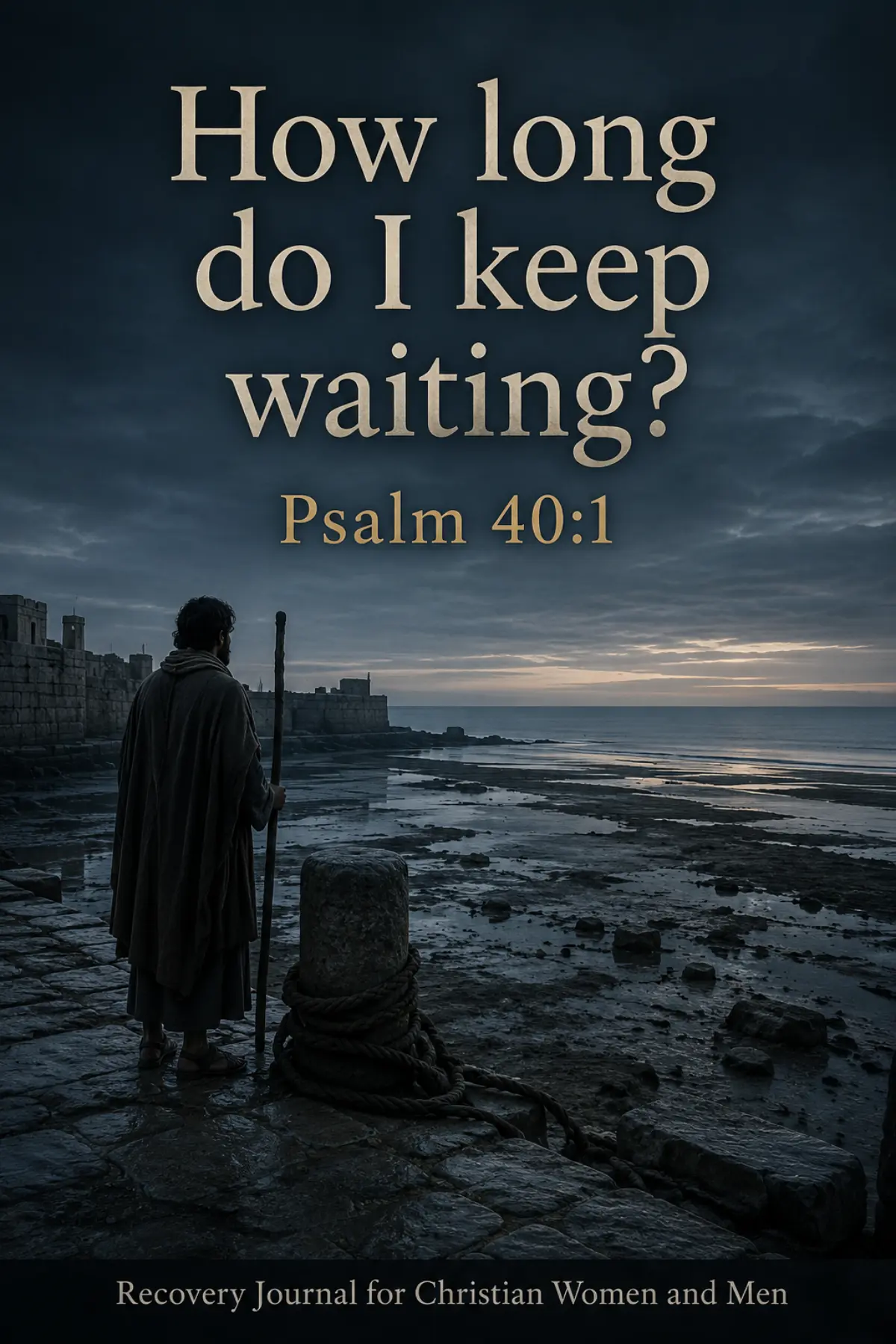
A lone figure stands by a dark shoreline beneath a heavy sky, holding a staff and facing the water while the words “How long do I keep waiting?” sit above Psalm 40:1. The waiting body, the dim horizon, and the quiet space before dawn carry the emotional weight of the verse: the cry has been made, the answer has not yet fully appeared, but the person remains before God.
Biblical Insight
Psalm 40 begins with testimony, but it is testimony that remembers waiting. David does not say, “I asked once and God answered immediately.” He says he waited for the Lord. The Hebrew sense carries the idea of waiting intensely or expectantly. This was not passive delay. It was a deliberate holding on to God while need remained real.
The verse gives us three movements: waiting, God turning, and God hearing. First, David waits. The waiting is not explained away. Scripture allows the delay to stand. That is important because many grieving people feel guilty for finding waiting hard. Psalm 40:1 does not treat waiting as failure. It treats waiting as part of faithful dependence.
Second, “he turned to me.” This is deeply personal language. David is not only saying that God solved a problem. He is saying that God attended to him. The Lord inclined Himself toward the one who cried. For a grieving Christian, this matters because grief often makes prayer feel as if it is vanishing into empty air. Psalm 40 insists that the Lord’s attention is real, even when the timing remains hidden.
Third, “and heard my cry.” God hearing does not mean every answer arrives in the form or speed we demand. Psalm 40:1 is not a promise that all waiting will end today. It is not a guarantee that grief will be removed quickly or that every circumstance will resolve neatly. It does not turn patience into a transaction.
What it does promise is that God is not deaf to His people. The cry matters. The waiting matters. The person waiting matters. David’s testimony gives language to Christians who are still in the middle of the gap. You may not yet be able to say, “He lifted me out,” as later verses describe. But you can still bring your cry to the Lord while you wait.
This verse also corrects a false view of patience. Patience is not emotional numbness. It is not pretending the delay does not hurt. It is not forbidding yourself to ask God hard questions. In Scripture, patient waiting can include tears, urgency, longing, and repeated prayer. Faith does not become false because it is strained.
For the grieving or struggling Christian, Psalm 40:1 gives a steady practice: keep turning your cry toward the Lord. Not because you can control the timing, and not because you can force the answer, but because the Lord hears. Your waiting is held before a God who can turn toward you in mercy.
In Application
- Name the wait honestly. Do not hide from God how long it has felt or how tired you are of carrying the unanswered cry.
- Keep your prayer simple. “Lord, hear my cry” is a faithful prayer when longer words are beyond you.
- Do not confuse delayed help with divine neglect. Psalm 40:1 holds waiting and being heard in the same verse.
- Look for one small act of endurance today: staying before God, opening Scripture, asking for support, or writing one honest sentence.
Practical Journaling
Reflect on Psalm 40:1, then write honestly:
- What have I been waiting for God to do, change, reveal, or heal?
- Where has waiting begun to feel like being ignored?
- What cry have I stopped bringing to God because I am tired of repeating it?
- What would patient waiting look like today if I did not pretend the delay was easy?

Follow on Medium for More Studies
If writing feels too heavy today, write only this: Lord, I am still waiting; hear my cry.
The Faith Recovery Journal explores this and many similar topics for Christians facing grief, loss, and recovery.