
John 16:33 – Peace in the Midst of Trouble
Peace That Does Not Deny the Storm
"I have told you these things, so that in me you may have peace. In this world you will have trouble. But take heart! I have overcome the world."
— John 16:33
Reflection
There are times when life feels less like a problem to solve and more like a storm that will not stop. Grief can come with waves: one memory after another, one pressure after another, one ordinary task made difficult by a heart already worn thin. You may want peace, but the trouble is too loud to ignore.
The scene shows a lighthouse standing on dark rocks in the middle of a violent sea. Waves crash around it. The sky is heavy and storm-dark. Yet the light in the tower burns warm and steady, shining into the chaos. Across the upper part of the image, the text reads, “EVEN IN THE MIDST OF CHAOS, HERE IS THE PROMISE OF CHRIST’S PEACE.” There are no people in the scene. The focus is the lighthouse: fixed, lit, and unmoved by the storm surrounding it.
John 16:33 speaks with that same realism. Jesus does not say, “In this world you might have trouble.” He says, “In this world you will have trouble.” The promise of peace is not built on denial. Christ names the storm before He gives the comfort. That matters for grieving Christians because real peace cannot be based on pretending pain is smaller than it is.
Start with the free sample
No email. No signup.
The peace Jesus gives is “in me.” Not in circumstances becoming safe enough. Not in every question being answered. Not in the removal of every wave. In Him. That means His peace can be present while trouble remains present too. You may still be grieving, still afraid, still under pressure, still facing decisions you did not ask for, and yet Christ’s word can stand like light in the storm.
“Take heart” is not a scolding. It is not Jesus telling wounded people to cheer up. It is His command of courage grounded in His victory: “I have overcome the world.” The storm is real, but it is not ultimate. Trouble is real, but it is not lord. Christ has already spoken the final word over the world that presses against you.
Christ does not promise a stormless life; He promises peace in Himself.
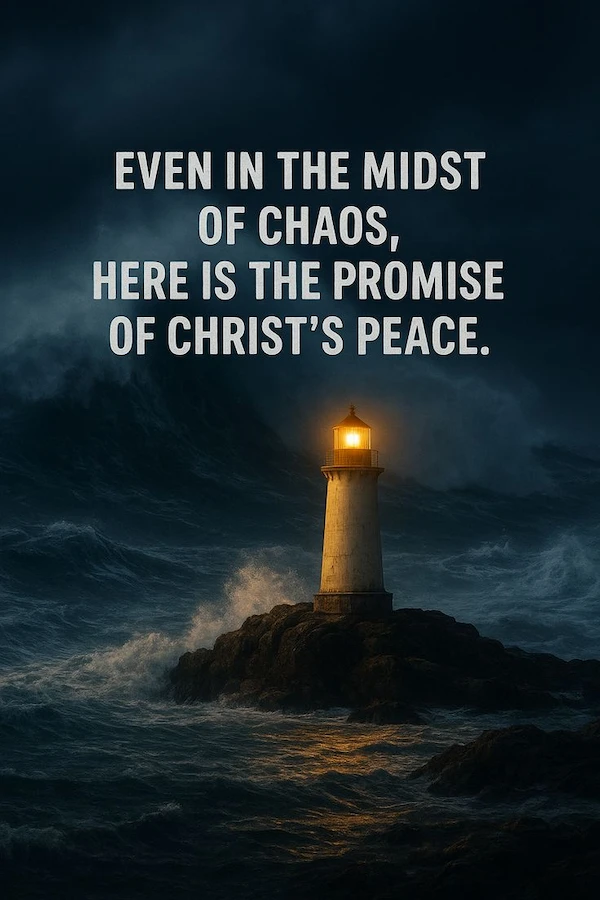
The lighthouse, dark water, crashing waves, and warm lamp make the verse visible. The light does not cancel the storm, and the storm does not extinguish the light. For someone grieving, anxious, or spiritually battered, that matters. Christ’s peace is not fragile comfort that survives only in calm weather. It is the steady promise of the One who has overcome the world while His people are still surrounded by trouble.
Biblical Insight
John 16:33 comes at the end of Jesus’ long words to His disciples before the cross. He has spoken to them about His departure, the coming of the Holy Spirit, their sorrow turning to joy, the world’s hatred, persecution, prayer, and the Father’s love. The disciples are about to face confusion, fear, scattering, and grief. Jesus does not hide that from them.
The verse begins, “I have told you these things, so that in me you may have peace.” His words are meant to prepare them. Peace comes through hearing and trusting what He has said. It is not vague calm. It is peace anchored in Christ’s person, Christ’s truth, and Christ’s victory.
Then Jesus says plainly, “In this world you will have trouble.” This is one of the most honest statements in Scripture. Christian faith does not exempt the believer from suffering. The disciples would face hostility. Christians still face grief, illness, conflict, loss, injustice, fear, and death. The world remains a troubled place.
That honesty matters because shallow comfort often fails grieving people. If peace is presented as the absence of trouble, then every new wave feels like proof that peace has failed. Jesus does not define peace that way. He locates peace in Himself. The trouble remains real, but it is no longer the deepest authority.
“But take heart!” is a call to courage, but it is not courage manufactured from personality or willpower. The reason follows immediately: “I have overcome the world.” Jesus speaks of His victory even before the cross and resurrection unfold in time. He is going to defeat sin, death, the devil, and the powers of this world through His suffering, death, and resurrection.
This verse does not promise that Christians will avoid pain. It does not promise that every storm will stop quickly. It does not promise that grief will feel peaceful at every moment or that the body will never panic. It does not make anxiety, sorrow, or tears into evidence of failed faith. Jesus Himself wept. Jesus Himself was troubled in spirit. The peace He gives is not emotional numbness.
For a grieving or struggling Christian, John 16:33 matters because it gives a truthful frame for suffering. Trouble is expected, but it is not victorious over Christ. Your grief may feel overwhelming, but it does not mean Jesus has lost control. Your heart may shake, but His victory does not shake. The world may press hard against you, but it has already been overcome by Him.
The lighthouse picture helps because it does not pretend the waves are gentle. The light’s strength is shown by the darkness around it. In the same way, Christ’s peace is not proven by an easy life. It is known as His word remains true under pressure, as His presence holds you in fear, and as His victory speaks louder than the trouble you cannot command.
So this verse invites neither denial nor despair. It allows you to name trouble honestly and to take heart honestly. You do not have to minimise the storm. You also do not have to give the storm Christ’s throne.
In Application
- Name the trouble honestly before God instead of pretending peace means it does not hurt.
- Anchor your prayer in Christ Himself, not in the demand that circumstances become calm before you can trust Him.
- Repeat the full truth of the verse: trouble is real, Christ’s peace is real, and Christ has overcome the world.
- Take one courage-shaped step today: ask for help, pray before reacting, rest, open Scripture, or face the next necessary task.
Practical Journaling
Reflect on John 16:33, then write honestly:
- What trouble feels most like a storm around me right now?
- Where have I expected peace to mean the absence of waves rather than the presence of Christ?
- What does “in me you may have peace” ask me to return to today?
- How does Christ’s statement “I have overcome the world” speak to the fear, grief, or pressure I am facing?

Follow on Medium for More Studies
If writing feels too heavy today, pray, “Lord Jesus, be my peace while the storm is still around me.”
The Faith Recovery Journal explores this and many similar topics for Christians facing grief, loss, and recovery.