
Isaiah 57:15 — God with the Lowly
When You Feel Too Crushed to Reach Him
"For this is what the high and exalted One says—he who lives forever, whose name is holy: 'I live in a high and holy place, but also with the one who is contrite and lowly in spirit, to revive the spirit of the lowly and to revive the heart of the contrite.'" — Isaiah 57:15 (NIV)
Reflection
Can God be high and still this close? That is not an abstract question when grief has pushed you low. It becomes painfully personal when you feel too tired to pray properly, too ashamed to speak freely, or too crushed to believe that the Holy One would come near someone in your condition.
Isaiah 57:15 begins with God's height. He is the high and exalted One. He lives forever. His name is holy. Scripture does not make God smaller so that wounded people can approach Him. It shows Him as He is: eternal, holy, lifted above all things.
But the same verse says He also dwells with the contrite and lowly in spirit. That is the astonishment. God is not only above the broken. He is with them. His holiness does not make Him remote from the crushed. It makes His nearness more merciful.
Start with the free sample
No email. No signup.
Catastrophic loss can make you feel spiritually low in every sense. Low in strength. Low in hope. Low in words. Low in patience. Low in the ability to endure another well-meaning sentence from someone who does not understand.
God does not despise that low place. Isaiah says He comes there to revive the spirit of the lowly and the heart of the contrite. Not to scold them for being weak. Not to demand that they climb first. To revive them where they are.
The high and holy God is not too high to sit with the crushed.
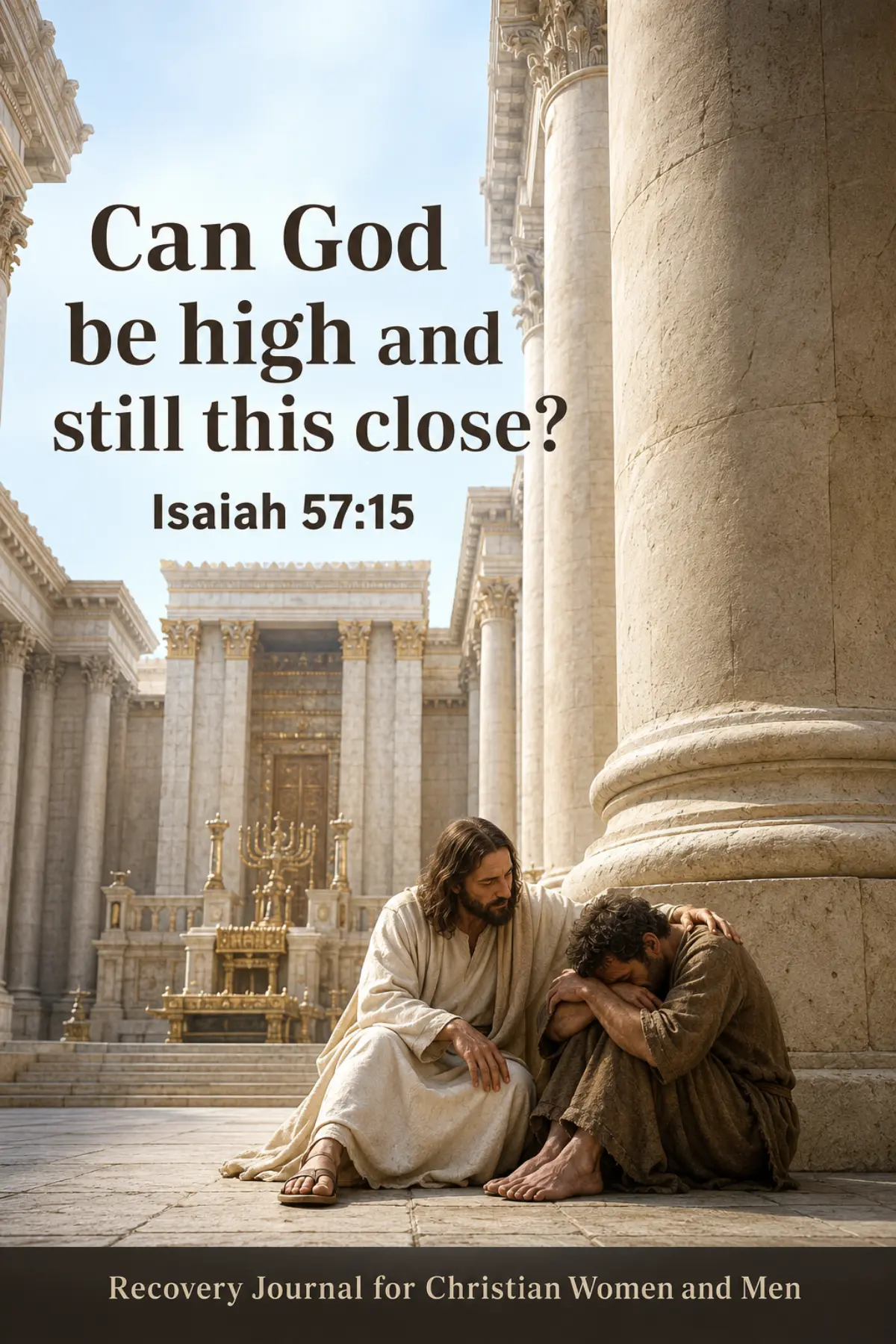
Christ sits beside a bowed, exhausted man at the base of a vast temple column, while the holy place rises behind them. Isaiah 57:15 holds that same tension: God is high and exalted, yet He draws near to the lowly in spirit to revive what grief has pressed down.
Biblical Insight
Isaiah 57:15 gives one of Scripture's clearest pictures of God's majesty and mercy held together. It does not reduce God to a comforting idea. He is "the high and exalted One." He "lives forever." His name is holy. He is not part of creation, not trapped by time, not limited by human weakness, and not morally ordinary.
That matters because grief often makes us want a God who is immediately understandable. We want Him near, but we may struggle with His greatness. We may wonder why the God who is high over all things allowed such devastation. We may feel the distance between our questions and His throne.
Yet the verse does not leave God only in the high and holy place. It says He also lives with "the one who is contrite and lowly in spirit." Contrite does not mean theatrically miserable. Lowly does not mean worthless. It describes the person who has been brought down, humbled, broken open, stripped of self-sufficiency, and made painfully aware of need.
That is why this verse matters for grief. Loss can lower you in ways you never chose. It can take away your confidence, your emotional steadiness, your sense of control, and even your ability to recognise yourself. You may feel spiritually flattened, not because you have rejected God, but because sorrow has pressed you to the ground.
Isaiah 57:15 says God is present there. His nearness is not reserved for the impressive, the composed, or the spiritually articulate. He comes to revive the spirit of the lowly and the heart of the contrite. Revival here is not shallow excitement. It is life breathed back into what has been crushed.
This verse does not promise that grief will vanish because God is near. It does not say the lowly will instantly feel strong. It does not turn sorrow into a quick lesson. It tells you something firmer: the Holy One is not absent from the low place.
For a grieving Christian, that means you do not have to climb into acceptability before God will come near. You do not have to make your prayers sound clean. You do not have to prove you are coping. The God who inhabits eternity also dwells with the one whose spirit is low.
In Application
- Do not assume God's holiness means distance. Isaiah 57:15 shows that the high and holy God also comes near to the lowly.
- Name the low place honestly. If grief has crushed your spirit, do not pretend you are merely tired or mildly sad.
- Stop trying to climb before you pray. This verse says God revives the lowly where they are, not after they become impressive.
- Ask for revival without pretending recovery is complete. You can need God to revive your heart while still feeling broken.
Practical Journaling
Reflect on Isaiah 57:15, then write honestly:
- Where do I feel lowest in spirit right now?
- What makes God feel too high, distant, or holy for me in this grief?
- What would it mean to believe that God dwells with the lowly, not merely above them?
- Where do I need Him to revive what grief has crushed?

Follow on Medium for More Studies
If writing feels too heavy today, write only this: "Lord, I feel low in spirit, and Your Word says You dwell with the lowly."
The Faith Recovery Journal explores this and many similar topics for Christians facing grief, loss, and recovery.