
Psalm 61:2 — What Do You Do When Your Heart Grows Faint?
Cry out to God when grief leaves you overwhelmed and unable to carry yourself
"From the ends of the earth I call to you, I call as my heart grows faint; lead me to the rock that is higher than I." — Psalm 61:2 (NIV)
Reflection
There are days when you do not feel strong enough for your own life. Grief has drained you, pressure keeps building, and even simple things feel too heavy. You try to hold yourself together, but your mind is tired, your body is tired, and your prayers feel more like distress signals than polished devotion. Psalm 61:2 speaks from exactly that place. Not from calm strength, but from collapse.
“I call as my heart grows faint” is not neat religious language. It is the language of a person who knows he is reaching his limit. That matters, because grief often brings you to the end of yourself. You may still be functioning outwardly, still answering messages, still showing up, still doing what needs to be done, but inwardly you feel spent. This verse does not rebuke that weakness. It gives it words.
The scene before us captures that cry vividly. A lone man kneels on dry, broken ground with both arms lifted wide. His face is turned upward in desperation. Above him, dark storm clouds churn across the sky, but several strong shafts of light break through and fall directly around him. “Psalm 61:2” appears near the top in pale green text. The setting feels exposed, dramatic, and urgent, yet not abandoned. The light does not erase the storm, but it breaks into it.
Start with the free sample
No email. No signup.
That is the tension of this verse. David is not pretending to be fine. He is crying from a place that feels far away, overwhelmed, and beyond him. Yet he is still crying out to God. When your heart grows faint, faith may not look like confidence. It may look like calling. It may look like kneeling in the dust and admitting that you need help higher than your own strength.
The request is just as important as the cry: “lead me to the rock that is higher than I.” David does not ask to become self-sufficient. He asks to be led somewhere steadier than himself. That is often what grieving Christians need most. Not a demand to toughen up, but a place of refuge stronger than their own failing resources.
When your heart is failing, God remains higher than your collapse.
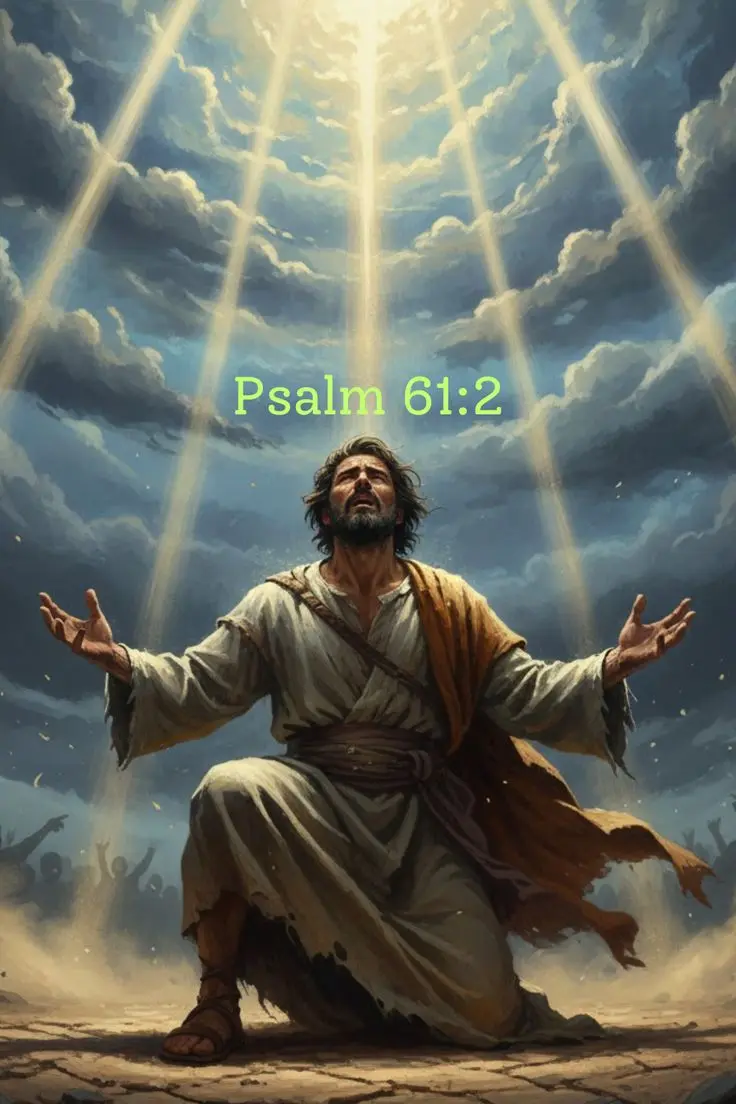
The kneeling figure, the open hands, the cracked ground, and the descending beams of light all press the same truth home. This is not a picture of a person in control. It is a picture of someone crying out because he cannot hold himself up by his own strength. The sky is heavy, the ground is barren, and yet light still reaches him from above. That is how this verse meets grief: not by denying the storm, but by directing the faint heart toward help beyond itself.
Biblical Insight
Psalm 61 is a prayer of David. In verse 2, he speaks as one calling “from the ends of the earth,” which expresses distance, isolation, and deep distress. He is not necessarily describing literal geography as much as spiritual and emotional extremity. He feels far off. He feels overwhelmed. He feels small. That is why the phrase “as my heart grows faint” is so important. Scripture is not embarrassed by human weakness. It tells the truth about it.
The “rock that is higher than I” is a picture of safety, stability, and elevation above danger. David knows he cannot get there alone. He asks God to lead him there. This verse does not promise that grief will vanish in a moment. It does not promise that you will always feel strong if you pray hard enough. And it does not teach that faith means pretending not to be overwhelmed. Instead, it teaches dependence. It teaches that when you are outmatched, God is not.
For a grieving or struggling Christian, that matters deeply. Loss can make you feel disoriented, exposed, and unable to trust your own footing. You may not even know what steady ground looks like anymore. Psalm 61:2 gives you a way to pray when you are beyond neat explanations. It tells you that you can call to God from the faint place, the far place, the frightened place. You do not need to climb into strength before you pray. You cry out because you do not have the strength.
This verse also guards against pride. David does not ask God to merely reinforce what he already has. He asks for something higher than himself. In grief, that is often where hope begins: not in discovering hidden reserves within, but in being led outside yourself to the Lord who remains firm when you are not.
In Application
- Pray honestly when you are overwhelmed. Use the language of Psalm 61:2 instead of trying to sound composed.
- Name where your heart is faint. Be specific about the grief, fear, exhaustion, or pressure that is breaking you down.
- Ask God for leading, not just relief. The verse points to a rock higher than you, not merely a lighter mood.
- Stop measuring faith by how strong you feel. In this psalm, faith is expressed by crying out when strength is gone.
Practical Journaling
Reflect on Psalm 61:2, then write honestly:
- Where in my life do I feel most overwhelmed right now?
- What does “my heart grows faint” look like in real terms for me today?
- Where have I been trying to carry myself instead of asking God to lead me?
- What would it mean for me to seek the “rock that is higher than I” in this present struggle?

Follow on Medium for More Studies
If writing feels too heavy today, pray simply: Lord, my heart is faint; lead me to the rock that is higher than I.
The Faith Recovery Journal explores this and many similar topics for Christians facing grief, loss, and recovery.