
Ephesians 4:31 — Letting Go of Bitterness
Bitterness is still burning in you, and you know it
"Get rid of all bitterness, rage and anger, brawling and slander, along with every form of malice. Be kind and compassionate to one another, forgiving each other, just as in Christ God forgave you."
— Eph. 4:31–32 (NIV)
Reflection
You know what is still burning in you. You do not need anyone to name it. It has a face, a voice, a specific moment attached to it. Bitterness does not arrive as a stranger; it arrives as a response to something real, something done to you, something lost, something broken by another person's hands. The wound was genuine. The anger that followed was understandable. But somewhere between the wound and today, the fire stopped being a reaction and started being a residence.
Paul does not tell you that your anger was wrong to feel. He tells you to get rid of it. That verb matters. "Get rid of" is not "suppress" or "deny" or "smile over." It is an active, deliberate removal, like emptying a vessel of what it has been holding. The assumption behind the command is honest: you have been holding it. The question is whether you are ready to put it down.
Bitterness convinces you that holding on is strength. It is not. It is the slow burning of your own interior, consuming energy you need for living, for grieving, for recovering. Every day you carry it is another day it shapes how you see God, how you treat others, and how little peace you actually have.
Start with the free sample
No email. No signup.
The second half of Paul's command is the harder half: forgive as God in Christ forgave you. Not forgive because the other person deserves it. Not forgive because the offence was small. Forgive because you yourself have stood before God with a debt you could not pay, and He absorbed it. That is the standard. It is high. It is meant to be. But it is not without power, because the same grace that forgave you is the grace that equips you to forgive.
You cannot carry bitterness and receive God's renewal at the same time. One has to go.
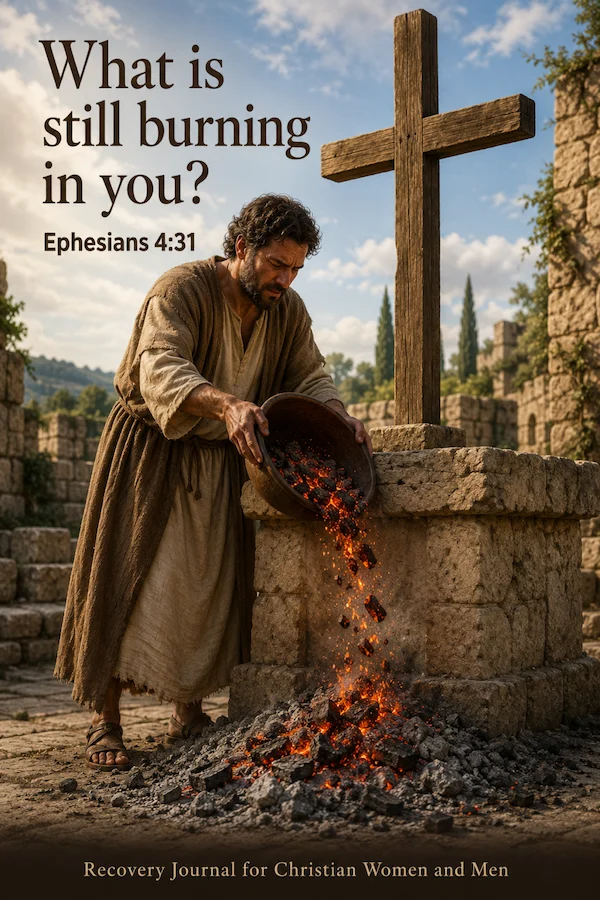
A man empties a bowl of burning coals onto the ground at the foot of a wooden cross. The fire scatters and begins to die. The cross stands behind him, silent and solid. That is the act Paul is describing: a deliberate emptying of what has been burning inside you, done in the presence of the cross, where the only debt that truly mattered was already paid. The coals were real. The heat was real. But they do not have to stay.
Biblical Insight
Eph. 4 addresses the conduct of believers within the body of Christ, people living together under shared pressure, grief, and imperfection. Paul lists bitterness, rage, anger, brawling, slander, and malice not as abstract vices but as the specific toxins that destroy community and corrode the individual soul. He places forgiveness at the end of the list as the only adequate replacement, and he grounds it entirely in the gospel: "just as in Christ God forgave you."
This grounding is not decorative. It is load-bearing. Paul does not tell you to forgive because it will make you feel better, or because the relationship deserves saving, or because time heals all wounds. He tells you to forgive because God forgave you at infinite cost, and that reality is the only foundation strong enough to bear the weight of genuine forgiveness. Without the cross, the command is crushing. With it, the command becomes, however painfully, possible.
What this verse does not promise is that forgiveness will be instant, painless, or once-and-done. It does not promise that the other person will change, apologise, or even know that you have forgiven them. Forgiveness here is not primarily about the offender. It is about what you are no longer willing to let live inside you.
In Application
- Name the bitterness specifically in prayer. Do not generalise it. Tell God exactly what happened, who did it, and what it cost you. Honesty is the beginning of release.
- Separate forgiveness from reconciliation. You can forgive someone you will never speak to again. Forgiveness is a decision about what you carry; reconciliation is a separate question about relationship.
- Return to the cross as your reference point. Ask God to remind you of the size of what He forgave in you before you weigh the size of what was done to you.
- Replace bitterness with a concrete act of kindness, not toward the person who hurt you necessarily, but toward someone in front of you today. Compassion actively practised displaces bitterness over time.
Practical Journaling
Reflect on Eph. 4:31–32, then write honestly:
- What is still burning in you? Name the bitterness, the rage, or the resentment you have been carrying, and how long you have been carrying it.
- What has holding onto this bitterness actually cost you, in your relationships, your peace, your faith, or your energy?
- When you consider that God forgave you in Christ as the basis for forgiving others, what is your honest response? Does it feel possible, or does it feel too much to ask?
- What would it look like, in one practical step, to begin emptying the bowl rather than keeping it full?

Follow on Medium for More Studies
If writing feels too heavy today, simply read the verse slowly and ask God to show you what He is ready to take from you.
The Faith Recovery Journal explores this and many similar topics for Christians facing grief, loss, and recovery.