
Matthew 18:21–22 — Forgiving Without Limit
When Forgiveness Feels Like Another Burden
"Then Peter came to Jesus and asked, 'Lord, how many times shall I forgive my brother or sister who sins against me? Up to seven times?' Jesus answered, 'I tell you, not seven times, but seventy-seven times.'"
— Matthew 18:21-22 (NIV)
Reflection
How many times is enough when the same wound keeps being touched? How many times are you expected to release the same offence, the same memory, the same bitterness, the same ache in your chest when someone else has already moved on?
Forgiveness can sound simple until grief is involved. Then it becomes harder. The people who hurt you may not understand what they damaged. They may never apologise properly. They may speak lightly about what still costs you sleep, prayer, peace, and concentration.
Peter's question is not foolish. It is painfully human. He wants a number. He wants a limit. He wants to know when obedience has finally done enough. Jesus does not answer by making forgiveness small. He answers by showing that forgiveness cannot be reduced to a tally.
Start with the free sample
No email. No signup.
That does not mean pretending the wound never happened. It does not mean calling evil good. It does not mean returning to unsafe people or handing them fresh access to your life. Forgiveness is not the same as trust, reconciliation, denial, or silence.
But Jesus does confront the part of us that wants to keep counting until we have permission to stop obeying Him. He knows how resentment tightens itself around the soul. He knows how grief can turn injury into a rope we keep gripping because letting go feels like losing control.
Forgiveness is not pretending the rope is harmless; it is refusing to let it own your hands forever.
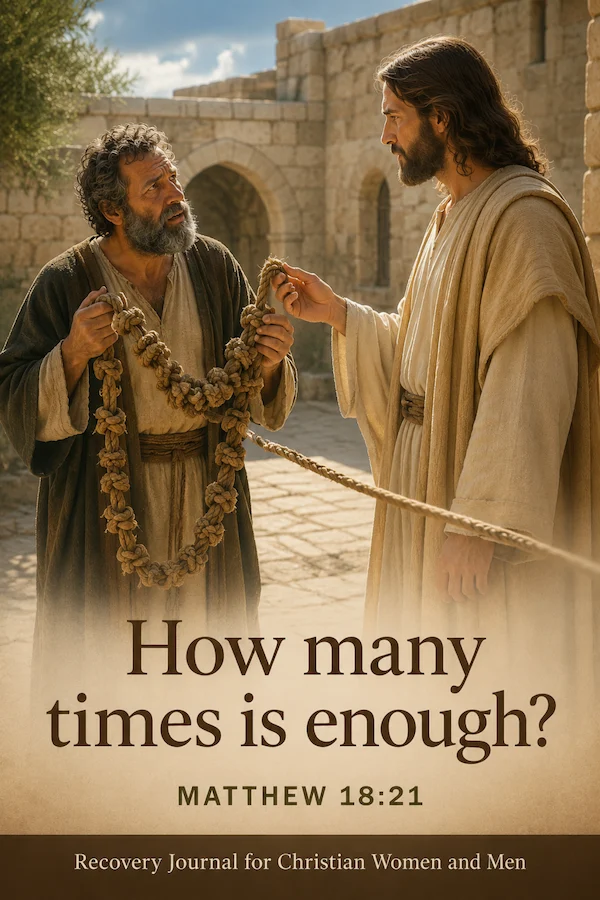
A man holds a heavy, tangled rope while Jesus takes one strand in His hand. The question on the scene is the question many wounded Christians carry: how many times is enough? Matthew 18:21 does not erase the pain of repeated hurt, but it shows Christ entering the place where forgiveness feels knotted, costly, and almost impossible to release.
Biblical Insight
Matthew 18 places Peter's question inside a larger teaching about sin, correction, mercy, and life within the family of God. Peter asks how many times he must forgive someone who sins against him. His suggested answer, seven times, sounds generous. Jesus answers, "not seven times, but seventy-seven times."
The point is not that a Christian should keep a careful record up to number seventy-seven and then finally become free to hate. Jesus is attacking the accounting spirit. Peter wants forgiveness to fit inside a limit. Jesus shows that kingdom mercy cannot be managed like a debt ledger.
This matters deeply in grief because loss often exposes old injuries and creates new ones. People say cruel things. Families fracture. Friends disappear. Some people turn your pain into gossip. Others make demands when you have nothing left to give. Forgiveness in that place is not sentimental. It can feel like Christ asking for something you do not have.
But Jesus does not command forgiveness because your pain is small. He commands it because bitterness is dangerous. It binds you to the injury. It keeps the offender at the centre of your inner life. It gives the wound continuing authority over your thoughts, words, prayers, and sleep.
This verse does not promise that forgiveness will be quick, easy, or emotionally clean. It does not require you to deny the seriousness of what happened. It does not require you to restore trust where trust has been destroyed. It does call you to bring the counting, the resentment, the repeated offence, and the exhausted question before Christ.
In Application
- Do not confuse forgiveness with pretending. You can forgive while still naming the wrong clearly and refusing to minimise what happened.
- Stop using a tally as proof that you have suffered enough. Jesus is not asking you to count better; He is calling you to bring the whole burden to Him.
- Keep boundaries where they are needed. Forgiveness does not require you to become available for repeated harm.
- Watch for bitterness hiding inside grief. Some anger is understandable, but if it becomes the thing you keep feeding, it will begin to feed on you.
Practical Journaling
Reflect on Matthew 18:21, then write honestly:
- Whose offence am I still counting, and what number do I feel they have already reached?
- What am I afraid will happen if I stop gripping this injury so tightly?
- Where do I need to distinguish forgiveness from trust, reconciliation, or access?
- What would it mean today to place one strand of this tangled anger into Christ's hand?

Follow on Medium for More Studies
If writing feels too heavy today, write only this: "Lord, I am still counting, and I need You to meet me there."
The Faith Recovery Journal explores this and many similar topics for Christians facing grief, loss, and recovery.