
Romans 12:12 — What Do You Pray When Grief Leaves You Without Words?
When Prayer Feels Hardest but You Still Need Somewhere to Turn
"Be joyful in hope, patient in affliction, faithful in prayer."
— Romans 12:12 (NIV)
Reflection
Grief can make prayer difficult in ways you did not expect. You may still believe in God, still want to pray, and still find that no words come. The same thoughts circle repeatedly, concentration disappears, and the prayers that once came naturally now feel strained or empty.
Romans 12:12 does not assume an easy life. Paul places hope, affliction, and prayer together because Christian faith has to function inside difficulty. "Patient in affliction" acknowledges suffering directly. "Faithful in prayer" speaks to what happens while that suffering continues.
That matters when grief has exhausted language. Faithfulness in prayer does not require eloquence. A prayer can be a sentence, a repeated phrase, a Psalm read slowly, or simply bringing the same pain before God again because nothing has changed since yesterday.
Start with the free sample
No email. No signup.
The command to be "joyful in hope" can also feel difficult when grief has changed what you expect from the future. Paul is not asking you to enjoy affliction. Christian hope reaches beyond present pain, while patience allows you to remain with God through circumstances that have not yet improved.
Prayer becomes part of that endurance. You may arrive with anger, confusion, exhaustion, silence, or the same unanswered question you brought yesterday. Faithful prayer can continue even when grief has taken away the words.
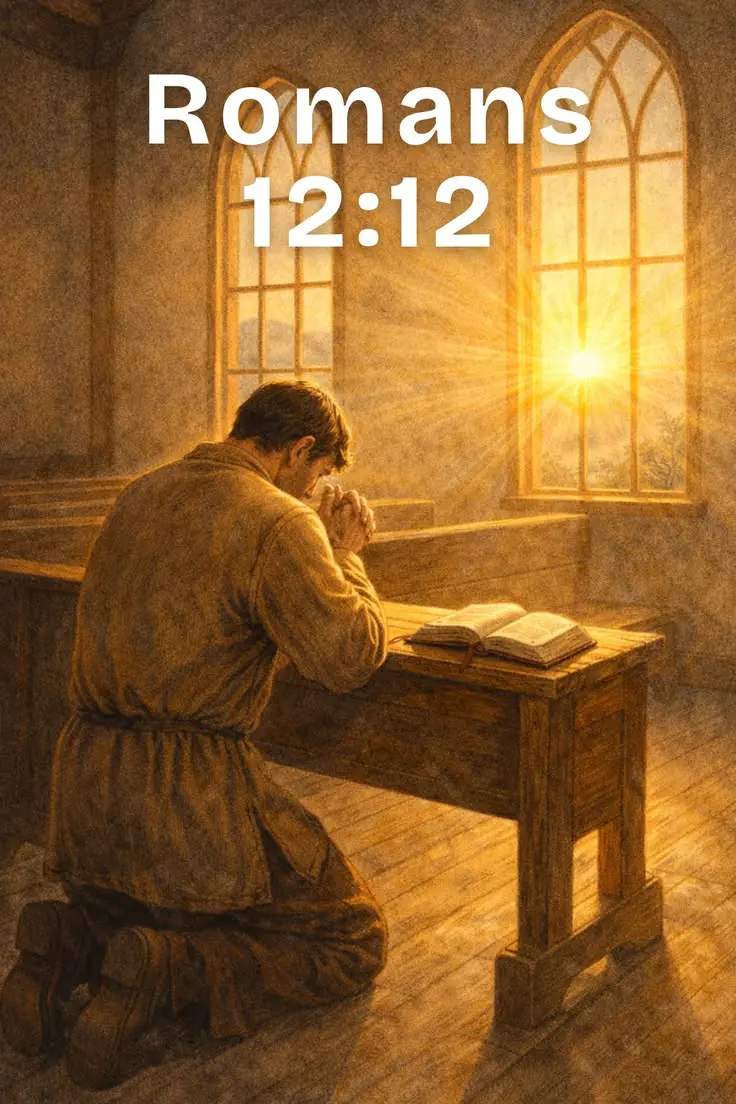
The kneeling man, open Bible, empty church, and warm light through the windows reflect prayer stripped back to its essentials. Nothing in the scene suggests that his grief has been resolved. Romans 12:12 places value on the simple act of continuing to turn towards God when affliction has made prayer difficult.
Biblical Insight
Romans 12 moves from doctrine into practical Christian living. Paul has spent much of the letter explaining sin, grace, faith, salvation, and God's mercy. He then describes the kind of life that should grow from those truths. Verse 12 sits amongst a series of concise instructions about love, service, perseverance, generosity, hospitality, and relationships.
The three phrases belong together. Hope gives the Christian a future beyond immediate circumstances. Affliction describes the pressure under which that hope must survive. Prayer keeps the believer turned towards God while the pressure continues.
The word translated "faithful" carries the sense of persistence or devoted continuation. Paul therefore gives no impression that prayer always feels emotionally satisfying. Persistence becomes especially important when circumstances offer little encouragement and when repeated prayer appears to have changed nothing.
For a grieving Christian, this removes some unnecessary pressure. You do not need to manufacture spiritual intensity before you pray. You can pray badly, briefly, tearfully, distractedly, or without knowing what you want to say. Faithfulness concerns continuing to bring yourself before God rather than producing impressive words.
Paul's instruction also leaves room for lament. Scripture contains prayers of complaint, fear, anger, confusion, and apparent abandonment. Faithful prayer can therefore include what hurts rather than requiring grief to be translated into respectable religious language before God will hear it.
In Application
- When words fail, use one short sentence repeatedly rather than forcing a longer prayer.
- Read a Psalm aloud when your own language feels exhausted and let its words carry the prayer for you.
- Bring the unresolved parts of grief directly to God, including anger, confusion, and disappointment.
- Measure faithfulness by whether you continue turning towards God, not by how emotional, eloquent, or confident the prayer sounds.
Practical Journaling
Reflect on Romans 12:12, then write honestly:
- What has become hardest to say to God since your loss?
- Which prayer have you repeated so often that you are tired of hearing yourself ask it?
- What would faithful prayer look like if you stopped expecting yourself to pray well?
- Which part of Romans 12:12 feels hardest right now: hope, patience, or prayer, and why?

Follow on Medium for More Studies
If writing feels too heavy today, choose one short prayer and repeat it slowly before God without trying to add anything else.
The Faith Recovery Journal explores this and many similar topics for Christians facing grief, loss, and recovery.