
What Is the Best Grief Journal for Me?
The best grief journal for you is the one whose structure matches how you actually need to write. Some people need a blank page, some need prompts, and others benefit from a more structured workbook. A journal can help you examine grief, but it cannot remove the loss or guarantee that writing will help.
That answer is less satisfying than naming one book and declaring it the winner, but grief journals are too different for that to be useful. A beautifully designed journal may give you almost nothing to work with. A plain notebook may be exactly right for somebody who already knows what they need to say. A heavily guided workbook may give one person the method they need and feel like an imposition to another.
Your choice should therefore begin with what happens when you sit down to write. Notice whether you usually know what you want to say or need a question to get started, whether you want Scripture and prayer built into the process, and whether you want a book that helps you examine parts of grief that would not otherwise occur to you.
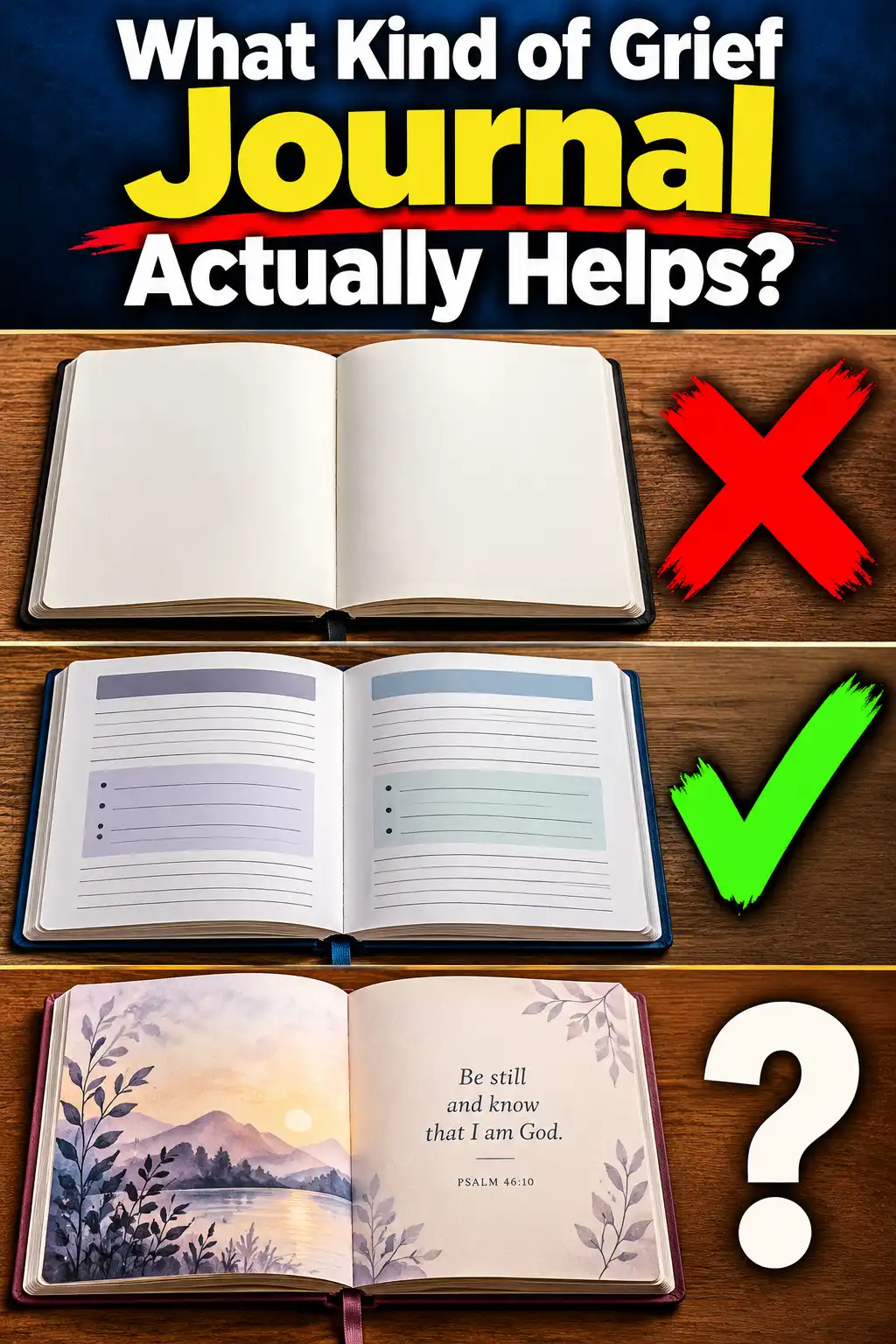
Start With How Much Guidance You Want
The simplest difference between grief journals is how much structure they provide.
A blank notebook gives you complete freedom. You choose the subject, the length, the form, and the frequency. That can be ideal when you already have something pressing for attention or dislike being directed by prompts.
A guided grief journal gives you somewhere to begin. It may use questions, themes, Scripture, reflection, prayer, or short pieces of explanatory material to focus your attention before you write.
A grief workbook usually goes further. It may provide exercises, sequences, inventories, or more detailed instructions designed to help you examine particular problems methodically.
None of those formats is inherently superior. The useful distinction is whether the amount of guidance helps you think or gets in your way.
Staring at a blank page without knowing where to start suggests a guided journal, an urge to ignore prompts and write about something else suggests a notebook, and a liking for defined exercises and a clearer process suggests a workbook.
If you want a fuller comparison of the three formats, see Guided Grief Journal, Blank Notebook or Grief Workbook?
Look Inside Before You Buy
The cover tells you almost nothing about whether a grief journal will be useful.
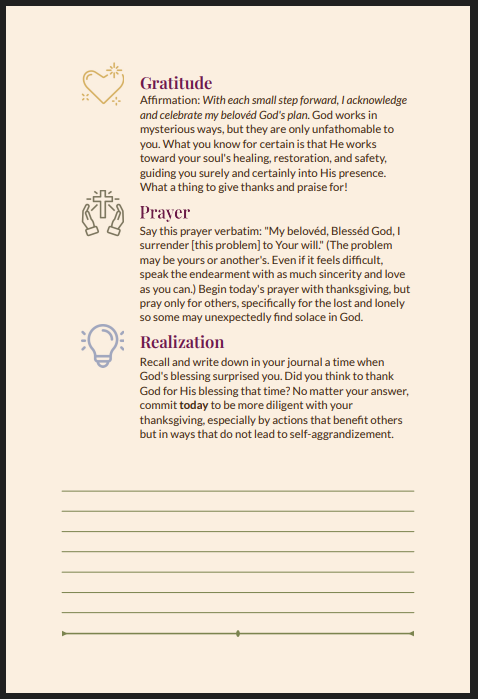
Whenever possible, look at several interior pages, read the prompts, and check how much of each page is occupied by instructions and how much is left for your response. The writing space should be usable, and it should be clear whether the book expects short answers or sustained reflection.
Pay attention to what the prompts actually ask you to do. A journal may look substantial because every page contains text, yet offer little beyond quotations and broad encouragement. Another may contain fewer words but ask precise questions that help you examine memory, fear, guilt, faith, or practical changes after loss.
You should also be able to see whether the journal allows disagreement and uncertainty. A prompt that assumes every bereaved person will eventually discover a blessing, lesson, purpose, or spiritual breakthrough may become irritating very quickly if that is not where you are. The interior pages tell you far more than the cover about how seriously the book has been designed around grief.
For a closer look at what a well-built interior contains, What Should a Genuine Grief Journal Look Like Inside? walks through a real set of pages.
Start with the free sample
No email. No signup.
Ask Whether the Prompts Leave Room for Your Actual Answer
A useful prompt gives you a subject without deciding what you are supposed to discover.
"What has changed since this loss?" is open enough to allow almost any answer. You may write about loneliness, money, family relationships, sleep, faith, or something else entirely.
A prompt such as "How are you moving on?" is much narrower because it assumes that moving on is already under way and is the right direction for the entry.
Good grief journalling should permit answers such as "I don't know", "I am still angry", "I cannot make sense of this", or "I do not believe that applies to me".
The same principle matters in Christian journals. A question about prayer should leave room for the person who cannot pray. A passage of Scripture may comfort you, trouble you, seem irrelevant that day, or raise a question you cannot answer. A useful journal gives those reactions somewhere to go.
Grief Journalling Prompts and How to Use Them shows what well-built prompts look like in practice.
Decide Whether You Want a Christian Grief Journal
For a Christian, faith may be inseparable from grief. Loss can affect prayer, trust, Scripture, worship, assumptions about God's protection, and beliefs about what suffering means.
A Christian grief journal can help by bringing those questions directly into the writing rather than treating faith as something separate from bereavement.
Look closely at how the journal uses Scripture. Bible verses should contribute to the reflection: they may provide language for lament, challenge a conclusion, offer comfort, raise a difficult question, or give you something specific to respond to, and they become less useful when they appear as decoration or as a shortcut around the reader's distress.
The Psalms give grief writing ample precedent, since they move between complaint, praise, and questions about God's apparent absence without insisting on a tidy ending. A Christian journal should have room for that range rather than assuming that every entry must finish with confidence.
Think About the Kind of Grief You Need to Examine
Some journals focus heavily on emotion, others on memory, self-care, gratitude, faith, or practical coping, and your grief may require more range than any one of those approaches provides.
Bereavement can affect identity, relationships, finances, sleep, concentration, faith, and the way you remember the person who died, and it can bring guilt, anger, fear, relief, or loneliness alongside the sorrow.
A good guided journal should expose you to subjects you might otherwise overlook without trying to make every possible issue equally important.
This is one reason it is worth scanning the contents before buying. If nearly every prompt asks how you feel today, the book may become repetitive. If it spends half its pages on gratitude and positivity, that may tell you more about the author's philosophy than about your needs.
Make Sure There Is Enough Space to Write
A grief journal can ask an excellent question and still fail practically if it gives you nowhere to answer it.
Some entries will be a single sentence, while other subjects may produce several pages.
Look at the amount of space provided and ask whether it matches the depth of the questions. A prompt about a traumatic memory, guilt, anger with God, or the death of a child may need considerably more room than a handful of ruled lines.
Extra pages elsewhere in the book are useful because they allow you to continue without squeezing an important entry into a predetermined space.
Line spacing, margins, type size, and contrast also matter. The journal has to be physically comfortable enough to use regularly.
Do You Want to Write Every Day?
Some grief journals are built around daily entries. That structure may suit you if regular writing helps establish the habit or if you like having a clear place to begin each day, but it can also create unnecessary pressure.
Grief does not produce equally useful material every twenty-four hours. You may write several days in succession and then leave the journal alone for a fortnight. You may need time after a difficult entry before returning to it.
Check whether the book treats missed days as a problem. A dated journal can make gaps feel conspicuous, and one organised around Day 1, Day 2, Day 3 and so on can suggest that you are falling behind. Numbered entries without calendar dates avoid most of that, because a missed week leaves no run of empty pages behind it. A sequence can still provide structure without imposing a deadline: you can work through one entry, leave the book alone, and return when you are ready.
How Often Should You Journal? goes further into why a grief journal does not need a daily schedule.
Consider Whether You Want to Reread What You Write
A grief journal can become useful again later because it preserves a record of what you were thinking at particular points in bereavement.
You may want to notice recurring themes, compare how you now respond to an old fear, or see whether something that once dominated your writing has become less important.
If rereading matters to you, a journal organised around identifiable themes can make comparison easier. You can see how you wrote about anger, memory, faith, guilt, relationships, or fear at different points.
A completely free-form notebook preserves the writing just as well, but you may have to search through entries to find the subject you want.
There is no requirement to reread old entries at all. Some people find it useful, while others prefer to leave what they wrote where it belongs. If you do go back, How to Read Your Old Grief-Journal Entries explains how to do it without turning the exercise into a test.

Do Not Pay Extra Merely for Prettiness
A grief journal is still a physical object, and there is nothing wrong with wanting one that looks good and feels pleasant to use.
Paper quality, typography, binding, cover design, and visual calm can make the experience of writing more inviting. A book you enjoy handling may be one you are more willing to return to, provided those features sit alongside useful content rather than substitute for it.
Before paying substantially more for an attractive journal, compare the inside with a cheaper alternative. If both contain generic quotations followed by blank pages, you may be paying for production rather than better grief support.
That can still be a legitimate choice if you value the physical object. You should simply know what the extra money is buying.
Do You Need a Journal That Gives You Somewhere to Start?
Difficulty beginning is one of the strongest reasons to choose a guided journal.
You may know that you need to write and still have no idea what to say once the page is in front of you. Grief can leave thoughts confused, concentration poor, or emotions difficult to identify.
A specific question reduces the size of the task. "What is troubling me most today?" is easier to answer than an empty page asking for everything.
If this is your main problem, choose a journal whose prompts are concrete enough to help without becoming intrusive. How to Start a Grief Journal When You Don't Know What to Write offers practical first sentences for exactly that moment.
The Recovery Journal for Christian Women and Men uses Scripture, reflection, prayer, and guided writing to provide that kind of starting point while allowing you to work through the material at your own pace.
Be Suspicious of Promises About What the Journal Will Achieve
A grief journal is a tool, and the claims made for it should reflect that.
Be cautious when a product promises healing within a fixed number of days, suggests that completing its exercises will bring closure, or implies that persistent pain means you have failed to follow the process properly.
Writing can help you understand parts of grief, identify patterns, preserve memories, examine difficult thoughts, and give private expression to things you may not want to discuss elsewhere, but it cannot determine how long grief will last or what shape your life will eventually take.
A serious grief journal should respect the difference between giving someone a useful method and promising an outcome it cannot control.
You Are Allowed to Use More Than One Kind of Journal
Your choice need not be permanent or exclusive.
You may use a guided journal for deliberate grief work and keep a blank notebook for whatever arises between entries. A workbook may help you examine one particular issue while a freer journal remains the place where you write memories, prayers, or everyday reactions.
You can also outgrow a format. Prompts may be useful when you first begin and increasingly unnecessary once you learn what kinds of questions help you think.
The journal serves the writing. There is no virtue in remaining loyal to a format that has stopped being useful.
So, What Is the Best Grief Journal for You?
Choose the journal whose structure solves the problem you actually have: a blank notebook if you already know what you want to say, prompts if you struggle to begin, a workbook if you want more defined exercises. If faith is central to your grief, check whether the Christian material engages seriously with Scripture, prayer, doubt, and loss, and look inside before buying to see whether the book gives you room to answer honestly.