
Matthew 11:28 — Grief in the Shadow of Despair
When You Are Too Tired to Keep Carrying What Grief Has Put on You
"Come to me, all you who are weary and burdened, and I will give you rest."
— Matthew 11:28
Reflection
There is a kind of grief that exhausts more than the body. You become tired of waking up to the same absence. Tired of thinking about what cannot be changed. Tired of explaining yourself. Tired of trying to function normally while something inside you keeps collapsing under the weight. Eventually even the effort of carrying grief becomes another burden.
Matthew 11:28 does not speak to people who have successfully pulled themselves together. Jesus calls the weary and burdened. He addresses people who already know they cannot keep carrying everything as they have been. His invitation begins there: "Come to me." Not solve this. Not become stronger. Not prove your faith. Come.
Despair makes that invitation difficult to hear. It tells you nothing will change, nobody can reach you, and even God has little to offer against what has happened. The longer grief weighs on you, the easier it becomes to treat exhaustion as evidence that there is nowhere left to turn. Christ says otherwise. He does not deny the burden. He names the burdened person and calls that person toward Himself.
Start with the free sample
No email. No signup.
That does not mean coming to Jesus instantly removes grief. Rest is not the same as forgetting the person you lost, escaping every painful thought, or waking tomorrow without sorrow. Sometimes the first rest is simply no longer pretending that you can bear everything alone. You bring Christ the weight exactly as it is: unresolved, repetitive, ugly, frightening, and exhausting.
You may still feel despair pressing close. You may still wake tired. You may still have questions for which no answer has come. But Matthew 11:28 shifts the question from whether you can endure indefinitely to where you will take what you cannot carry. Christ does not ask the exhausted to become strong before coming to Him.
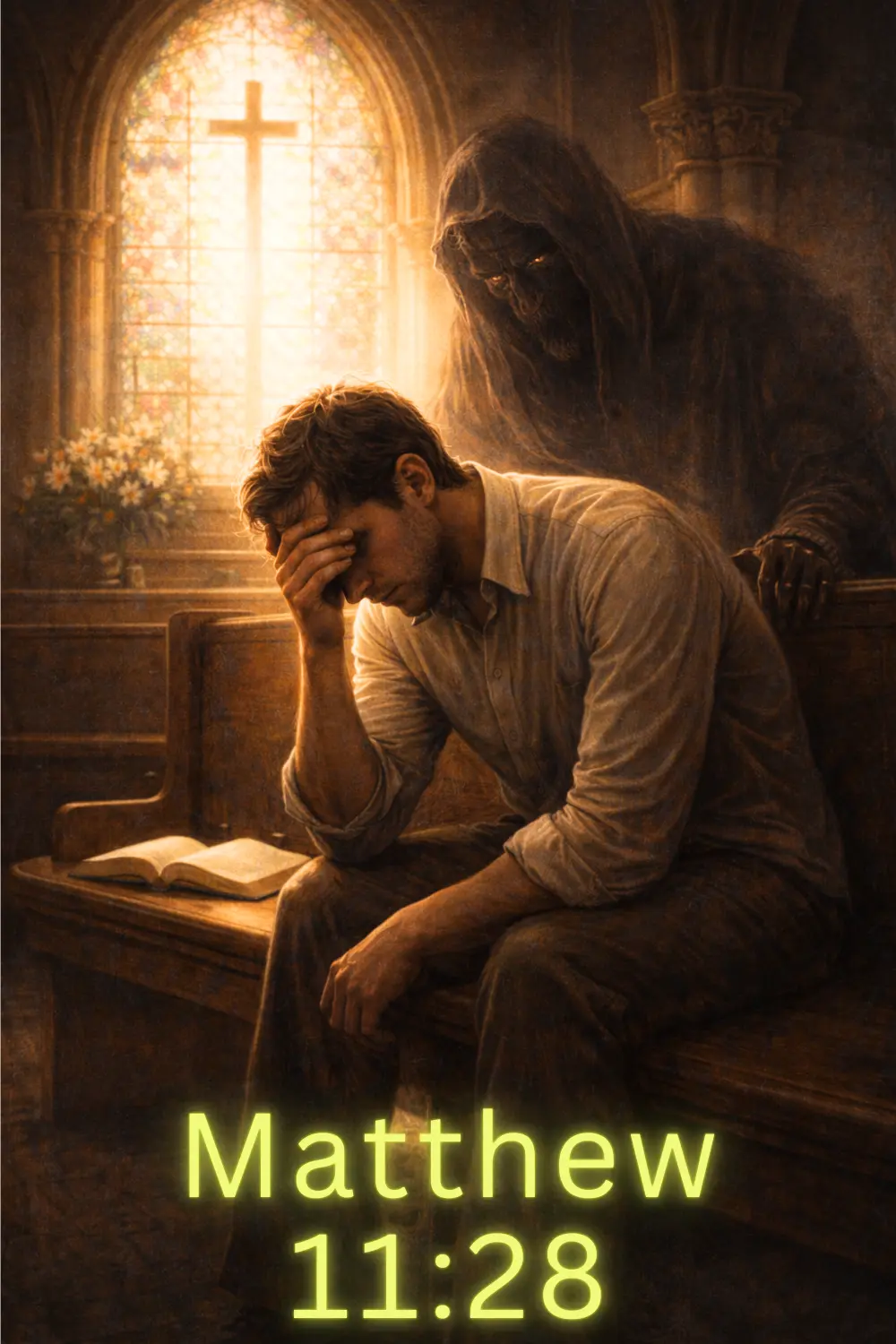
A grieving man sits hunched in a church pew beside an open Bible while a dark hooded figure looms behind him and bright light pours through a cross-shaped window. The scene reflects how despair can feel like an unwelcome presence that follows grief even into places of faith, while Christ's invitation remains open to the person who is exhausted by carrying it.
Biblical Insight
Matthew 11:28 belongs to a larger invitation in Matthew 11:28–30. Jesus calls the weary and burdened to come to Him, take His yoke, and learn from Him. He describes Himself as gentle and humble in heart and says that in Him they will find rest for their souls.
That context keeps the verse from becoming a vague promise of relaxation. Jesus is not simply offering a break from difficult circumstances. He is inviting people into discipleship under Him. A yoke still implies being joined to someone and learning how to walk under guidance. The difference is whose yoke you bear and who carries authority over you.
For a grieving Christian, that distinction matters. Grief often creates burdens of its own: fear about the future, guilt about the past, anger at what happened, responsibility for other people, pressure to recover quickly, and the exhausting effort of appearing functional. Jesus does not promise that every external burden disappears. He calls the burdened person away from carrying life as though everything finally depends on them.
The word "rest" should therefore not be reduced to feeling calm. A Christian may come to Christ and still cry. You may pray and remain physically exhausted. You may trust Him while still struggling with despair. The verse does not promise immediate emotional relief on demand. It promises Christ Himself as the place to which the weary and burdened are summoned.
That is important because despair tends to close possibilities. It speaks in absolutes: nothing will help, nothing will change, nobody understands, there is nowhere to go. Matthew 11:28 interrupts that closed circle with a direction: come to Me. Before the burden has changed, before the emotions have settled, before you know how the story continues, there is still somewhere to go.
Jesus also does not shame weariness. He does not ask why you are still tired or why grief still hurts. The invitation assumes burden. It assumes limitation. It assumes that the person coming has reached the point of needing rest. Weakness is therefore not a disqualification from the invitation. It is part of the reason the invitation matters.
For someone living beneath the shadow of despair, this verse does not require pretending that the shadow is small. It asks whether despair will become the final voice, or whether Christ's invitation will still be allowed to answer it.
In Application
- Name what is actually exhausting you. The burden may include more than the loss itself: guilt, fear, loneliness, anger, responsibility, or the effort of appearing all right.
- When despair says there is nowhere left to go, answer with the direction Jesus gives: "Come to me."
- Stop treating exhaustion as proof that you have failed spiritually. Christ's invitation is addressed specifically to the weary and burdened.
- Let rest begin with surrendering one burden you have been carrying as though everything depends on you.
Practical Journaling
Reflect on Matthew 11:28, then write honestly:
- What part of grief has left me most weary or burdened?
- What does despair keep telling me about my future, God, or my ability to keep going?
- What am I carrying as though I alone must hold it together?
- If I took Jesus' words "Come to me" literally today, what would I bring Him first?

Follow on Medium for More Studies
If writing feels too heavy today, say only this: Jesus, I am weary, and I am coming to You.
The Faith Recovery Journal explores this and many similar topics for Christians facing grief, loss, and recovery.