
What Is Christian Grief Journalling?
Christian grief journalling is the deliberate use of private writing to examine your experience of loss in the light of your Christian faith. It gives you somewhere to record what grief is doing to you, consider what Scripture has to say about your circumstances, and express thoughts or questions that you may struggle to put into words elsewhere. It can help you understand aspects of your grief, although it cannot remove the loss, guarantee emotional relief, or resolve every difficulty you encounter.
At first glance, adding the word "Christian" to grief journalling might seem unnecessary. Grief is a human experience, and people of every faith, or none, can benefit from writing about it. A Christian who has lost somebody they love faces many of the same difficulties as anybody else: loneliness, disrupted routines, painful memories, uncertainty about the future, and the absence of somebody whose presence mattered enormously.
Writing about these experiences does not require religious belief. You can use an ordinary notebook, describe what happened, examine your reactions, and discover something useful about yourself without referring to God at all.
There is also a reasonable objection to bringing faith into the process. Religious expectations sometimes make bereavement more difficult. A grieving Christian may feel obliged to demonstrate trust in God, suppress anger, or interpret every painful experience as part of a divine plan. Introducing Scripture or prayer into a journal could reinforce those pressures if the writer believes that every entry must end with a reassuring spiritual conclusion.
These objections deserve serious consideration because Christian grief journalling can become unhelpful when it encourages somebody to conceal their actual experience behind expressions of faith they do not presently feel.
Nevertheless, Christian belief raises questions about bereavement that an ordinary account of emotional experience may leave untouched. Those questions deserve somewhere to be examined, particularly when the death of somebody you love has disturbed your understanding of God, prayer, suffering, or the promises of Scripture.
What Makes Grief Journalling Christian?
The distinguishing feature is the place that Christian faith occupies in the writing. Your understanding of God, your knowledge of Scripture, your prayers, and your spiritual uncertainties become part of what you are willing to examine.
Consider somebody who has lost a husband or wife after a long illness. Their journal might contain memories of the final weeks, frustration over medical decisions, anxiety about managing the household, and the loneliness of coming home to an empty house. These are ordinary subjects for grief journalling.
For a Christian, additional questions may arise about why God allowed the illness to progress, what became of the prayers offered for recovery, how to understand biblical promises about God's goodness when the outcome was so devastating, and whether it is possible to keep trusting Him while feeling profoundly disappointed in Him.
Those questions may be inseparable from the person's grief. Ignoring them would leave an important part of their experience unexplored.
Christian grief journalling provides a place to consider such matters without requiring an immediate answer. A person might record a biblical passage that troubles them, write a prayer expressing bewilderment, or examine how their understanding of a particular teaching has changed since the death.
The entries can be intensely practical, deeply theological, or concerned with ordinary events. Their Christian character comes from the relationship between the writer's experience and their faith, however little religious language appears on the page.
Why Write About Your Grief Privately?
Bereavement often creates difficulties that are hard to discuss, even with people who genuinely care about you.
Some subjects are too personal to share comfortably. You might feel resentment towards a deceased family member, regret something you said before the death, or experience relief that a prolonged period of suffering has ended. You may worry that admitting such feelings will invite criticism or cause somebody to misunderstand the relationship you had with the person who died.
Christian communities can present additional complications. A person who has always been regarded as spiritually strong may find it difficult to admit that prayer now feels pointless or that familiar biblical assurances have become hard to accept. Even a sympathetic listener may be tempted to offer reassurance before fully understanding the problem.
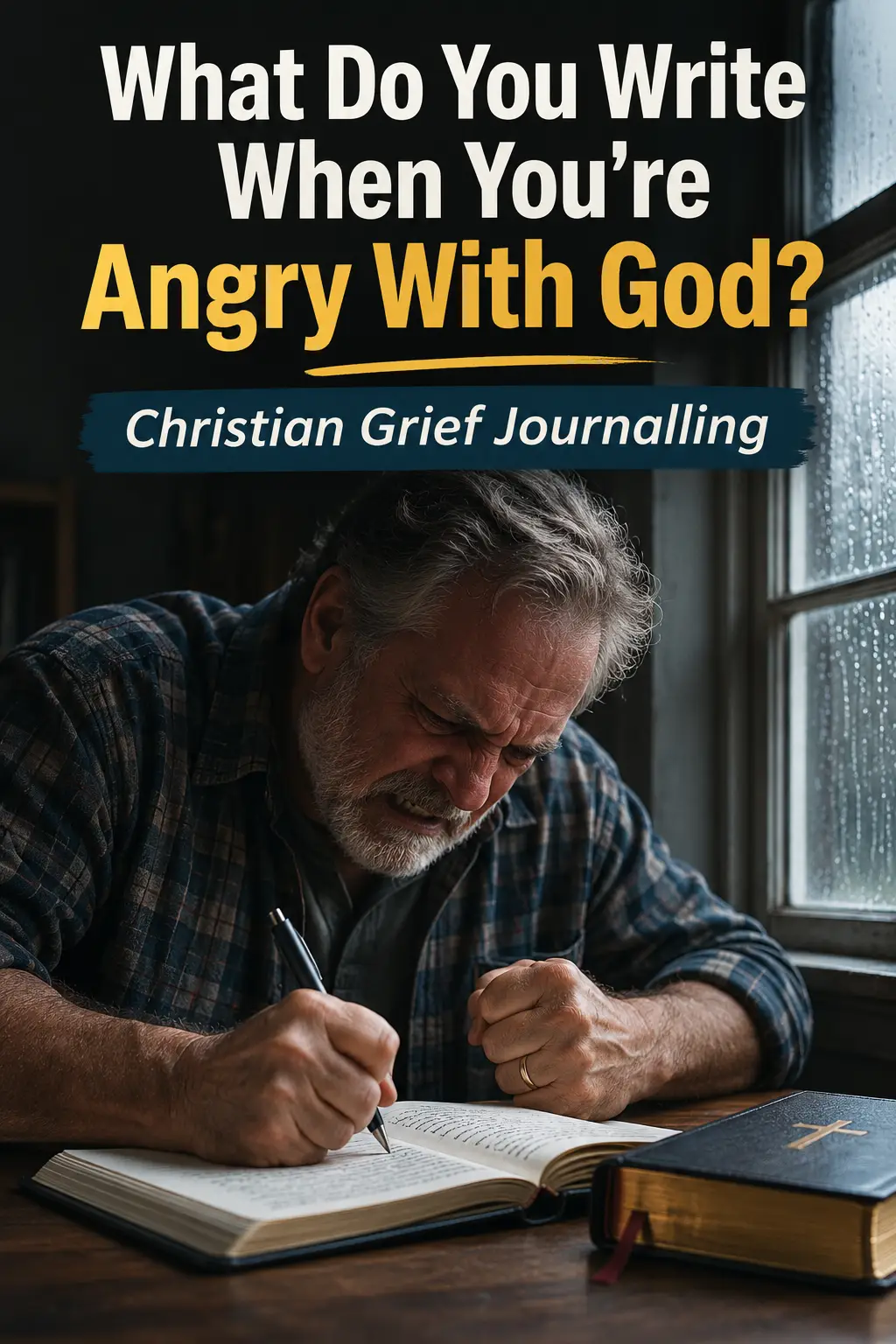
Private writing allows you to explore these matters at your own pace. You can contradict something you wrote yesterday, change your mind halfway through an entry, or leave a question unanswered. You can also decide that a subject is too painful to examine today and return to it another time. There is no audience to satisfy, provided you maintain the privacy you need.
For somebody who has become isolated, or who cannot readily obtain support, this can be particularly valuable. Journalling offers a relatively inexpensive and self-directed way to give difficult thoughts sustained attention. It can also help you organise what you eventually want to discuss with a minister, counsellor, trusted friend, or another person.
If you are unfamiliar with the practice, Grief Journalling — Why and What to Write explains the underlying method and the kinds of experiences worth recording.
How Does Scripture Belong in a Grief Journal?
Scripture gives Christian grief journalling a source of reflection beyond the writer's immediate feelings and circumstances. The Bible contains accounts of bereavement, suffering, lament, apparent abandonment, perseverance, and hope. These accounts can help a grieving person examine their experiences within the broader context of Christian belief, and the most useful passages are often the ones that voice the difficulty itself.
Consider Psalm 13. David begins by asking, "How long, LORD? Will you forget me forever? How long will you hide your face from me?" (Psalm 13:1, NIV).
A grieving Christian who feels abandoned by God might recognise something of their own experience in those words. The passage provides a biblical precedent for bringing that distress directly before God.
Writing about the psalm could involve examining why God's apparent absence has become such a painful concern: the writer may have expected prayer to produce a different outcome, a particular promise of Scripture may now seem difficult to reconcile with what happened, or the feeling may resist explanation altogether. The journal gives them room to consider the passage seriously and record their response.
Other biblical texts may raise difficult questions rather than provide immediate comfort. A promise about God's provision, protection, or faithfulness can become troubling after a catastrophic loss. In such cases, careful attention to the passage's original context matters. The writer may need to distinguish what Scripture actually promises from what they previously understood it to mean.
This form of reflection can be particularly useful when a familiar verse has acquired a different significance since the bereavement.
There is no requirement to interpret every entry through a biblical text. Sometimes the most useful thing you can write is an account of what happened that day. Scripture can remain available for reflection when it has something relevant to contribute.
Can You Use a Grief Journal to Pray?
Yes. Written prayer is one practical way of using a Christian grief journal, especially when speaking aloud has become difficult or your thoughts seem too confused to organise.
You might write directly to God about what you are experiencing, explain why something has troubled you, ask for help with a practical difficulty, or express gratitude for something that has happened. Writing gives you an opportunity to consider your words without the pressure of completing a spoken prayer.
For some people, that deliberate pace is helpful because grief can make concentration difficult. Thoughts disappear, memories interrupt, and the subject that prompted the prayer may become lost amongst other concerns.
A written prayer remains on the page. You can return to it later and see what you actually said, including requests you may have forgotten or questions that continue to trouble you.
Written prayers also need not resemble formal devotional language. The Psalms contain direct expressions of fear, anger, distress, and complaint. Psalm 88 is particularly striking because its writer describes prolonged suffering and ends without the reassuring resolution found in many other psalms.
That matters to a Christian who cannot presently produce expressions of confidence or gratitude. The existence of lament within Scripture gives such a person a legitimate biblical language for approaching God in distress.
There may also be days when prayer feels impossible. You can record that difficulty honestly. An entry describing your inability or unwillingness to pray may be worth revisiting when you are ready to examine what has changed in your relationship with God.
What Should You Actually Write?
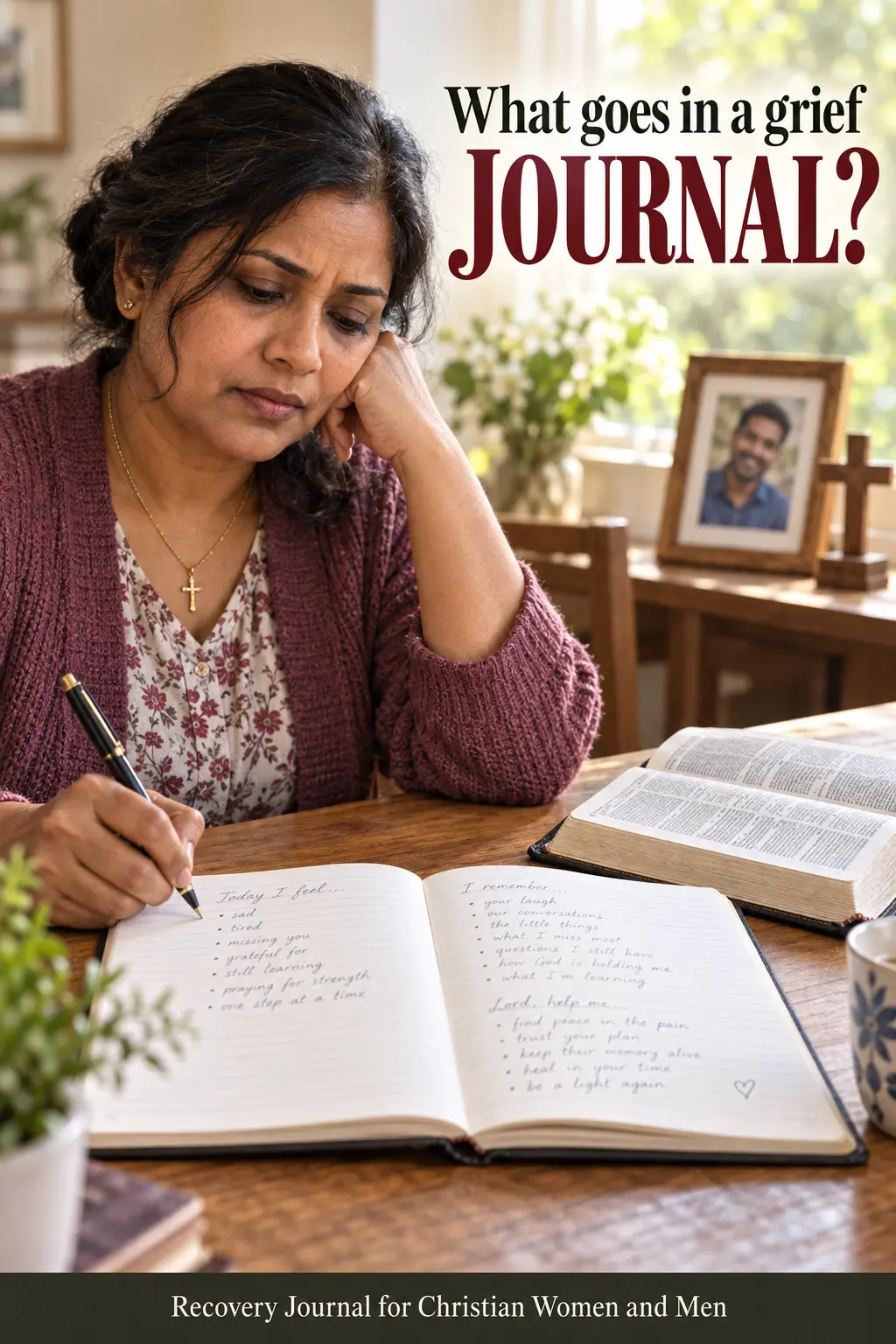
Begin with something that matters to you now. It might be an event, a memory, an emotion, a question, or a practical problem created by the death.
A person who has recently lost a parent might write about clearing the family home and discovering an object associated with childhood. The entry could begin by describing the object and the memory it prompted. As the writing develops, the person may recognise that the difficulty involves more than missing the parent. The sale of the house may also feel like the loss of a place associated with safety, identity, and family history.
A Christian writer might then consider whether faith has influenced how they understand that experience. Perhaps they have been attempting to dismiss their sadness because they believe they should concentrate on their parent's eternal life. They may want to examine whether that belief genuinely requires them to minimise the earthly relationship they have lost.
Another entry might concern an unanswered prayer, a disagreement with a relative, or the anxiety of making decisions alone. The subject does not have to sound spiritual to belong in a Christian grief journal.
Useful starting points include the following:
- What happened? Describe an event or experience that has affected you.
- What has been troubling you? Examine a thought, memory, fear, or unresolved question.
- What has changed? Consider an aspect of your daily life, relationships, or understanding of yourself.
- Where does faith enter the picture? Record a prayer, a biblical passage, a spiritual difficulty, or a question about God when one is relevant.
You can write a few sentences or several pages. Some entries may remain unfinished. You can also revisit an earlier entry and respond to what you wrote then, particularly if you are returning to journalling after a long absence.
For more practical guidance, see How to Start a Grief Journal When You Don't Know What to Write, and What Goes Into a Grief Journal? covers the wider range of material worth recording.
If you would like to see how a structured Christian grief journal works before deciding whether to use one, the extended sample of the Recovery Journal for Christian Women and Men provides real examples of Scripture, reflection, prayer, and writing space.
Start with the free sample
No email. No signup.
What If Your Faith Has Been Shaken by Bereavement?
For some Christians, the death of somebody they love produces spiritual difficulties that persist long after the immediate practical consequences have been addressed.
A person may continue attending church while privately questioning beliefs they once accepted without difficulty, struggle with biblical passages about healing, provision, protection, or answered prayer, or feel angry with God and then guilty about that anger.
Christian grief journalling can provide a place to examine these experiences without requiring the writer to pretend that their faith is unaffected.
One approach is to identify the particular belief that has become difficult. Rather than writing generally that God seems unfair, you might describe what happened, what you expected God to do, and why the outcome has challenged your understanding of Him.
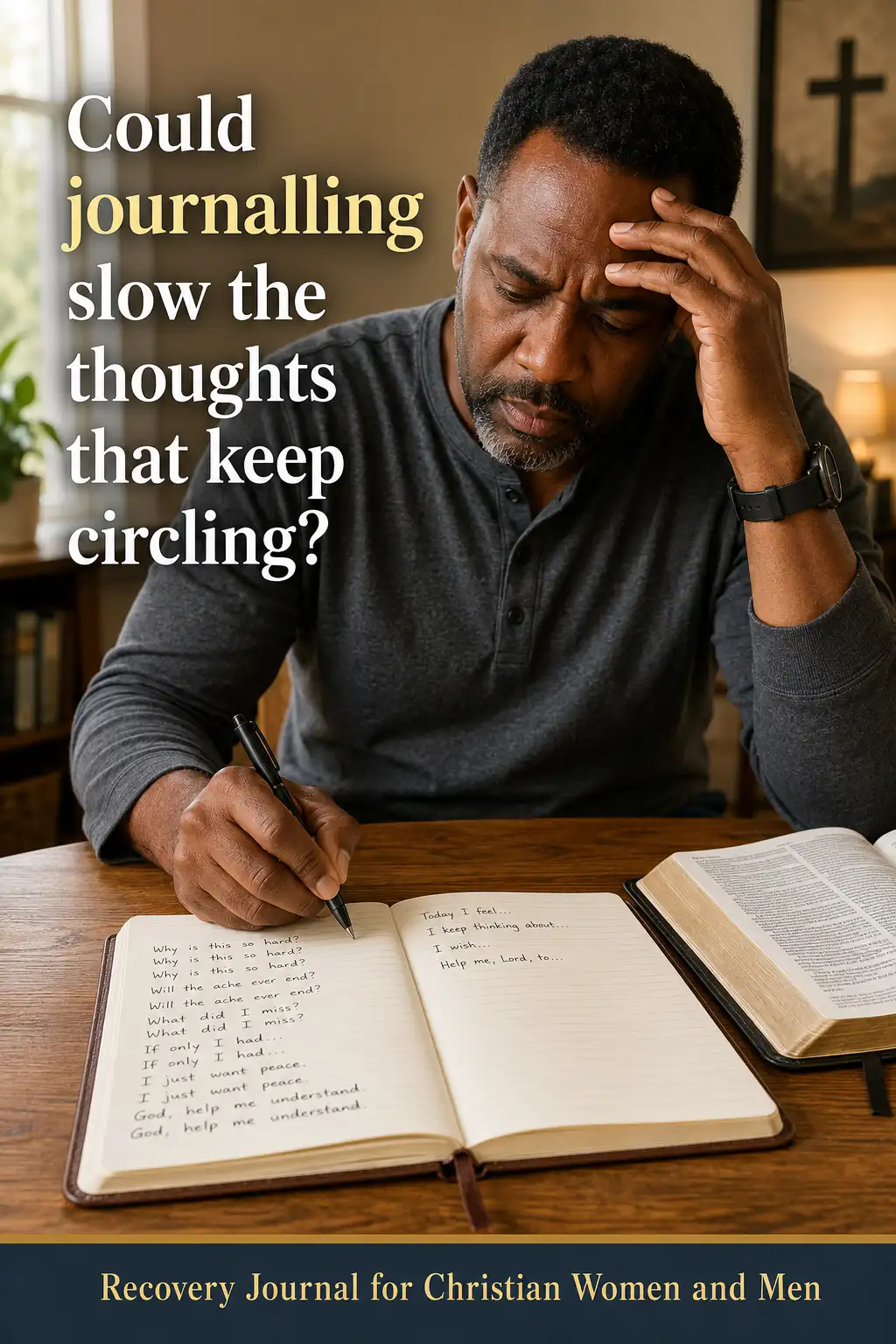
That distinction can help you recognise the actual question you are struggling with: you may be uncertain whether Scripture promises protection from particular forms of suffering, may have assumed that sufficiently persistent prayer should produce a desired outcome, or may understand the relevant biblical teaching intellectually yet remain emotionally overwhelmed by the loss.
These possibilities lead to different kinds of reflection. Some call for closer biblical study. Others concern expectations formed through personal experience or teaching received over many years. Still others involve the emotional consequences of loving somebody whose death cannot be undone, and the journal can help you distinguish amongst them.
There is also a place for recording disagreements with what you read or hear. A sermon intended to comfort bereaved people may instead leave you troubled by its interpretation of suffering. Writing down the claim and your objection allows you to examine both more carefully.
The book of Job is especially relevant here. Job's suffering provokes extensive argument about God's justice, human innocence, and the explanations offered by his friends. Their confident interpretations repeatedly fail to account adequately for his circumstances. The book gives serious attention to the limitations of human explanations for suffering.
You may eventually reach a different understanding of a biblical passage, recover confidence in a belief, or accept that a question remains beyond your present ability to answer. Journalling gives you a record of that examination without demanding a particular outcome.
Does a Christian Grief Journal Need a Particular Structure?
No single layout is appropriate for everybody. Some people are comfortable writing freely in a blank notebook, while others benefit from prompts and a more deliberate sequence of reflection.
A blank notebook offers considerable freedom. You can decide what to write, how much space to use, and whether to include Scripture or prayer. Its principal difficulty is that it provides no guidance when you are uncertain where to begin.
A guided journal can reduce that difficulty by presenting questions, passages, or themes for consideration. A Christian journal might invite you to examine a biblical text, reflect on its relevance to your circumstances, write about a particular concern, and formulate a prayer if you wish.
Structure can also make it easier to return to difficult subjects over time. An issue recorded briefly in one entry may become clearer when you encounter a related question later.
However, prompts need to leave room for the writer's actual circumstances. A journal that repeatedly asks you to identify blessings, express gratitude, or describe spiritual progress may become frustrating if those questions dominate the experience. Gratitude has a legitimate place in Christian life, but a bereaved person may also need substantial space for sorrow, uncertainty, complaint, and memories that have no obvious positive interpretation.
The design of the Recovery Journal for Christian Women and Men reflects an attempt to balance guidance with freedom. Scripture and written reflections provide material for consideration, while sections for insight, gratitude, prayer, and personal writing allow the reader to respond. Separate contemplation pages provide additional space when an entry requires more attention.
The structure is intended to support the writer's own examination of grief and faith. You remain free to use the sections according to what you have to say, and there is no prescribed timetable for completing the journal.
If this approach suits you, the Recovery Journal for Christian Women and Men is available in several editions. Its guided format offers a continuing source of Christian reflection alongside space to record your personal experience of bereavement.
How Can You Recognise Change in What You Have Written?
One advantage of keeping a journal is that earlier entries remain available for examination. Memory can be unreliable, particularly during periods of severe emotional strain, and you may not accurately remember how you understood a problem several months earlier.
Rereading an old entry can reveal changes in your circumstances, concerns, or beliefs. A practical difficulty that once seemed overwhelming may have become manageable, a question about God may have acquired greater complexity, and a memory that previously caused intense distress may now bring several different emotions.
Other matters may remain much as they were. You may still miss the same person, struggle with a particular anniversary, or feel troubled by an unanswered question.
These observations can be useful without being treated as evidence of success or failure. The purpose of rereading is to understand what has happened in your experience and how you have responded to it.
There is no obligation to reread entries regularly. Some may contain material you are not ready to revisit. Others may be useful only after considerable time has passed.
Where spiritual questions are concerned, reviewing earlier writing can help you identify how your beliefs have developed, which difficulties remain unresolved, and what you might want to examine more closely through Scripture, prayer, or conversation. How to Read Your Old Grief-Journal Entries explains how to go back through earlier pages and what to look for.
When Is Christian Grief Journalling Worth Trying?
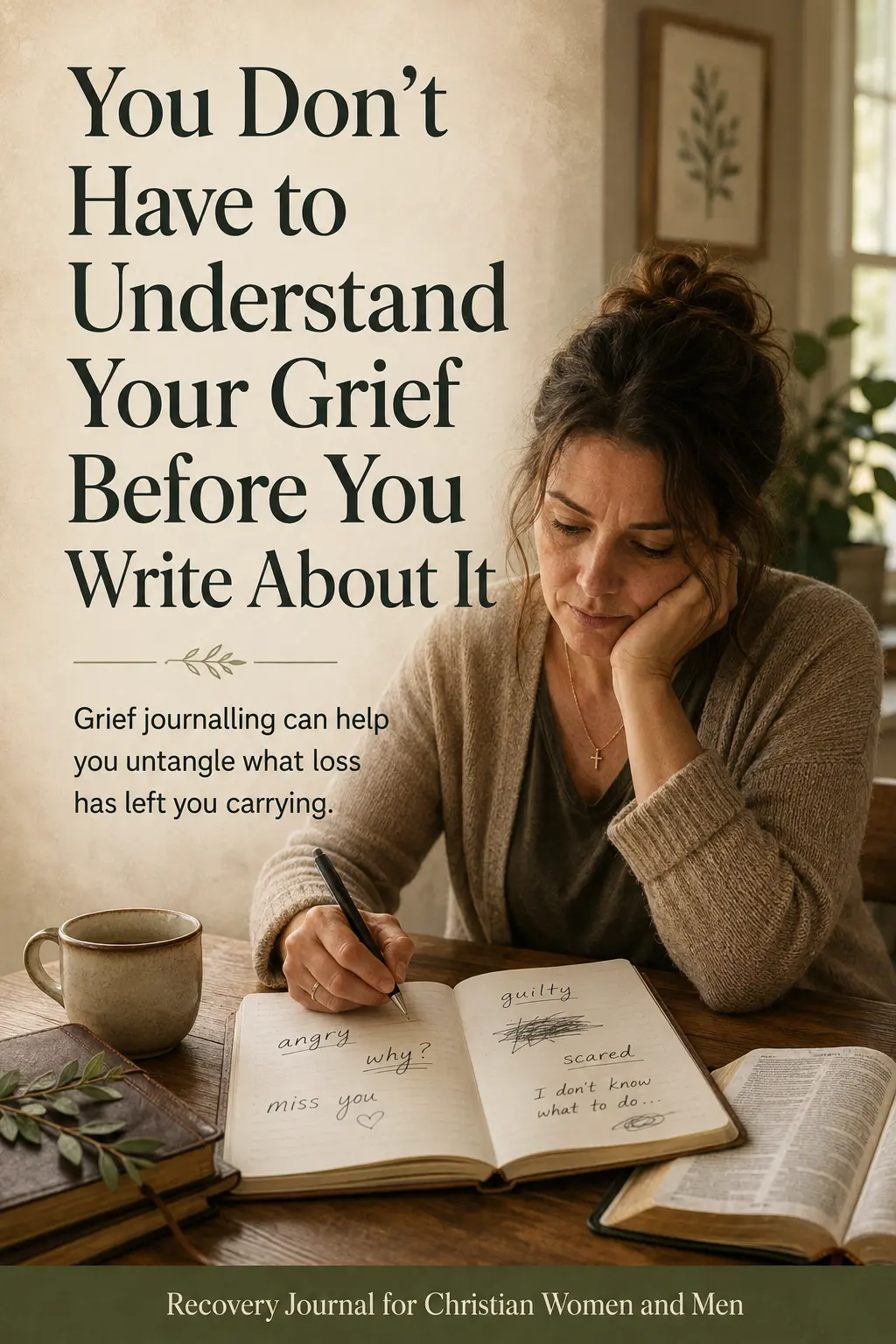
Christian grief journalling may be worth trying when you have thoughts about bereavement that you want to examine privately, when your faith has become difficult to reconcile with your experience, or when you would benefit from a written record of the questions and memories that continue to occupy you.
You do not need to be an experienced writer, understand the Bible extensively, or possess a particularly strong sense of faith. You can begin with the circumstances you know and the questions you actually have.
Its usefulness may also vary. Some subjects become clearer through writing, while others remain painful or confusing. If writing intensifies distress, it is reasonable to stop or change your approach.
Persistent difficulty functioning, serious deterioration in your wellbeing, or thoughts of harming yourself call for appropriate help beyond journalling. If you are in immediate danger or acute distress, see Free Crisis Hotlines 24/7.
Christian grief journalling offers a way to give your experience of bereavement sustained attention whilst allowing Scripture, prayer, and the questions raised by faith to form part of that examination. What you discover, and how long the process takes, will depend on your circumstances.