
Proverbs 24:16 — Rising Again When Grief Knocks You Down
When You Are Tired of Having to Get Back Up
"For though the righteous fall seven times, they rise again, but the wicked stumble when calamity strikes."
— Proverbs 24:16
Reflection
You can reach a point where getting up no longer feels brave. It just feels exhausting. You have already survived one blow, then another, then another. You have already prayed through shock, pushed through grief, faced disappointment, carried pressure, and tried to remain faithful. Then something else hits, and the question becomes painfully simple: Can I rise one more time?
Proverbs 24:16 does not say the righteous never fall. That matters. Scripture does not describe faithfulness as a life untouched by collapse, weakness, grief, failure, or calamity. The righteous fall. They may fall more than once. They may fall repeatedly. The difference is not that they remain untouched by trouble. The difference is that they rise again.
This verse is not a slogan for pretending you are fine. It is not a demand to leap up quickly before anyone notices your pain. Rising again may be slow. It may be trembling. It may begin with one honest prayer, one phone call, one meal, one shower, one sentence written down, one refusal to disappear completely into despair. The rise may look small, but it still matters.
Start with the free sample
No email. No signup.
Grief often makes repeated falling feel like proof that something is wrong with you. You think, “Surely by now I should be stronger.” But Proverbs 24:16 does not shame the righteous for falling seven times. It assumes the fall and speaks about what follows. The wound is real, but it does not get the final word.
There is also a warning in the verse. Calamity exposes what people are leaning on. The wicked stumble when calamity strikes because there is no rooted trust beneath them. But the righteous rise again because their hope is not finally in their own strength. God is not asking you to manufacture resurrection power out of exhaustion. He is calling you not to confuse being knocked down with being finished.
Falling is not the same as being forsaken.
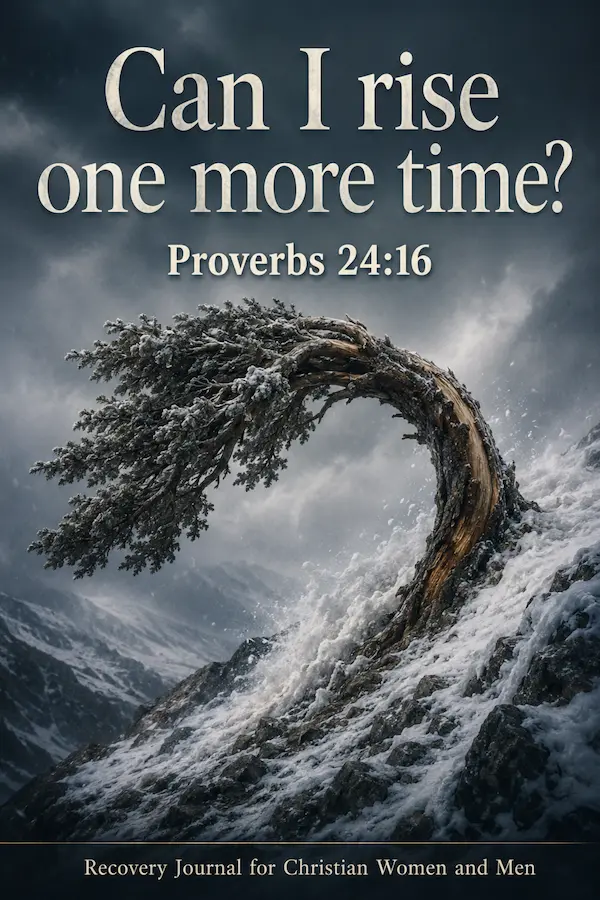
A storm-battered tree bends almost flat beneath snow on a mountain slope, scarred and strained but not broken, with the words “Can I rise one more time?” above Proverbs 24:16. The twisted trunk, sliding snow, and brutal weather give the verse its weight: rising again is not instant triumph, but painful endurance after grief has bent you nearly to the ground.
Biblical Insight
Proverbs 24 warns against envying the wicked, fearing their strength, or assuming their apparent success means they are secure. Verse 16 contrasts two kinds of people under pressure: the righteous and the wicked. Both may face trouble. Both may encounter calamity. But their outcomes differ because their foundations differ.
The righteous person in this verse is not someone who never suffers, never fails, never grieves, and never reaches the floor. That would contradict the verse itself. The righteous fall. The phrase “seven times” suggests repeated falling, not a single neat setback. Scripture is honest enough to say that God’s people can be knocked down again and again.
That honesty matters for grieving Christians. Grief does not always unfold in one clean line. You may think you are standing, then an anniversary, conversation, memory, financial pressure, family conflict, or fresh loss knocks you down again. That second or seventh fall can feel more humiliating than the first because you expected yourself to be further along. Proverbs 24:16 removes that false expectation. Repeated struggle is not automatic proof of spiritual failure.
Still, the verse does not romanticise falling. It does not say the fall is good in itself. It does not say calamity is harmless. It does not promise that rising will be quick, painless, or visible to everyone else. It does not tell you to deny the damage or call every wound a blessing. The fall is real. The calamity is real. The snow is heavy. The bend hurts.
What the verse does promise is that falling does not have final authority over the righteous. “They rise again” is not a celebration of human grit detached from God. In the wider witness of Scripture, the righteous rise because the Lord sustains, restores, corrects, forgives, and upholds His people. The strength to rise is not pride. It is dependence.
This also changes how we understand endurance. Endurance is not always dramatic. It may look like returning to prayer after weeks of numbness. It may look like admitting you are not coping. It may look like accepting help. It may look like refusing bitterness one more day. It may look like standing again with scars still visible. Scripture does not require the rise to look impressive. It calls you back to God.
For those grieving, Proverbs 24:16 gives permission to be honest about the fall and firm about the next step. You do not have to pretend calamity did not strike. You do not have to call yourself faithless because you are bent low. But you also do not have to agree with despair when it says you will never rise again. In Christ, the story of God’s people is not defined by the fall alone.
In Application
- Name the latest fall honestly. Do not minimise it, spiritualise it, or pretend it has not knocked strength out of you.
- Ask what “rise again” means today, not in theory. It may be one prayer, one practical task, one honest conversation, or one act of obedience.
- Refuse the shame that says repeated struggle proves you are not righteous. Proverbs 24:16 expects repeated falling and still speaks of rising.
- Look for the support God has placed near you. Rising again does not mean rising alone, silently, or without help.
Practical Journaling
Reflect on Proverbs 24:16, then write honestly:
- What has knocked me down most recently, and what am I afraid it proves about me?
- Where do I feel bent but not completely broken?
- What would rising again look like today if I stopped demanding that it look triumphant?
- What help, prayer, truth, or small act of obedience do I need before I try to stand again?

Follow on Medium for More Studies
If writing feels too heavy today, write only this: Lord, help me rise again without pretending I am not hurt.
The Faith Recovery Journal explores this and many similar topics for Christians facing grief, loss, and recovery.